





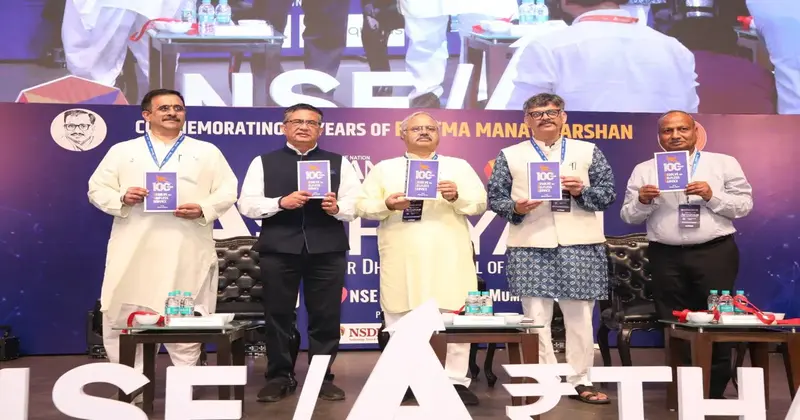
The Arthayam Conclave, jointly organised by Organiser Weekly and the National Stock Exchange (NSE) in Mumbai on September 19, 2025, set the stage for a vital rethinking of Bharat’s development path. More than just another economic gathering, it revisited and reinterpreted Ekatma Manav Darshan (Integral Humanism), the philosophy propounded by Pt. Deendayal Upadhyaya, and called for a Dharmic model of development. Unlike mainstream paradigms that emphasise profits and growth at all costs, this model is anchored in fairness, virtue, inclusion, cultural continuity and ecological balance.
Revisiting the balance between Dharma and Artha
The central theme of Arthayam was how to reconcile Artha (wealth and material prosperity) with Dharma (righteousness and moral order). Pt. Deendayal Upadhyaya had warned six decades ago that economies focusing only on profit risk ignoring people. His vision placed Artha Pratham wealth creation as necessary but always within the framework of dharma. Businesses cannot survive without profits, yet profits should never come at the expense of people’s dignity or societal well-being.
Even Kautilya’s Arthashastra emphasised that material strength sustains moral duty and both together ensure the welfare of the state. This interdependence of economic power and ethical responsibility is timeless and the Conclave sought to translate it into modern corporate life.
In today’s world of acquisitions, monopolies and corporate consolidation, Ekatma Manav Darshan offers a counterbalance: a humanistic, cultural and sustainable economic framework. As many speakers reminded the audience, “The economy should serve society, not the other way around.”
Key takeaways from Arthayam
Dharma as fairness and inclusion: A Dharmic economy must include everyone. The message was clear: opportunity and equity must be embedded into financial and business systems. Purely profit-driven models tend to sideline social justice, while a Dharmic framework insists that no one be left behind.
Tradition and modernity can coexist: The conclave did not reject the global markets or modern systems but urged India to “Indianize” them, aligning them with local values and culture. It emphasise with a thought of “Jo Deshi Hai, Unhe Yuganukul Karna Hai Aur Jo Bahar Se Aa Raha Hai Use Deshanukul Karna Hai”. The NSE’s involvement underscored this bridging of financial modernity with civilizational thought.
Trust and cooperatives as pillars: In Bharat, many economic relationships are built not just on contracts (within section 2A to 2H of contract act) but also on trust and shared social norms. Sessions such as “Money Matters Trust” highlighted how financial inclusion and savings habits must connect with community structures, cooperatives and accountability-driven models especially to empower rural and small entrepreneurs.
From philosophy to grassroots action: Discussions showcased practical examples: reviving water bodies, sacred groves and community identities; fostering reverse migration; and harmonizing livelihoods with ecology. These grassroots efforts demonstrated that philosophy without implementation remains incomplete.
Challenges of translation into governance: Thought leaders like Dr. Ram Madhav warned against romanticizing the past and stressed the need to translate civilizational wisdom into governance, policy and regulatory systems. He also highlighted the absence of ethical oversight in areas like AI and robotics, urging India to lead globally in tech ethics grounded in its worldview.
Relevance for future businesses and entrepreneurs
Entrepreneurs today must look beyond profits to purpose. Businesses rooted in fairness, sustainability and community well-being can achieve long-term impact while also serving broader societal goals. The conclave reinforced the Swadeshi principle: production by the masses over mass production. Entrepreneurs could build village-level enterprises or region-specific supply chains that reflect local needs rather than replicating foreign templates.
Trust and networks can often substitute for weak formal institutions. Entrepreneurs who nurture ties with cooperatives, self-help groups, bachat-gat and community organizations will find resilience and legitimacy. The Dharmic model discourages short-term exploitation in favour of long-term regeneration. It emphasises on Sustainable Growth. Startups must innovate without depleting natural or social resources, ensuring that businesses last across generations without destroying or disturbing environment.
As Arthayam’s philosophy matures, it could influence policies favouring cooperative finance, decentralized industrial ecosystems and ethical technology adoption. Political independence and pluralism were also highlighted as essential for genuine economic growth.















Comments