





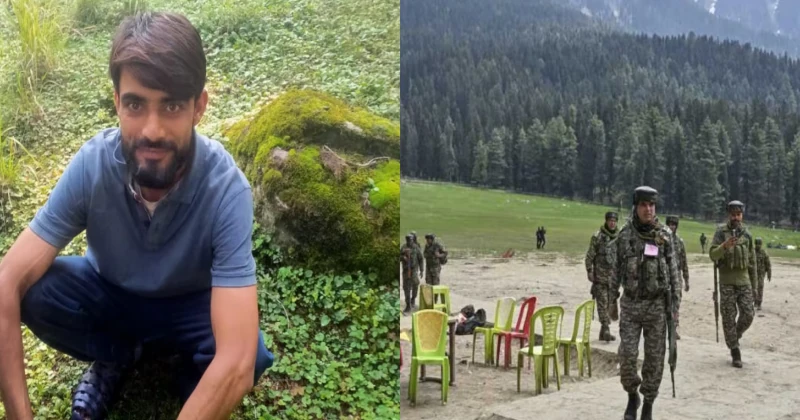
Five months after the Pahalgam massacre, one of the bloodiest terror strikes in J&K’s recent history, security forces have arrested a key overground worker (OGW) who allegedly enabled the Lashkar-e-Taiba (LeT) module responsible for the slaughter. The accused, Mohammad Yousuf Kataria, a 26-year-old resident of Kulgam, has been taken into custody for providing logistical support, shelter, and safe passage to the Pakistan-backed terrorists who stormed the Baisaran Valley meadow on April 22 and executed 25 Hindu tourists at point-blank range.
Officials confirmed that Kataria’s arrest came after a forensic analysis of weapons and intelligence leads collected during Operation Mahadev, a counter-terrorist operation in July that wiped out the main Lashkar masterminds of the Pahalgam attack. He has been remanded to 14 days of police custody, with investigators preparing to hand him over to the National Investigation Agency (NIA) for deeper interrogation into Pakistan’s cross-border terror network.
On April 22, four heavily armed terrorists stormed Baisaran Valley in Pahalgam, a popular tourist spot known as the “Mini Switzerland of Kashmir.” The gunmen specifically targeted Hindu tourists, asking their names and religion before shooting them dead in cold blood.
25 Hindu tourists were killed, along with a local Kashmiri guide who tried to shield them. The attackers were trained Lashkar operatives, heavily armed with assault rifles and grenades. Security officials later revealed the strike was intended to terrorise Hindu visitors, cripple Kashmir’s tourism economy, and ignite communal violence in the Valley.
The massacre shocked the nation and prompted Operation Sindoor, India’s most significant retaliatory offensive since the 2019 Balakot strikes.
On May 7, less than three weeks after the massacre, the Indian Air Force carried out precision airstrikes on nine terror launchpads in Pakistan and Pakistan-occupied J&K (PoJK).
Over 100 terrorists were eliminated. The targets were Lashkar-e-Taiba, Jaish-e-Mohammed, and TRF camps , and the message was clear, India signalled that state-sponsored massacres of civilians would invite direct retaliation inside Pakistan’s terror infrastructure.
The strikes set a new precedent in India’s counter-terror doctrine—terrorism would not be fought only within Kashmir, but also at its roots across the border.
While Operation Sindoor struck across the border, security forces intensified ground operations within Kashmir under Operation Mahadev. On July 28, the Army and J&K Police tracked the Pahalgam attackers to Dachigam forest near Srinagar, resulting in a fierce encounter.
Killed in action were three top Lashkar operatives:
- Suleiman Shah alias Faizal Jatt – a Pakistani national, main shooter in the April 22 massacre.
- Hamza Afghani – foreign commander, Lashkar trainer.
- Jibran – foreign terrorist, directly involved in Pahalgam strike.
Their elimination not only avenged the massacre but also exposed the deep Pakistani hand behind the attack.
While neutralising terrorists is one battle, choking their support network is another. Lashkar’s Pakistan-based handlers rely heavily on OGWs (Overground Workers) – locals who provide food, shelter, transport, and intelligence.
On June 22, the NIA arrested Parvaiz Ahmad Jothar and Bashir Ahmad Jothar from South Kashmir for harbouring the Pahalgam attackers. Their interrogation revealed the movement patterns of the Pakistani terrorists and confirmed Suleiman Shah’s role as the lead shooter.
On September 25 arrest of Mohammad Yousuf Kataria marked a fresh breakthrough. Kataria, described as a seemingly ordinary contractual worker and part-time tutor, allegedly acted as a guide and facilitator, helping Lashkar operatives move through Kulgam’s forests, providing shelter, and supplying essentials. His double life—as a teacher by day and terror aide by night illustrates the hidden ecosystem that sustains cross-border terrorism.
A senior officer told media that, “During investigation of Operation Mahadev, Kataria’s name surfaced. His role in enabling terrorists killed in Dachigam was established. He is a vital link in Lashkar’s OGW chain. His arrest is not the end; it is the beginning of exposing Pakistan’s local support cells.”
The Resistance Front, the group that claimed responsibility for the Pahalgam massacre, is nothing but a front organisation of Lashkar-e-Taiba, created to bypass international scrutiny after LeT was banned globally.
Project Pakistan-sponsored terror as “indigenous Kashmiri resistance.” The killing of foreign commanders like Shah, Afghani, and Jibran proved TRF is an ISI-controlled extension of Lashkar. Intelligence agencies have traced hawala routes and cross-LoC smuggling networks that fund OGWs like Kataria.
On July 29, a day after the Dachigam encounter, Union Home Minister Amit Shah addressed Parliament, stating:
- The slain terrorists were Pakistani nationals, not local militants.
- The Pahalgam massacre was a Pakistani state-backed terror operation.
- Attempts by opposition leaders to portray it as “home-grown terror” were misleading and dangerous.
Amit Shah’s statement cemented India’s stance: Pakistan, through Lashkar and TRF, orchestrated the slaughter of innocent Hindu tourists.
The arrest of Mohammad Yousuf Kataria is not just about nabbing one more OGW. It strikes at the invisible lifeline of Pakistan’s terror apparatus in Kashmir.
- Without OGWs, foreign terrorists cannot survive in Kashmir’s hostile terrain.
- Locals like Kataria provide safe houses, food, reconnaissance, and transport, enabling Pakistani operatives to strike.
- His interrogation could unravel larger support networks, including financial conduits, sympathiser groups, and sleeper cells.
Security experts believe dismantling the OGW chain is as critical as eliminating active militants.












Comments