





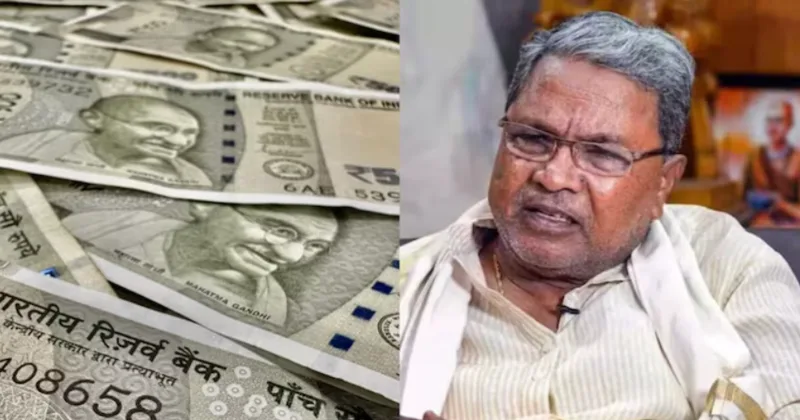
Bengaluru: The Karnataka Congress Government is staring at a deepening financial crisis, caught between the enormous burden of its five guarantee schemes, dwindling revenue collections, and a borrowing ceiling that has now been exhausted. With no room left to raise additional loans for the next four years, the state faces a grim fiscal deadlock that could stall governance and development.
Since returning to power in 2023, the Congress government has relied heavily on borrowing to fund its ambitious guaranteed schemes, which alone cost the exchequer nearly Rs 52,000 crore annually. Revenue collection shortfalls, coupled with additional losses from GST simplification, have compounded the problem.
Unable to generate sufficient resources internally, the government has repeatedly turned to loans. Finance Department figures show that in just two years, Karnataka has borrowed over Rs 1.72 lakh crore from the open market, mostly through state development loans facilitated by the Reserve Bank of India.
The numbers lay bare the scale of the crisis. In 2023–24, the government borrowed Rs 90,280 crore, well above the budgeted figure of Rs 85,818 crore. In 2024–25, borrowing rose further to Rs1.07 lakh crore, exceeding the budget estimate of Rs 1,05,246 crore.
In the current financial year 2025–26, borrowing has already crossed Rs 4,000 crore within the first few months. Cumulatively, debt in the last two years has breached the Rs 2 lakh crore mark.
A senior Finance Department official admitted, “The guarantees have created an unavoidable fiscal pressure. Every year we are borrowing more than estimated, which is unsustainable. We have reached a point where loans can no longer be our fallback option.”
No scope for additional loans till 2029
The crisis deepened further this month after the Finance Department formally conveyed to the government that Karnataka has hit the maximum borrowing limit permitted under the Fiscal Responsibility and Budget Management (FRBM) Act.
The Act allows states to borrow only up to 25 percent of their Gross State Domestic Product (GSDP), with fiscal deficit capped at 3 percent. Karnataka’s liabilities have already touched 24.91 percent of GSDP, while the fiscal deficit stands at 2.95 percent.
In a note submitted on September 15, 2025, the Finance Department warned that the state will exhaust all eligible borrowings in 2025–26 itself. “No additional loans can be raised this year or for the next four years,” the note clarified, effectively closing the debt window for the Congress government.
Revenue shortfall adds to woes
The borrowing cap comes even as the state is struggling to meet revenue targets. Against an estimated revenue receipt of Rs 2,92,477 crore for 2025–26, collections in the first five months fell short by Rs 7,413 crore.
Adding to the deficit, GST rationalization by the Union government is expected to reduce Karnataka’s annual GST collection by nearly Rs 15,000 crore. For 2025–26 alone, the shortfall is estimated at Rs 6,000 crore.
The government had hoped to raise Rs 3,000 crore this year by levying additional taxes on mining. But as the bill awaits Presidential assent, the amount is unlikely to be realised. Overall, the Finance Department has projected a revenue shortfall of at least Rs 22,000 crore this year.
No room for new taxes
In the same note, officials pointed out that the government has already revised major tax rates in previous years to boost resource mobilisation. With no political or economic scope for further hikes, tax revision is off the table for 2026 as well.
This leaves the state with limited revenue options at a time when expenditure commitments are at an all-time high.
The mounting crisis has provided ammunition to the opposition, which accuses the Siddaramaiah government of reckless fiscal mismanagement. Former Chief Minister Basavaraj Bommai said, “Congress promised the people the moon with its guarantees but never explained how it would fund them. Now Karnataka is staring at bankruptcy.”
Economists, too, have expressed concern. Prof. Harish Ramaswamy noted, “When guarantees consume such a large share of the budget, the state is forced to cut back on development and infrastructure. The borrowing freeze will hit growth badly.”
With debt, deficit, and guarantees squeezing the treasury, the government has few alternatives left. It has appealed to the Centre for additional assistance, but BJP leaders have ruled out bailouts, arguing that the state must first practice fiscal discipline.
As things stand, Karnataka’s poor financial condition threatens to paralyze development projects, delay salaries and pensions, and reduce welfare spending outside the guarantees. The Congress government, which came to power promising both welfare and progress, now finds itself cornered by its own financial commitments.
Unless new sources of revenue are tapped and spending re-prioritized, Karnataka could face one of its worst fiscal crises in decades—one that will define both the government’s legacy and the state’s economic stability.















Comments