





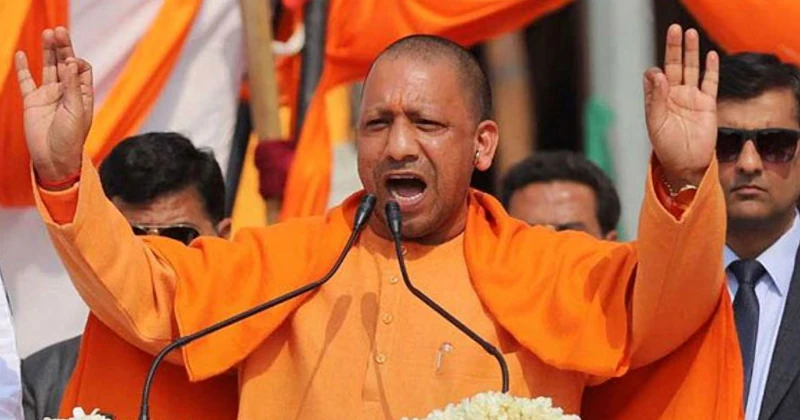
Uttar Pradesh Chief Minister Yogi Adityanath delivered a forceful and historically charged critique of centuries of foreign invasions and colonial exploitation, claiming that these upheavals led to the dramatic halving of India’s Hindu population and the widespread collapse of its agrarian economy. Speaking at a state-level workshop on ‘Atmanirbhar Bharat-Swadeshi Sankalp’ in Lucknow, the Chief Minister warned that India’s historical exploitation has long-lasting repercussions that continue to shape contemporary social and economic challenges.
“By the year 1100, the Hindu population in India was 60 crore. And when the country gained independence in 1947, the Hindu population was only 30 crore. Tell me, should our population have increased or decreased in these 800-900 years?” CM Yogi asked, framing the demographic decline as a direct consequence of foreign invasions, colonization, and systemic oppression.
The Chief Minister pointed out that the decline was not only due to wars and massacres but also famine, disease, and institutionalized oppression imposed by successive foreign rulers. “This population, which declined, was not only killed by invaders but also died of hunger, disease, and all sorts of torture. This is how foreign slavery happens,” he said, emphasizing the human cost of centuries of exploitation and the deliberate dismantling of India’s socio-economic structures.
CM Yogi argued that India was inherently endowed with abundant resources, fertile lands, and cultural wealth, yet these were undermined by deliberate divisive policies. “What did India not have? It had everything. But some divided people on the basis of caste, region, language, on the basis of many things. And even today, they operate with the same foreign mentality. They’re dividing society, creating divisions,” he added, implicitly linking historical fragmentation with contemporary societal divisions.
The Chief Minister also connected India’s historical exploitation with the contemporary push for economic self-reliance. He praised Prime Minister Narendra Modi’s emphasis on Swadeshi and indigenous production, describing it as a strategy to empower Indian workers and youth. “They’ll point fingers at this Swadeshi campaign in every way. But the Prime Minister’s message is that we should promote whatever is made with the labour of Indian workers and the talent of our youth,” CM Yogi said.
These remarks coincide with the rollout of GST 2.0, described by the central government as a major reform in the country’s indirect tax system. PM Modi, in a letter to citizens, termed the initiative a ‘GST Bachat Utsav’ (GST Savings Festival), highlighting its benefits for farmers, women, youth, traders, and MSMEs. “These reforms will encourage greater growth and investments and accelerate the progress of every state and region,” the Prime Minister stated, framing economic self-reliance as both a developmental and nationalistic imperative.















Comments