





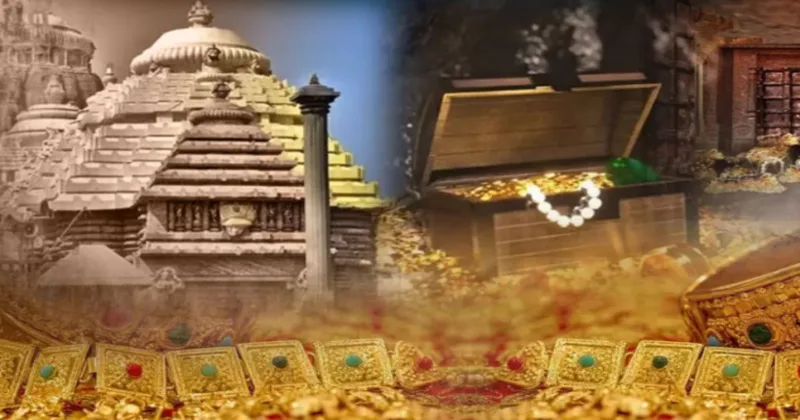
Bhubaneswar: In a historic and meticulously planned operation, all valuables and ornaments of the world-famous Shree Jagannath Temple in Puri were permanently restored to their original treasury, the Ratna Bhandar, following months of conservation and renovation work.
The shifting of treasures, which included ornaments, artifacts, and other invaluable materials of the temple, was carried out under tight security and strict adherence to procedure. The operation began at 10:55 am and concluded at 2:55 pm on Monday, taking exactly four hours.
Chief Administrator of the Shree Jagannath Temple Administration (SJTA), Dr. Arbinda Kumar Padhee, confirmed that the process was executed in accordance with the provisions of the Sri Jagannath Temple Rules, 1960 and guidelines approved by the state government.
The valuables had been removed from the Ratna Bhandar in 2024 during the Rath Yatra for essential conservation work. While the internal ornaments and materials were temporarily stored in the temple’s bedroom and a specially built strongroom, the external valuables were shifted to the Changada Ghar and Phul Ghar.
On July 7, 2025, the Archaeological Survey of India (ASI) completed maintenance and conservation of both inner and outer sections of the Ratna Bhandar. The renovated storehouse was formally prepared for use on July 19. Monday’s transfer marked the culmination of this year-long process.
The shifting operation was initiated with traditional rituals and the blessings of Mahaprabhu. Members of the Ratna Bhandar Committee and a high-level supervisory committee, all dressed in traditional attire, entered the Jagmohan of the temple to oversee the process.
The temporary inner strongroom was opened in the presence of a magistrate, using the keys obtained from the district treasury. Each valuable item was carefully transferred to the permanent inner Ratna Bhandar. Once the process was complete, the inner chamber was locked, sealed, and the keys redeposited in the district treasury.
Subsequently, the Changada Ghar, which temporarily housed external ornaments, was opened using three separate keys held by the Gajapati Maharaja, temple administration, and the treasurer. All materials were transferred to the newly renovated outer Ratna Bhandar. The chamber was then secured with all three keys.
To ensure full transparency, the entire operation was videographed.
Devotee entry into the temple was temporarily restricted during the transfer. District Collector Dibya Jyoti Parida, SP Prateek Singh, and senior members of the Ratna Bhandar Committee, including retired High Court judge Biswanath Rath, were present to supervise the operation.
Strong security arrangements were in place, with district police, ODRAF teams, fire services, and other agencies kept on standby to handle any emergency.
Following the successful transfer, committee members and officials had darshan of Bhagwan Jagannath at the temple before departing.
Dr. Padhee expressed his gratitude to all stakeholders, including the state government, Shrimandir Management Committee, its Chairman Shri Gajapati Maharaja, members of the High-Level Committee, the Niyog community, ASI officers, temple employees, district and police administration, media, and countless devotees.
He acknowledged the patience and cooperation of devotees who faced temporary darshan restrictions during the operation. “All works were done perfectly and videographed in order to maintain transparency,” Dr. Padhee said.
The Ratna Bhandar, regarded as one of the most sacred and secure treasuries in the country, houses the priceless ornaments and offerings of Bhagwan Jagannath, Bhagwan Balabhadra, and Devi Subhadra. The return of the treasures to their permanent abode has not only restored tradition but also reaffirmed faith among devotees that the temple’s rich heritage is being preserved with utmost care.













Comments