





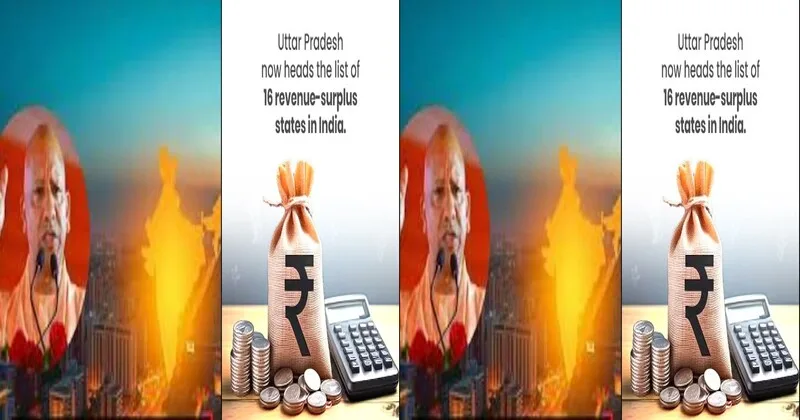
Once tagged as a “Bimaru” (ailing) state due to poverty, backwardness, and financial instability, Uttar Pradesh has today emerged as a remarkable example of economic growth. The latest report by the Comptroller and Auditor General of India (CAG), which reviewed the economic performance of states over the last 10 years, highlights the transformative journey of Uttar Pradesh.
According to the CAG, Uttar Pradesh recorded a revenue surplus of Rs 37,000 crore in the financial year 2023, placing it among the 16 states in the country whose earnings exceeded their expenditure. The report notes that the state, under Chief Minister Yogi Adityanath’s leadership, has successfully implemented policies that not only ensured fiscal discipline but also paved the way for sustainable development.
Uttar Pradesh Tops the List of Revenue Surplus States
The CAG report highlights that Uttar Pradesh leads the country in terms of revenue surplus with Rs 37,000 crore. Following it are Gujarat (Rs 19,856 crore), Odisha (Rs 15,560 crore), Jharkhand (Rs 13,920 crore), Karnataka (Rs 13,496 crore), Chhattisgarh (Rs 8,592 crore), Telangana (Rs 6,944 crore), Kerala (Rs 5,310 crore), Madhya Pradesh (Rs 4,091 crore), and Goa (Rs 2,399 crore).
Interestingly, several northeastern states, including Arunachal Pradesh, Manipur, Mizoram, Nagaland, Tripura, and Sikkim, also feature in the surplus category. Out of the 16 surplus states, at least 10 are governed by the Bharatiya Janata Party (BJP), underlining the fiscal prudence of their administrations.
While Uttar Pradesh and other states are registering growth, 12 states continue to face significant revenue deficits. Andhra Pradesh (-Rs 43,488 crore), Tamil Nadu (-Rs 36,215 crore), Rajasthan (-Rs 31,491 crore), West Bengal (-Rs 27,295 crore), Punjab (-Rs 26,045 crore), Haryana (-Rs 17,212 crore), Assam (-Rs 12,072 crore), Bihar (-Rs 11,288 crore), Himachal Pradesh (-Rs 6,336 crore), Kerala (-Rs 9,226 crore), Maharashtra (-Rs 1,936 crore), and Meghalaya (-Rs 44 crore) remain in deficit.
The report highlights that these states are unable to generate enough income to meet their expenditure needs, making them heavily dependent on central grants.
High Dependence on Central Grants
States like West Bengal, Kerala, Himachal Pradesh, and Punjab rely substantially on revenue deficit grants from the Centre. In FY 2023, West Bengal received the largest share of 16 per cent to bridge the gap between its income and expenditure, followed by Kerala (15 per cent), Andhra Pradesh (12 per cent), Himachal Pradesh (11 per cent), and Punjab (10 per cent).
On the other hand, states such as Haryana, Maharashtra, Telangana, Karnataka, Tamil Nadu, and Gujarat reported high State Own Tax Revenue (SOTR) collections, strengthening their fiscal autonomy. In contrast, northeastern states including Arunachal Pradesh, Manipur, Meghalaya, Mizoram, Nagaland, Sikkim, and Tripura reported SOTR levels below 30%, reflecting weaker revenue capacity.
The CAG report also sheds light on states that have successfully expanded their own sources of income through both tax and non-tax avenues. Haryana tops the chart, generating over 80 per cent of its revenue internally. Telangana follows with 79 per cent, while Maharashtra (73 per cent), Gujarat (72 per cent), Karnataka (69 per cent), Tamil Nadu (69 per cent), and Goa (68 per cent) also reported strong self-reliance.
State GST (SGST) continues to be the largest contributor, along with excise duty on alcohol, VAT on petroleum products, and taxes on electricity, which remain outside the GST framework. In FY 2022-23, states together received Rs 1,72,849 crore as Finance Commission grants, out of which Rs 86,201 crore was allocated as revenue deficit grants.
The CAG report specifically recognizes the remarkable turnaround of Uttar Pradesh. Under the “double engine government,” the state has accelerated its growth trajectory and emerged as a model for others.
Tax Collection Growth: In 2012-13, the state collected only Rs 54,000 crore in taxes, which increased to Rs 85,000 crore by 2016-17 under the previous government. In contrast, under Yogi Adityanath’s tenure, tax collection jumped from Rs 95,000 crore in 2017-18 to Rs 2,25,000 crore in 2024-25, marking an increase of over Rs 1.3 lakh crore in just 8 years.
Budget Expansion: The state budget was Rs 2 lakh crore in 2012-13 and rose to Rs 3.46 lakh crore in 2016-17. Under the current government, it expanded from Rs 3.84 lakh crore in 2017-18 to Rs 8.08 lakh crore in 2025-26, more than doubling within 8 years.
GSDP Growth: The Gross State Domestic Product (GSDP) of Uttar Pradesh stood at Rs 8 lakh crore in 2012-13 and rose to Rs 12.5 lakh crore by 2016-17. Under Yogi’s governance, it grew from Rs 13.6 lakh crore in 2017-18 to an estimated Rs 30 lakh crore in 2025-26, an impressive jump of Rs 16.4 lakh crore in just 8 years.
A New Economic Identity for Uttar Pradesh
The transformation outlined by the CAG report shows a significant shift in Uttar Pradesh’s identity. Once dismissed as a “Bimaru” state plagued by poverty, unemployment, and weak governance, the state is now earning recognition as “Bemisal Uttar Pradesh” (Unparalleled UP) for its strong fiscal performance, rising revenues, and expanding economy.
With a focus on infrastructure, industry, and fiscal reforms, Uttar Pradesh is setting an example for other states. The positive economic indicators highlighted in the CAG report reaffirm that the policies of the state government have translated into measurable financial gains, bringing the state into the league of India’s leading economies.
















Comments