





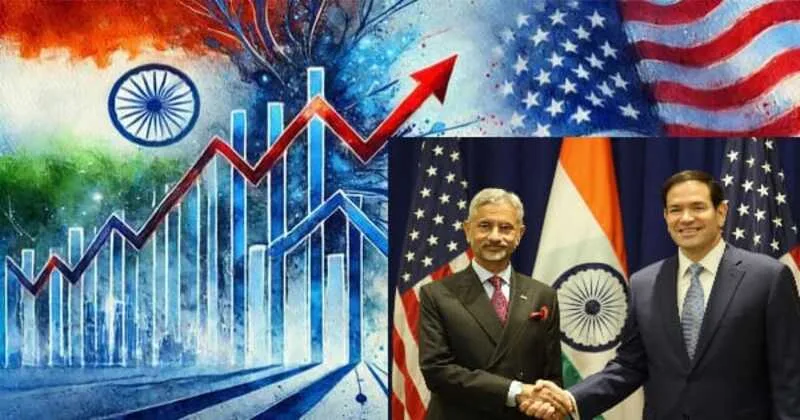
The United States appears to be softening its unilateral tariff war against the people of India. While ongoing issues, including the sharp increase in H1B visa fees, Washington is actively working to advance a trade agreement with New Delhi. Indian External Affairs Minister S. Jaishankar held discussions with US Secretary of State Marco Rubio during his visit to the United States for the UN Annual Assembly. Marco Rubio described India as a strategic partner of the United States and said that discussions covered trade, energy, pharmaceuticals, minerals, and defense. Jaishankar also highlighted that bilateral and international issues were reviewed during the talks. Both sides agreed to prioritise cooperation in key areas and to continue discussions to finalise the trade agreement.
Earlier, US President Donald Trump had imposed a 50 percent tariff on Indian imports of Russian oil and indicated that there would be no further trade talks with India. He had also encouraged the European Union to impose higher tariffs on India. Additionally, Trump’s trade adviser Peter Navarro and other officials had levelled severe allegations against India. The postponement of a US team’s visit to Delhi for trade negotiations further reflected growing tensions between the two countries.
Good to meet @SecRubio this morning in New York.
Our conversation covered a range of bilateral and international issues of current concern. Agreed on the importance of sustained engagement to progress on priority areas.
We will remain in touch.
🇮🇳 🇺🇸 pic.twitter.com/q31vCxaWel
— Dr. S. Jaishankar (@DrSJaishankar) September 22, 2025
However, recent diplomatic engagement has led to a softening of the US stance amid India’s unparalleled diplomatic and trade moves. Both countries have agreed to resume discussions on the India-US trade deal. Trump’s recent birthday greetings to Prime Minister Narendra Modi, accompanied by mutual praise, have further signalled a thaw in relations. Efforts are underway to finalise the trade agreement within this year.
If the trade deal materialises, the United States is expected to reduce tariffs on India, potentially lowering them to 10–15 percent. Government sources have indicated that a significant agreement is on the horizon. A negotiating team led by Union Commerce Minister Piyush Goyal has arrived in Washington to hold discussions with the US Trade Representative, led by Jamieson Greer. Officials suggest that a decision on the trade deal could be reached within a few weeks.
GST relief and industrial growth boost consumer confidence
The first day of the new GST 2.0 relaxations sparked a surge in consumer and business activity. From dairy products to automobiles, sales across sectors have soared. Maruti Suzuki, India’s largest car manufacturer, reported receiving more bookings in a single day than at any time in its 35-year history. On the first day alone, the company received over 80,000 inquiries and sold more than 25,000 vehicles, with an additional 30,000 expected to be sold shortly. Maruti had announced price reductions of up to ₹1.29 lakh on several models on September 18, leading to an average of 15,000 daily bookings in the period since.
"Let us proudly say – what we buy is Swadeshi"
PM @NarendraModi ji extends Navaratri greetings to everyone through this letter, marking the #GSTBachatUtsav!
His encouraging words inspire us to embrace this festive season by choosing Made In India products and supporting our… pic.twitter.com/CxUvB3ZEbi
— Piyush Goyal (@PiyushGoyal) September 22, 2025
Hyundai also reported record bookings, selling 11,000 vehicles on the first day of Navratri celebrations. Electronics and home appliance firms similarly enjoyed strong demand, with some companies recording sales growth exceeding 20 percent in a single day. Items such as air conditioners, televisions, and refrigerators were in particularly high demand. India’s core industrial sector, encompassing coal, crude oil, natural gas, refinery products, fertilisers, steel, electricity, and cement, also showed robust growth. It expanded by 6.3 percent in August, up from 3.7 percent in July, and contributes 40.27 percent to India’s Index of Industrial Production (IIP).
Indian markets show resilience amid global uncertainty
Despite global challenges and concerns such as the H1B visa fee hike, Indian stock markets are demonstrating resilience. The GIFT Nifty dipped 20 points in early trading, but analysts point to strong domestic demand and robust industrial growth as stabilizing factors for the Sensex and Nifty. While the Nifty IT index saw a temporary 2.5 percent dip due to visa-related uncertainties, Indian IT companies continue to enjoy long-term growth prospects thanks to their diversified global footprint and strong innovation capabilities. Shares of Adani Group companies, meanwhile, rose sharply following SEBI’s clean chit in the Hindenburg case. Adani Power, which recently underwent a share split, surged 20 percent, while Adani Total Gas also gained 20 percent.
Gold prices are also climbing, buoyed by expectations of further reductions in the US base interest rate. The international price of gold reached a record high of $3,758 per ounce.














Comments