





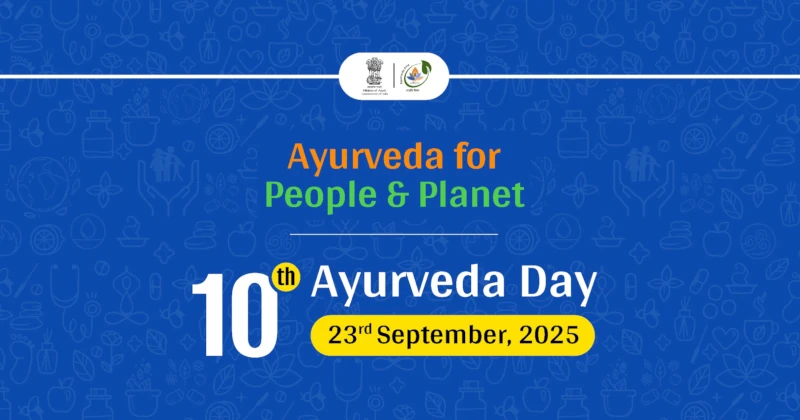
For the first time in history, India is celebrating Ayurveda Day September 23, moving away from the earlier practice of observing it on Dhanteras, which shifted every year according to the lunar calendar. This significant shift, formalised through a Gazette Notification issued in March 2025, states the government’s determination to standardise, globalise, and institutionalise Ayurveda as a scientific and holistic healthcare system.
This year’s celebration, themed “Ayurveda for People & Planet”, coincides with the 10th edition of Ayurveda Day and highlights Ayurveda’s unique ethos the harmony between individual health and environmental balance. The central event is being hosted at the All India Institute of Ayurveda (AIIA), Goa, while the Ministry of AYUSH has mobilised nationwide activities across states and union territories, as well as global events through Indian Missions, universities, wellness organisations, and diaspora networks.
Building on last year’s massive participation in over 150 countries, Ayurveda Day 2025 is being projected as India’s strongest global outreach in the traditional medicine sector, firmly positioning Ayurveda as a pillar of sustainable healthcare in the 21st century.
Key launches and initiatives
The Ministry of AYUSH has rolled out a robust set of initiatives, blending classical Ayurvedic knowledge with cutting-edge scientific approaches:
- Desh ka Swasthya Parikshan – a nationwide health checkup campaign launched through the Central Council for Research in Ayurvedic Sciences (CCRAS), deploying a certified health assessment tool for preventive and personalised healthcare.
- DRAVYA Portal – the world’s most comprehensive digital repository of Ayurvedic ingredients and products, unifying references from classical texts, scientific studies, and field research.
- APTA Portal – documenting the lives and contributions of legendary Ayurveda practitioners who preserved and advanced the discipline.
- Integrated Oncology Unit – to be jointly run by the Goa Government, AIIA, and Tata Memorial Center, integrating Ayurveda with modern oncology practices.
- Ran-Bhaji Utsav – a unique festival organised with the Goa State Biodiversity Board to promote nutritional diversity and healthy lifestyles through local food traditions.
- New Healthcare Facilities at AIIA, Goa – including a Central Sterile Supply Department, Hospital Linen Processing & Care Unit, and Blood Supply Unit, to strengthen hospital infrastructure and patient safety standards.
As part of the milestone celebrations, the National Dhanwantari Ayurveda Awards will be presented today to practitioners, researchers, and policymakers who have made exceptional contributions to Ayurveda in teaching, research, policy planning, and integration into national health programs.
Earlier this year, the Ministry of AYUSH provided healthcare services to over 8 lakh pilgrims at the Maha Kumbh 2025, showcasing Ayurveda’s ability to handle large-scale public health needs in high-pressure environments. This massive outreach reaffirmed Ayurveda’s relevance in preventive, promotive, and curative healthcare.
The Ministry of AYUSH has spearheaded international initiatives to mainstream Ayurveda within global healthcare frameworks:
- Integration with WHO’s ICD-11 (TM-2 module) – Ayurveda, Siddha, and Unani systems are now officially recognised within the world’s standard medical classification system.
- BIS Standards for AYUSH – with 91 published standards, including 80 for traditional herbs and the first-ever national standards for Panchakarma equipment, ensuring safety, quality, and global credibility.
- ISO Standards for Ayurveda (2023) – establishing international benchmarks for quality and safety in Ayurvedic practices and products.
- Global Centre for Traditional Medicine in Gujarat – developed in collaboration with the WHO.
- International MoUs – with countries like Germany, Mauritius, Japan, and Nepal for education, research, and recognition of Ayurveda.
AYUSH Information Cells in 30+ countries and Ayurveda Chairs in foreign universities, including at Western Sydney University, Australia, strengthening Ayurveda’s academic and clinical legitimacy worldwide.
The World Ayurveda Congress (WAC), a biennial event established by the World Ayurveda Foundation, remains a key driver of Ayurveda’s international journey. The 10th edition was held in Dehradun in December 2024 on the theme “Digital Health: An Ayurveda Perspective”. Since its inception in 2002 at Kochi, WAC has emerged as a global knowledge and trade platform, bridging India’s ancient healing wisdom with global healthcare innovations.
Since its inception in 2016, Ayurveda Day has consistently aligned its themes with India’s healthcare priorities and global positioning:
- 2016: Diabetes prevention through Ayurveda.
- 2022: Ayurveda @ 2047 (part of Azadi Ka Amrit Mahotsav).
- 2023: Ayurveda for One Health – linking human, animal, plant, and environmental health.
- 2024: Vaishvik Swasthya Ke Liye – global wellness, with over 150 countries participating.
The 2025 theme, “Ayurveda for People & Planet”, elevates this journey to the next level of integration, situating Ayurveda not only as a personal health system but also as a solution for planetary wellbeing in an age of climate crisis, lifestyle disorders, and over-medicalisation.














Comments