





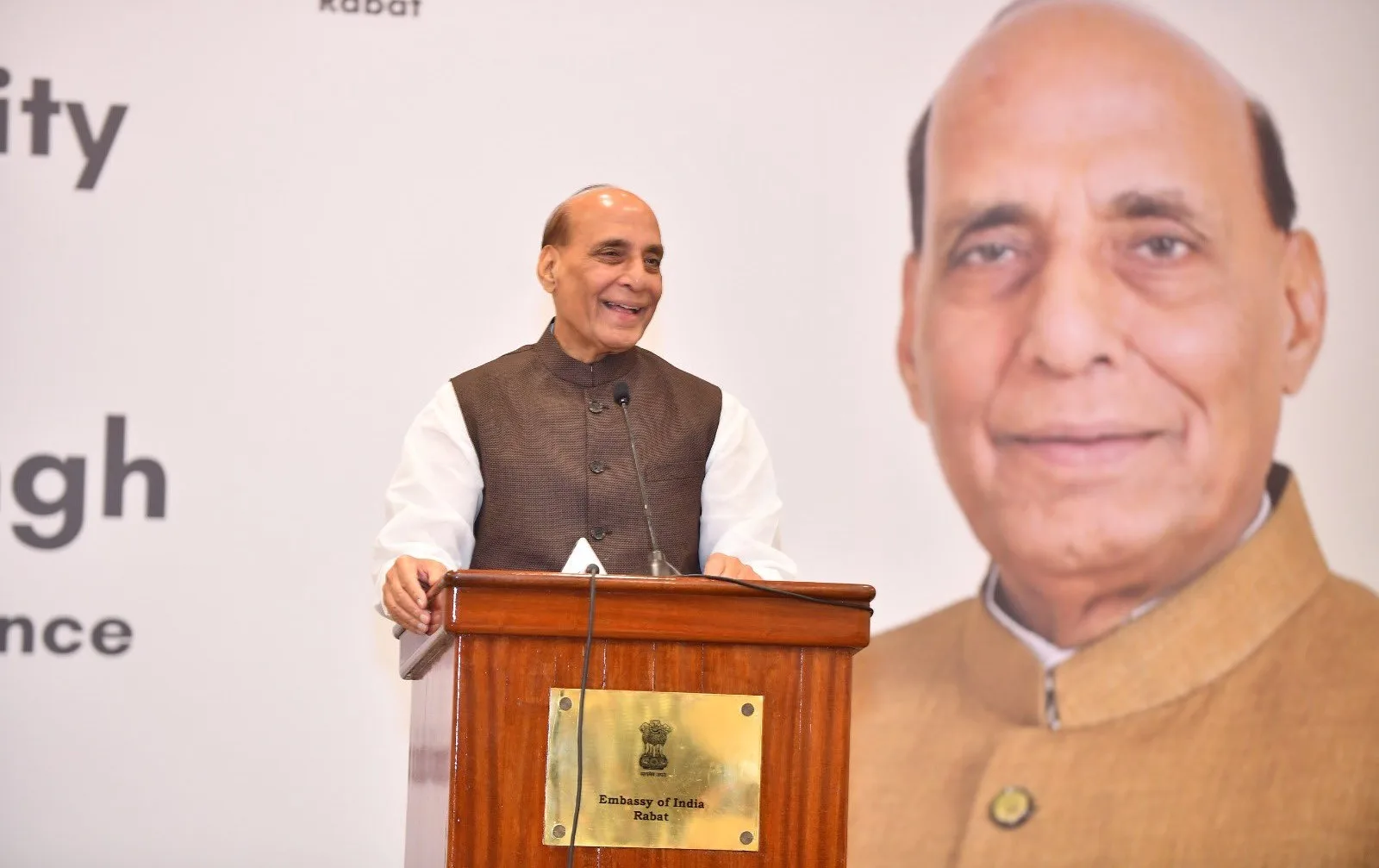
Union Defence Minister Rajnath Singh addressed questions on September 22 regarding India’s measured response to the 50 per cent tariffs imposed by the United States on Indian exports. Speaking to the Indian community during his official visit to Morocco, Singh described India as a nation that exercises patience and strategic foresight in international matters.
“We did not respond right away. Those who are broad-minded and big-hearted do not react immediately,” Singh said, explaining why India refrained from taking immediate countermeasures following the tariff imposition.
The U.S. had earlier levied a 50 per cent tariff on Indian exports, including a 25 per cent additional penalty linked to India’s continued purchase of Russian oil, a move that drew global attention and posed potential economic challenges for New Delhi.
India’s approach: Patience and diplomacy
Singh emphasised that India’s delay was not indecision but a calculated diplomatic stance, reflecting the country’s long-term strategic thinking. By waiting before responding, India aimed to maintain strong bilateral relations with the United States while simultaneously protecting its national interests.
“The world must understand that patience is a strength. India’s response to international issues is always measured, well-considered, and guided by principles of fairness and foresight,” Singh added.
Comments on Pakistan-Occupied Jammu and Kashmir (PoJK)
During his interaction with the diaspora in Morocco, Rajnath Singh also addressed the long-standing issue of Pakistan-occupied Kashmir (PoK). Reiterating India’s vision for the region, he said:
“PoK will come under our control naturally. There are already voices within the region demanding freedom from the current administration.”
Singh recalled making similar remarks five years ago while addressing an Indian Army program in Jammu and Kashmir. At that time, he had suggested that PoK would eventually declare itself part of India without the need for military intervention, a statement he reaffirmed.
“I had said then that we would not need to attack or capture PoK; it will itself proclaim, ‘Main bhi Bharat Hoon.’ That day will come,” Singh asserted.
Operation Sindoor and opposition criticism
Singh’s statements come against the backdrop of heightened scrutiny following Operation Sindoor on May 7, during which Indian forces downed multiple Pakistani jets.
Opposition leaders have alleged that the government missed an opportunity to capture PoK outright, criticising the reported ceasefire despite India’s perceived upper hand during the operation.
Rajnath Singh’s comments appear to reaffirm the government’s preference for a strategic, long-term approach rather than immediate military action, emphasising diplomacy and calculated patience over aggressive intervention.
Engaging the Indian diaspora
Addressing the Indian community in Morocco, Singh also highlighted India’s broader vision for global engagement. He underscored the importance of connecting with the diaspora to strengthen cultural, economic, and strategic ties between India and host nations.
“The Indian community abroad plays a crucial role in projecting India’s soft power, sharing our values, and contributing to our nation’s growth,” he said, urging citizens abroad to support India’s policies and initiatives.
Strategic Implications
India’s restrained response to the U.S. tariffs demonstrates a mature approach to global economic pressures. Rather than reacting impulsively, India opted to assess the situation, engage diplomatically, and preserve strategic interests, particularly concerning energy procurement and trade negotiations.
This approach signals India’s rising confidence as a global economic and strategic player, able to navigate complex international disputes while safeguarding its sovereignty and national priorities.
Patience as policy
Rajnath Singh’s remarks underline a central principle of India’s contemporary foreign and defence policy: measured patience over hasty retaliation. Whether it involves economic pressures from global powers or territorial matters such as PoK, India continues to prioritise diplomacy, long-term strategy, and engagement over immediate confrontation.
Singh not only reassured the Indian diaspora but also conveyed a clear message to international observers: India’s decisions are guided by prudence, strategic vision, and an unwavering commitment to national interest.











Comments