





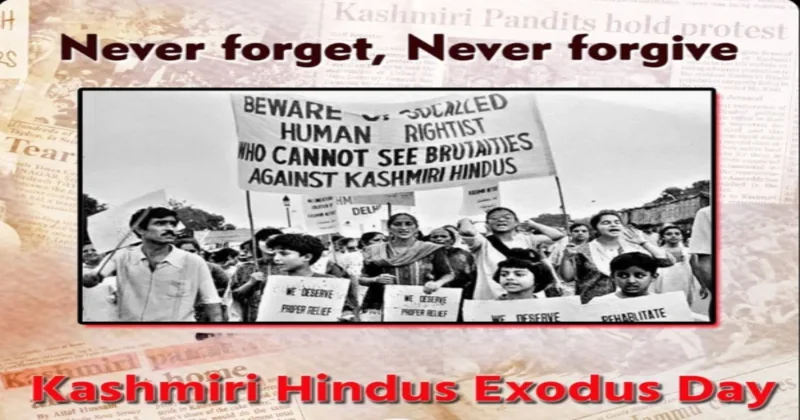
It is an established fact that the period of 1989-90 was the worst time of the 20th century for the Kashmir valley. The irony is that the worst time of its history was invited and orchestrated by a large section of the society in Kashmir which had gone into the subjugation of the fundamentalist, extremist & radical elements heads down. The Kashmir-centric political forces of all hues excluding a miniscule minority among them either went with the rabid communal tornado or chose to maintain silence. The biggest compromise was made by the government of Jammu and Kashmir led by Farooq Abdullah and the Central government headed by Rajiv Gandhi. In no case they or their successors can hide behind any sort of excuse in this regard. The worst resultant effect was the genocide of the Hindu community in Kashmir which consequently led to their ethnic cleansing through tragic mass-exodus from the valley of Kashmir in 1990 and thereafter.
However, after the tragic and unfortunate exodus, it regrouped itself immediately in Jammu, Udhampur and Delhi, the three main centres where the displaced community took shelter in 1990. Two generations of the prominent swayamsevaks of Kashmir in collaboration with the RSS unit at Jammu and under the guidance of the RSS state leadership organised big relief camps in Jammu, Udhampur, Nagrota, Kathua and also at Delhi. The Sanatan Dharam Sabha headquarters, Geeta Bhawan-Parade Ground Jammu, emerged as the main centre of all activities related to the displaced community issues and it played a historical role in the most tough and adverse conditions.
The first thing that was done was the creation of Jammu & Kashmir Sahayita Samiti with its first focus on the relief matters of the displaced community. A big organised group of RSS swayamsevaks went to different states to apprise people therein about the Kashmir situation, Islamic terrorism, Pakistan’s role in cross-border terrorism in Kashmir, genocide of Hindus in Kashmir and the holocaust of the Kashmiri Pandit community. They also appealed for funds and donations so that the relief and other welfare measures were taken up in favour of the displaced community in Jammu and Kashmir. Consequent upon the appeal made by the leading swayamsevaks throughout the nation, donations came rushing to the J&K Sahayata Samiti at Jammu in huge quantities. This and the intervention of the local government brought a big quantitative and qualitative change in the efforts to bring succour to the lakhs of refugees in and around Jammu.
In the months of April-May 1990, the premier historical representative organisation of the Kashmiri Pandit community, the All State Kashmiri Pandit Conference (ASKPC) was revived by the prominent and active swayamsevaks of Kashmir. Accordingly, they decided to organise the Kashmiri Hindu Convention on 13-14 July, 1990 at Jammu. This convention under the aegis of ASKPC became the most unifying force for the entire displaced community with Amarnath Vaishnavi as the President of the organisation. It was a very successful programme that was attended by around five hundred delegates. The Convention adopted many resolutions, prominent among them was the Resolution no. 4 which demanded the establishment of a security zone with constitutional guarantees for Kashmiri Hindus in the valley of Kashmir.
The Resolution no. 4 caught the imagination of the people and they started identifying themselves with the demand as it espoused their socio-political cause in an unambiguous manner. The kind of a vicious narrative against India and the Kashmiri Pandits unleashed by the Congress, left-liberal cabal, Islamic terrorist and fundamentalist groups and the Kashmir centric political parties in the then mainstream media under the influence of the powerful people in the governments at the centre created ferocious and dangerous disinformation campaign throughout the country. Resolution no. 4 opened the gates for the activists among the Kashmiri Pandit community to counter the misinformation and the fake narrative of the anti-social and anti-national forces. It provided a valid platform to put things in the right perspective. The prominent RSS swayamsevaks took a leading role in this context.
When all these developments were taking place at Jammu level, there was a band of swayamsevaks in Delhi which brought the plight of the Kashmiri Pandit community into focus thereat. For this purpose, they organised themselves under the banner of Jammu & Kashmir Sangharsh Samiti (JKSS). It became the voice of the displaced people in Delhi NCR region and caught the attention of the political circles, local government and the media. Youth leader Vijay Handoo and Dr. Surinder Kaul (currently in GKPD) were the two key figures of the JKSS who made a visible impact on the ground. Vijay Handoo had acquired enough experience of the struggle during the high tension period of Punjab due to terrorism when he joined the “Balidani Jatha” from Jammu and Kashmir to visit the whole state of Punjab in 1981-82. This organisation made contacts with the central BJP, Kashmir Samiti Delhi and the other activists to take the cause of the displaced people ahead. They also took the issue to the then PM VP Singh, L.K.Advani, Atal Bihari Vajpayee, Madan Lal Khurana and Kidar Nath Sahni, the top BJP leadership.
In August-1990, it was decided by the Akhil Bharatiya Vidhyarthi Parishad (ABVP) to organise the “Kashmir Chalo March” from all parts of India in September-1990. All active youth swayamsevaks of Kashmir took keen interest in this project and toured various states to mobilise support for this venture. It was a great show and had a great impact on the morale of the displaced community. However, the march was stopped by the government in Udhampur and thus it culminated there. It took the issue of Kashmir and Kashmiri Pandits to all corners of the nation and also coincided with the Ramjanambhumi Rath Yatra of L K Advani, who was also espousing the cause of the displaced community throughout his Yatra.
The second generation, the younger element in RSS Kashmir-in exile, was very active throughout. They were a party to all the activities and programmes right from January-1990 enumerated herein above. However, these swayamsevaks wanted to establish a solid platform to take the issue of Kashmir and Kashmiri Pandits to the national level and also to the relevant political stage. Resolution no. 4 passed by the ASKPC Convention became the main ideological basis for this generation. This active group went for a gigantic public contact drive throughout Jammu province and came to be recognised, slowly and steadily, as the new and emerging leadership of the displaced community. Ultimately, they were guided by the top leadership of the RSS in Jammu and accordingly founded Panun Kashmir (PK) in the RSS headquarters on 31 December, 1990.
Thus the overall movement of the displaced people of Kashmir evolved itself as (i) a struggle for survival and (ii) the struggle for existence. While ASKPC focussed on the struggle for survival, Panun Kashmir fought the struggle for existence. The key figures involved in the struggle for survival were A.N.Vaishnavi, H.L.Chatta and M.L.Malla. The main activists who took the struggle for existence to the new heights at a national level under the banner of Panun Kashmir included besides this author, Utpal Kaul, Dr. Agnishekhar, Dr. Ajay Chrungoo, Dr. Ramesh Razdan, Surinder Bharti, Shailendra Aima, Tej Krishen Jigyasu and Ajay Bharti. After one year of its formation, Panun Kashmir organised a big Convention named Margdarshan-1991 on 27-28 December at Jammu and adopted the historic and path-breaking resolution of Homeland in the two-day conclave attended by 1,000 delegates from around the world. This founded the basic platform for the ideology of the struggle for existence by the displaced Hindu community of Kashmir.
With the passage of time, some more important initiatives were taken by various other RSS swayamsevaks in Delhi & Jammu. While the JKSS-Delhi merged with the Panun Kashmir, a new platform to take ahead the socio-cultural issues was formed in the name of Jammu Kashmir Vichar Manch (JKVM) in Delhi. Simultaneously, Sanjeevani Sharda Kendra came up in Jammu that got involved in espousing the social, cultural and religious issues of the displaced Kashmiri Pandit community in exile. RSS swayamsevaks were involved in the formation of these two initiatives at both the places i.e, Delhi and Jammu. Over the last decade, the Sanjeevani Sharda Kendra has begun organising the three-day festival every year that focuses on Shri Bhat Divas, Navreh and Vijay Divas of the Kashmir king Lalitaditya Mukhtapeed on the occasion of ‘Nav-Varsh Pratipada’. The Kendra has been doing very well under the guidance of Avtar Krishen Trakroo, presently the J&K Prant Karyavah of RSS.
In addition to all this, the J&K BJP also established the ‘Kashmir Displaced District Unit’ in Jammu that played an important role in the political arena. The resolution passed by the Unit in one of its Conventions in Jammu put up a demand for the resettlement of the displaced community in Kashmir at one place in consonance with the demand of the Margdarshan resolution. Chand ji Bhat, an old swayamsevak, has been the main contributor to the formation and running of the unit under the guidance of the State General Secretary (Org.) of BJP, Ashok Kaul, a wholetimer pracharak of RSS.
One more initiative is the Pt. Premnath Bhat Memorial Trust whose main focus is on the legislation (Bill) that paves way for a system to bring all the Sanatan temples, shrines and other places of worship in Kashmir under one constitutional mechanism. This mechanism should lead to the protection, preservation, renovation and reclamation of places of worship in the valley. This forum launched its struggle fifteen years back and is continuing with it relentlessly. Adv. Kashmiri Lal Bhat, a prominent displaced swayamsevak from Anantnag-Kashmir is at the centre of this organisation.
A number of RSS swayamsevaks of Kashmir contributed in various fields of social activity for the last 35 years of exile whose number is surely encouraging. This endless story of contributions continues and has no culmination; the other aspects of the story next time….!










Comments