





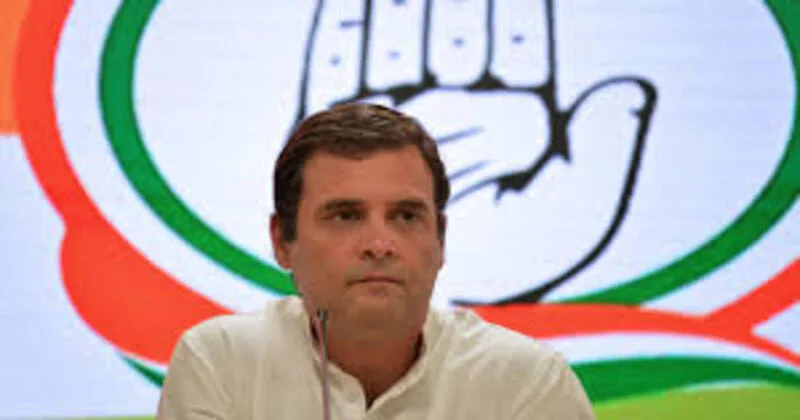
Once a party of freedom fighters, now the Congress has morphed into a factory of falsehoods churning out conspiracy theories to attack India’s most trusted institutions. From the Election Commission to the UPSC, Supreme Court judges to the India Army, no institutions are safe from their smear campaigns. Allegations are made without evidence, outrage is staged for cameras and every setback at the ballot box is spun into a story of “institutional bias”. This isn’t the defense of the Constitution; it’s the deliberate demolition of public faith in it.
In recent years, the Congress Party under the leadership of Rahul Gandhi has attempted to rebrand itself as the sole “protector” of India’s Constitution. But behind the grand slogans and padyatras lies a strategy built on undermining public trust in the very institutions that safeguard our democracy.
The Election Commission of India (ECI), a globally respected institution, has been repeatedly attacked by the Congress leaders. Allegations of bias and manipulation, often without concrete evidence, have become a staple in Congress’s political playbook.
Healthy criticism of institutions is vital in a democracy. But Congress’s current approach is not healthy criticism; it’s a campaign of doubt and distortion. By turning every institutional decision into an imagined battle for the Constitution, the party is not defending democracy; it is eroding it from within.
The Election Commission: A convenient scapegoat
When elections don’t go their way, Congress’s first target is the Election Commission of India. Voter rolls revisions? “Biased.” Poll dates? “Rigged.” Even before facts emerge, the verdict is declared not by courts, but by Congress press conferences. In Bihar, they spread panic over alleged electoral roll manipulation without conclusive proof, creating needless suspicion among the voters. This isn’t constructive criticism; it’s an attempt to make people lose faith in the one body that guarantees free and fair polls.
The real aim: Political positioning, not constitutional protection
Congress’s year-long Samvidhan Bachao Yatra was framed as a moral crusade. In reality, it is a calculated political campaign to keep the BJP on the defensive. By painting every decision of the constitutional bodies as part of a “government conspiracy,” Congress hopes to create an image of a broken system with itself as the only cure. But here lies the danger: if the public begins to believe that every constitutional body is compromised, democratic faith collapses. And when faith collapses, the vacuum is filled not by healthy reform but by chaos and instability.
In Bangladesh, militant and fundamentalist groups spread allegations that Sheikh Hasina had won elections through manipulation, attempting to undermine her legitimacy. In reality, Hasina was a widely popular leader who enjoyed strong public support due to her development policies and pro-people governance. However, by fueling false propaganda and exploiting religious sentiments, the Muslim fundamentalists created unrest and managed to capture power for themselves, despite lacking genuine democratic backing.
False narratives, Real damage to India
In Bihar, they staged protests over the Special Intensive Revision, turning a routine process into a “democracy in danger” headline. This pattern isn’t about protecting the vote — it’s about protecting Congress’s ego.
A woman from Rohtas district created a stir during Rahul Gandhi’s Voter Adhikar Yatra when she claimed that six members of her family were missing from the Bihar draft electoral roll. Within 24 hours, however, she retracted, admitting that local workers had asked her to make the statement. Later, after checking with the BLO, she confirmed that all her family members’ names were indeed present in the list. The U-turn caused embarrassment for the INDI alliance in Bihar.
In Bihar, Congress’s script was the same as always — lose ground, cry foul and drag the Election Commission into the mud. When the voter list revision process began, routine updates were painted as part of a grand conspiracy. Without waiting for the verification or evidence, leaders rushed to the microphones to declare that the polls were “compromised”.
In Karnataka, Rahul Gandhi questioned voter rolls without waiting for verification, igniting suspicion and confusion among voters. But what happened to his allegations? His own party’s minister in Karnataka KN Rajanna said, “When was the voter list prepared? It was prepared by state government employees when our own government was in power.” He was forced to resign.
By constantly questioning the referee, they’re telling the public that no game can be fair unless they win. That’s not leadership — that’s institutional vandalism. In doing so, Congress wasn’t defending democracy in Bihar; it is dismantling trust in the very institution that guarantees fair elections. That’s not opposition — that’s sabotage. It cannot be ruled out that there is a larger conspiracy against India’s democracy and constitution behind this calculated deceit. After all, their family’s history is also filled with the dark chapter of the 1975 ‘Emergency’.
“In democracy, the decision of the people is universally accepted and by attacking the Election Commission, Rahul Gandhi is insulting the wise decision of the people. Where was Rahul Gandhi when the Election Commission invited every party to lodge a complaint regarding SIR in Bihar, then neither Congress nor any party of the INDI alliance went to the Election Commission.
In Maharashtra, Congress and its allies were happy when they won a majority in the Lok Sabha. And when they lost badly in the Vidhan Sabha, it became a problem for them. Rahul Gandhi for months he has been pushing the dramatic claim of “vote chori,” alleging mass voter-roll manipulations across states. The problem is most of his claims collapse under scrutiny. In Maharashtra, “suspicious” voter-roll data circulated by the Congress leaders was found to be riddled with errors. And now, even so called respected analysts like CSDS’s Sanjay Kumar have fumbled with numbers, feeding into the same narrative before retracting. By posting the voter data that later turned out to be flawed — and then quietly deleting it with an apology — Kumar handed fresh ammunition to conspiracy theorists like Rahul Gandhi who thrive on half-baked statistics.
The danger here is not just one faulty tweet. It is the cumulative effect of selective statistics, hasty conclusions and choreographed outrage. When Rahul Gandhi uses these flawed numbers to cry “democracy under attack,” and when researchers amplify them without rigorous verification, the end result is the same: a deliberate erosion of trust in the institutions. Now, mistakes happen. Even the most seasoned academics and researchers can commit error. But in a hyper-charged political climate, such lapses are not seen as innocent slips; they are interpreted as attempts to push a narrative.
The apology was welcome, but it also underlined the larger crisis: credibility. Once public trust in data is shaken, it is very hard to restore. Opposition leaders, activists and media commentators were quick to amplify the initial numbers but far quieter about the correction.
Rahul Gandhi’s habit of playing loose with the facts
Rahul Gandhi has always projected himself as the voice of the ‘truth’ against the establishment. Yet, when one looks closely, his politics appears built less on facts and more on slogans, exaggerations and selective narratives. Over the years, his statements have repeatedly been called out as misleading or false, exposing a pattern of careless rhetoric.
The Rafale controversy is the clearest example. Rahul’s repeated slogan, Chowkidar chor hai, accusing Prime Minister Modi of handing 30,000 crore to Anil Ambani, electrified his campaign but collapsed under scrutiny. The Supreme Court, CAG reports and even Dassault itself dismissed his allegations. Yet Rahul offered no proof beyond political theatre.
During the COVID-19 crisis, Rahul mocked Covaxin and Covishield as “Modi’s vaccines,” raising doubts about their safety. Ironically, the same vaccines received WHO approval, became India’s shield against the pandemic and were exported to the world.
His attack on India’s global standing follows the same line. Rahul argues that “India has lost respect internationally” under Modi, while global surveys from Gallup, Pew, and international forums actually show India’s approval ratings improving and its geopolitical weight is increasing.
Beyond these, his sweeping claims like “all make in India products are made in China” ignore the reality of domestic successes in sectors from metro rail to defense manufacturing. His narrative may win claps in rallies, but it fails the test of facts.
Take LIC. When the stock markets were reeling after the Hindenburg report on Adani, Rahul loudly declared that “LIC and SBI money is sinking,” suggesting that the savings of ordinary Indians had been wiped out. The fact? LIC’s exposure to Adani was less than 1% of its total assets, and SBI’s was under 1% of its loan book. Neither institution faced any systemic risk. Instead of presenting facts, Rahul stoked panic, undermining public trust in two of India’s most respected financial institutions.
Then there is the airports story. Rahul has repeatedly alleged that Modi “handed over all airports to Adani.” The truth? Adani won bids under an open, competitive tender process introduced during the UPA years itself. Multiple companies competed and Adani happened to bid the highest for six airports. Claiming that the government gifted airports to Adani is a distortion of facts and a deliberate attempt to mislead.
In the end, Rahul Gandhi risks being remembered not as a leader of ideas, but as a politician of half-truths and misplaced slogans. In an age where facts are easily verifiable, relying on rhetoric alone is not just poor strategy but it is self-sabotage.
Rahul Gandhi’s reckless claims on national security
When it comes to sensitive issues of national security, facts and responsibility matter more than rhetoric. Yet Rahul Gandhi has often treated these serious matters as just another opportunity for political one-upmanship and in the process, weakened his own credibility.
Rahul Gandhi has repeatedly claimed that “China has taken thousands of kilometers of Indian land” and that the Modi government is “silent.” He has even alleged that Indian troops have been beaten and humiliated. The facts, however, do not support such sweeping statements. While border tensions in Ladakh did flare up and clashes at Galwan led, the Government of India consistently maintained backed by satellite images that no territory was ceded. By exaggerating the situation, Rahul not only undermined the morale of the armed forces but also handed talking points to China, which used his remarks in Chinese and global media.
In this matter when the Supreme Court recently observed that Rahul Gandhi must behave like a “true Indian” while making political remarks, it was more than a courtroom exchange it was a rebuke. For a leader who aspires to guide the nation, being cautioned by the Supreme Court to act in the spirit of a “true Indian” is both telling and embarrassing.
The Surgical strikes
Perhaps most damaging was Rahul Gandhi’s repeated questioning of the 2016 surgical strikes against Pakistan. While the Army itself released proof of the operations, Rahul demanded “evidence,” echoing Pakistan’s line. At one point, Congress leaders even suggested the strikes were fake. National security demands maturity, discretion and respect for facts. By treating it as another campaign slogan, Rahul Gandhi not only diminishes his own credibility but risks undermining India’s position against its adversaries. That is not just careless politics, it is dangerous politics.
Rahul Gandhi’s Questionable Friends – China & Soros
Politics is built on perception and Rahul Gandhi has a knack for creating the wrong one. Two episodes stand out, his quiet meetings with Chinese officials and his alignment with the rhetoric of George Soros backed groups. Both raise troubling questions about where his loyalties lie and at the very least, whose script he is echoing.
The China angle
In 2017, when Indian soldiers were standing eyeball to eyeball with the Chinese PLA at Doklam, Rahul Gandhi chose that exact moment to secretly meet the Chinese Ambassador in Delhi. At first, his party flatly denied the meeting. Only when evidence surfaced they admit it, terming it as a “routine diplomatic interaction.” But why the secrecy? Why the denial? And why during a military standoff?
The Soros shadow
Then there is George Soros, the billionaire who openly declared that Narendra Modi is an obstacle to his “open society” mission and predicted that Modi would fall because of scandals like Adani-Hindenburg. Rahul Gandhi’s talking points, Modi-Adani nexus, “democracy in danger,” and calls for international intervention fit neatly into the Soros script.
Several NGOs and think tanks in India, later exposed as recipients of Soros-backed funds, amplify the same themes Rahul pushes in Cambridge lectures or US panel discussions: that India is sliding into dictatorship, that minorities have no voice, that Modi is destroying institutions. Rahul’s critics argue that he is not just an opposition leader but a willing megaphone for a global network that wants to destabilize India.
For Rahul Gandhi’s supporters, this is all coincidence: a leader meeting diplomats, a politician speaking his mind abroad. But in politics, coincidences don’t exist for long. When your “routine meeting” lines up with your enemy’s aggression, and your speeches mirror the agenda of a billionaire who wants your Prime Minister removed, people are entitled to ask uncomfortable questions.
Rahul Gandhi might claim to be defending democracy. But by aligning knowingly or otherwise with China’s narrative and Soros’s agenda, he risks looking less like a protector of India and more like a pawn in someone else’s game.












Comments