





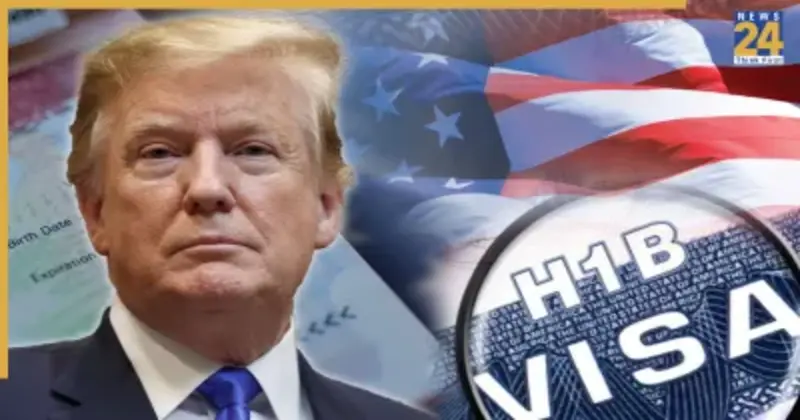
US President Donald Trump has signed an executive order which is deemed as a stringent measure against the immigration. The order asserts that any H-1B visa holder entering the US has to pay an annual fee of USD 100K. In case of non-compliance stringent entry ban will be imposed. This massive clampdown on the H-1B visa holders is considered as a measure to control immigration into the US, about which President Trump is very vocal about since the days of presidential election campaign and in his previous term as well. The latest order is set to commence from September 21, Sunday.
#WATCH | President Donald J Trump signs an Executive Order to raise the fee that companies pay to sponsor H-1B applicants to $100,000.
White House staff secretary Will Scharf says, "One of the most abused visa systems is the H1-B non-immigrant visa programme. This is supposed to… pic.twitter.com/25LrI4KATn
— ANI (@ANI) September 19, 2025
The measure is seen as a major blow to the US tech industry that predominantly encompasses the highly-skilled professionals from countries such as India and China. In the wake of the latest announcement, tech giants such as Microsoft have asked their employees to return to the United States before September 21. The latest visa order has also stirred high-voltage debate across the US with few supporting the decision of Trump and few others are sceptic as the visa restrictions can derail the profit and growth prospects of the US tech economy.
‘Stop bringing people and train Americans’: US Commerce Secretary
Howard Lutnick the Commerce Secretary of the United States while speaking about the latest decision exclaimed, “If you’re going to train somebody, you’re going to train one of the recent graduates from one of the great universities across our land. Train Americans. Stop bringing in people to take our jobs”. He further added that the decision has been conveyed to all the big companies and there was a briefing about the revised fees before signing the executive order. “A hundred thousand dollars a year for H-1B visas, and all of the big companies are on board. We have spoken to them”, Lutnick further asserted during an event at the Oval office.
“Either the person is very valuable to the company and America or they are going to depart and the company is going to hire an American. And that’s the point of immigration. Hire Americans and make sure the people coming in are the top, top people. Stop the nonsense”, Commerce Secretary Lutnick further said while explaining the true purpose of the H-1B visas and how the H-1B programme can suppress and side-line the Americans.
US tech economy is flooded with H-1B visa holders
The numbers reveal that the US tech sector is highly dependent on the professionals who enter the country with the H-1B visa. In the first half of 2025, Amazon approved more than 10,000 H-1B visas. Microsoft and Meta approved 5,000 visas each. Cumulatively, every year the United States government offers 65,000 H-1B visas to employers, in order to bring skilled or highly-skilled professionals to the country. Invariably, the tech giants are dependent on the H-1B professionals.
Thus, there are many experts who have criticized the latest executive order claiming that it might harm the growth prospects of the US economy. The critics of the immigration crackdown measure of Trump, includes billionaire Elon Musk, who himself was a H-1B visa holder, when he migrated from South Africa. At many occasions, Mr. Musk has reiterated that the H-1B visas helps to bring in the highly-skilled workers essential to fill the talent gaps and to keep the industry competitive.
Deedy Das, partner at Menlo Ventures, said that the latest executive order “created disincentive to attract the world’s smartest talent to the US. It drastically reduces its ability to innovate and grow the economy”.
Daniel Di Martino, a research fellow and Economist in the US has said that H-1B visa holders, both new applicants and those who seek extension must pay USD 100K to process the application and also has to pay USD 100K every year to maintain the visas. “This will effectively end the H-1B programme completely. No one, even the highest paid at 500K will be paying an extra 100K a year to the government. It will destroy the healthcare, higher education and technology sectors”, Mr. Martino further added.
SUMMARY OF H-1B EXECUTIVE ORDER
– ENTRY BAN: No H-1B visa holder may enter the United States beginning Sunday September 21st, including current visa holders, unles they pay $100K to enter.
– VISA FEE: New H-1B and H-1B extensions must pay 100K to be processed and 100K per year…
— Daniel Di Martino 🇺🇸🇻🇪 (@DanielDiMartino) September 20, 2025
Burden to the employers
As per the existing regulations, H-1B applicants pay a nominal fee to enter the lottery system. If selected in the lottery system, subsequent fees have to be paid and the amount varies depending on the nature of the application. Usually, all the visa fees are borne by the companies/employers that might amount to several thousand dollars. H-1B visas are also approved for three to six years depending on the case which has to be renewed accordingly.
Thus, the latest annual fee of USD 100K imposed by the Trump administration will pose a huge burden to the companies. For example, the revised H-1B visa fees can amount to 10% of the profits of Indian IT firms such as TCS, Infosys, Cognizant etc.
Legal challenges to the executive order
Meanwhile, debates are also circulating regarding the authority of the executive branch of the US government to impose such orders. Experts are questioning whether the US executive has the power to impose massive visa fees. Aaron Reichlin-Melnick, Senior fellow at the American Immigration Council has expressed, “The President literally has zero legal authority to impose USD 100K fee on visas. The only authority Congress has ever given the executive branch here is to charge fees to recover the cost of processing the application”.
In this background, the latest crackdown on the H-1B visas might reach the doors of the US Court. If the court verdict acknowledges the executive order then the future of the H-1B visa holders will dwindle and the companies has to bear a huge burden. Of annually paying USD 100K.












Comments