





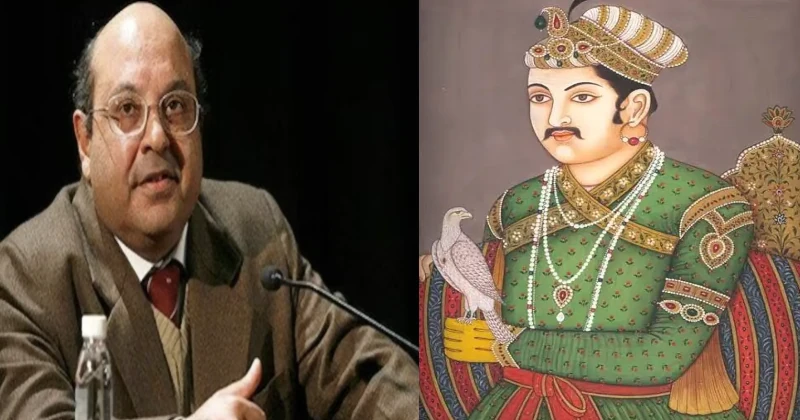
Former Supreme Court judge Rohinton Fali Nariman has triggered outrage among nationalist and Hindu voices after criticising the revised NCERT history textbooks for presenting the Mughal ruler Akbar as a tyrant who massacred Hindus. Speaking at the KM Bashir Memorial Lecture in Trivandrum, Nariman called it a “distortion of history,” expressing shock that students are being told about the brutality Akbar unleashed during the siege of Chittorgarh.
His remarks are not only ill-informed but also reflect a dangerous trend of protecting Mughal invaders’ image while dismissing the lived trauma of Hindus, who for centuries faced slavery, temple destruction, forced conversions, and mass killings under Islamic rule.
Let us recall the very episode Nariman wants hidden from students: Akbar’s 1568 siege of Chittorgarh. After a prolonged battle, Akbar ordered the slaughter of 30,000 Hindus, proclaiming it a victory of Islam over “infidels.” Women in the fort chose jauhar (self-immolation) over capture, slavery, and dishonour. Those who survived were enslaved, their children sold in markets.
This was not an isolated incident. Mughal chronicles themselves document similar horrors:
- Babur ordered the massacre of entire populations in conquered cities, declaring them victories for Islam.
- Aurangzeb reimposed jizya, destroyed temples, banned Hindu practices, and executed Guru Tegh Bahadur for resisting conversions.
- Shah Jahan, glorified for the Taj Mahal, razed hundreds of temples and imposed severe restrictions on Hindus.
For decades, however, history textbooks hid these truths, presenting Akbar as a symbol of tolerance while reducing Hindu suffering to footnotes. This deliberate whitewashing denied Hindu children the right to know their ancestors’ struggle for survival.
The recent revision of NCERT’s Class 8 Social Science textbook under the National Curriculum Framework (2023) is an attempt to correct this imbalance. The new version does not erase Mughal achievements but places them alongside their brutalities, giving students a balanced picture grounded in facts.
- Akbar is described as embodying a blend of brutality and tolerance acknowledging both his abolition of jizya and his genocidal violence.
- Aurangzeb is rightly portrayed as a military despot who persecuted Hindus.
- Babur is exposed for his mass killings.
- Even the artistic contributions of Jahangir and Shah Jahan are presented without hiding the darker realities.
This is not distortion; it is restoration of truth, giving Hindus dignity by ensuring their pain is not erased from the nation’s memory.
Against this backdrop, Nariman’s claim that portraying Akbar’s brutality is “distortion” raises serious questions. Why should the genocide of Hindus be hidden? Why should history only glorify rulers who butchered millions of Hindus but never give voice to the victims?
This selective outrage comes from a man whose own career was shaped by privilege and whose family has a legacy of protecting the powerful at the expense of justice:
- Rohinton Nariman became Senior Counsel at 37, widely attributed to the influence of his father, Fali Nariman, who was Additional Solicitor General under Indira Gandhi.
- He was appointed Solicitor General during Sonia Gandhi’s UPA regime, resigning shortly before being elevated directly to the Supreme Court.
- While occupying the Bench, he made disparaging remarks about the Vedas, hurting Hindu sentiments while projecting himself as a defender of “composite culture.”
The platform where Nariman delivered his lecture Justice Ahmadi Foundation itself exposes the deep nexus of elite privilege and compromised justice. Former CJI A.M. Ahmadi, whose name the foundation carries, diluted criminal charges against Union Carbide in the Bhopal Gas tragedy case, reducing the world’s deadliest industrial disaster to mere “negligence.” Within days of retirement, he became trustee of the Bhopal Memorial Hospital Trust, funded by Union Carbide.
In this case too, Fali Nariman Rohinton’s father represented Union Carbide, effectively ensuring that victims of Bhopal, largely poor Hindus and Muslims, were denied justice. The irony of the Nariman family sermonising on “distortion of history” is not lost on anyone.
Rohinton Nariman has also been a leading voice in spreading misinformation about electoral reforms under Prime Minister Modi. He falsely claims PM Modi “changed the law” to handpick Election Commissioners. The truth is clear:
- 29 Election Commissioners before PM Modi were all appointed by Prime Ministers, without opposition involvement.
- Modi’s government, for the first time, included the Leader of the Opposition in the selection panel, strengthening transparency.
By twisting facts, Nariman has attempted to delegitimise reforms that actually make the system fairer.
The larger issue here is not just about textbooks but about a systematic attempt by privileged elites to deny Hindu suffering. For centuries, invader atrocities were brushed aside in the name of “composite culture.” The truth about temple demolitions, mass killings, forced conversions, and genocides of Hindus was hidden so that children grew up venerating their oppressors.
Rohinton Nariman’s outrage at the revised NCERT textbooks shows how deeply entrenched this mindset remains. For him, acknowledging the massacre of Hindus at Chittorgarh is “distortion,” but glorifying Akbar as a saint of tolerance is “heritage.” This is not just hypocrisy it is an assault on Hindu identity and memory.













Comments