





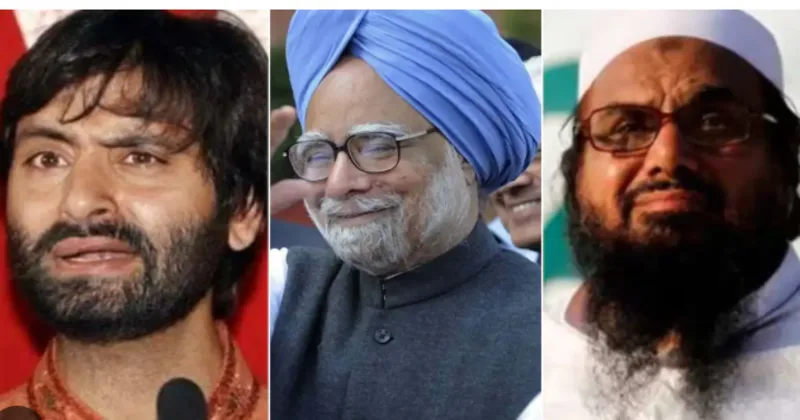
Jammu Kashmir Liberation Front (JKLF) Chief Yasin Malik has claimed that he met Lashkar e Toiba (LeT) founder Hafiz Saeed in 2006 at the initiative of intelligence officials. He has told the Delhi High Court that after this meeting, then Prime Minister Manmohan Singh had thanked him personally at 7 Race Course Road (the PM residence now renamed Jan Kalyan Marg). It needs to be mentioned here that Hafiz Saeed masterminded the 26/11/2008 attack in Mumbai, one of the bloodiest terrorist attacks on the Indian soil.
Malik is in Tihar jail presently serving a life sentence for the past many years for involvement in a terror funding case. He has now claimed that he personally informed the PM as also then National Security Adviser (NSA) M K Narayanan regarding his meeting Saeed. In a sensational claim, he has said that Mr Singh had thanked him for the meeting.
The JKLF terrorist has made these assertions in an affidavit submitted to the Delhi High Court on August 25. Malik has claimed the meeting was a backchannel peace process initiated by Indian intelligence agencies.
According to Malik, then Special Director of the Intelligence Bureau (IB) V.K. Joshi met him in New Delhi before his Pakistan visit in the aftermath of massive earthquake that rocked Jammu and Kashmir on October 8, 2005. There was widespread damage on both sides of the Line of Control (LoC). The areas which suffered the most included parts of Poonch, Uri in Kashmir and some areas in Pakistan Occupied Jammu Kashmir (POJK).
Joshi, Yasin Malik has said in the affadavit, urged him to use the trip to engage not only with political leaders but also with terrorists, including Saeed, in support of PM Singh’s peace outreach (as part of Track II peace parleys). Malik said he was told that dialogue with Pakistan would lack credibility unless terrorist leaders were included in the peace process.
Acting on this request from an IB official, Malik claimed he attended a gathering organised by Saeed and the United Jihad Council (UJC). At this gathering, Yasin Malik said that he delivered a speech calling on terrorists to embrace reconciliation over violence. Citing Islamic teachings, he urged them to “purchase peace” if it was offered. It can be mentioned here that one of the key figures in running the affairs of the UJC for over two decades is Syed Salahuddin, leader of the terrorist group Hizbul Mujahideen (HM). Salahuddin (aka Yusuf Shah) had fought in the 1987 Legislative Assembly elections of J&K and crossed over to Pakistan later.
Years later, this particular meeting between Malik and Saeed was cited as evidence of the former’s proximity to Pakistani terror groups. The JKLF chief, however, described this as a “classic betrayal,” insisting it was a sanctioned effort, later twisted for political purposes.
The most explosive portion of his affidavit relates to his return to India. Malik said he was debriefed by the IB and then asked to brief Prime Minister Singh directly. He claimed he met Singh the same evening, in the presence of then National Security Advisor MK Narayanan, where the PM conveyed gratitude for his “efforts, time, patience and dedication” in engaging hardliners living in Pakistan. Malik further claimed that PM Singh even described him as the “father of the non-violent movement in Kashmir.”
After leading gun-wielding youth of JKLF for many years, Yasin Malik had, in 1994, had publicly declared that he was giving up gun. Of all the terrorist groups that have been involved in separatist and secessionist activities, JKLF alone has argued for an independent Jammu & Kashmir. Most of other groups have always wielded gun claiming J&K’s merger with Pakistan was their goal. For the JKLF, this pursuit of an independent J&K had earned the wrath of Indian as also Pakistani intelligence agencies. When JKLF cadres started dying in the hands of these agencies in large numbers, Yasin Malik had announced, in a tactical move, that he was giving up gun.
The affidavit also references Malik’s past interactions with political leaders, including Atal Behari Vajpayee, Sonia Gandhi, P. Chidambaram, I. K. Gujral and Rajesh Pilot. He asserted that successive governments since the early 1990s had engaged him as part of peace efforts and even encouraged him to raise the Kashmiri cause on international platforms. A large number of people mentioned in the affidavit have died during the past few years.
P Chidambaram as Union Home Minister under PM Singh had control over intelligence agencies. Sonia Gandhi as Chairperson of United Progressive Alliance (UPA) for many years was considered a super boss way above PM Singh. Neither Sonia nor Chidambaram have so far spoken about Yasin Malik’s sensational claims.
If accurate, Malik’s revelations raise serious questions about India’s covert peace strategies and the extent of reliance on separatist leaders accused of terrorism. Most significantly, Yasin Malik’s claim that a sitting Prime Minister of India expressed gratitude following a meeting with Hafiz Saeed could ignite a major political controversy.
Malik has been accused of killing four Indian Air Force (IAF) personnel in Srinagar in 1990. He has also been accused of involvement in the kidnapping of Rubiya Saeed, daughter of then Union Home Minister Mufti Mohammad Sayeed in November 1989. This kidnapping had led to release of five terrorists from different jails. A court case has been going on at a snail’s pace for past over three decades. Kashmiri Pandits also hold Malik responsible for the ethnic cleansing and exodus of their community from the Kashmir Valley.
Senior journalist Aditya Raj Kaul, a Kashmiri Hindu migrant himself, has said that Malik was getting money from Indian intelligence agencies also, besides his masters in Pakistan. The UPA government under PM Singh provided the best of medical facilities to Yasin Malik, in India and even sent him to US for treatment.
For now, Malik’s affidavit stands as a controversial intersection of diplomacy, intelligence operations and terrorism—thrusting former Prime Minister Manmohan Singh into the frame of one of India’s most secretive peace gambits.











Comments