





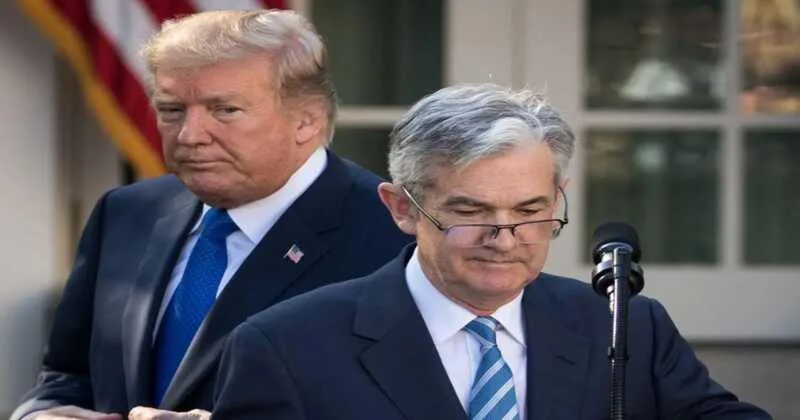
Under sustained pressure from President Donald Trump, US Federal Reserve Chairman Jerome Powell has finally lowered interest rates, the first cut of 2025. The Fed also signalled two more cuts later this year. Markets initially responded with enthusiasm with stocks and gold surged, while the US dollar and government bond yields fell. But the rally quickly lost momentum.
Speaking after the policy announcement, Powell stressed that the move was a temporary measure designed to cushion the economy against current shocks, particularly a deepening crisis in employment. He described the step as a ‘risk-management interest rate cut,’ making clear that the central bank did not intend to enter a prolonged cycle of monetary easing. His words quickly punctured market optimism. Profit-taking in gold intensified, driving down prices, while Wall Street lost ground. The dollar index and Treasury yields, which had been expected to decline sharply, rebounded instead.
Trump–Powell Feud Intensifies Over Rates and Fed Independence
Powell’s uneasy relationship with Trump has long been the subject of public scrutiny. Appointed by Trump in November 2017 during his first term, Powell soon fell out with the president. During the COVID-19 pandemic, Trump attempted to remove him from office but eventually backed down. Later, President Joe Biden reappointed Powell for another term, which is set to end in May 2026.
When Trump returned to the White House this January, one of the earliest questions posed to him was whether he would fire Powell. Reporters also asked Powell directly if he feared dismissal. At the time, Trump said he had no immediate plans to remove the Fed chair, while Powell insisted that the president had no authority to do so.
The latest cut comes after a four-year pause in monetary easing. In September 2024, the Fed slashed its benchmark interest rate by half a percentage point, 0.50 per cent, bringing it down from a 23-year high of 5.25–5.50 per cent to 4.75–5 per cent. Inflation, which had peaked at 9 per cent in 2022, had by then fallen to 2.5 per cent. The central bank, which targets inflation at 2 per cent, signalled that easing would begin even before the precise goal was met. Subsequent quarter-point reductions in November and December lowered the rate to 4.25–4.5 per cent.
Since Trump’s return, however, no cuts had been made until now. The president has been vocal in demanding steeper reductions, while Powell has insisted that decisions must be guided by data on inflation and broader economic indicators. The tension escalated further when Powell warned that Trump’s tariff hikes would stoke inflation and weaken GDP growth.
Trump, angered by Powell’s resistance, publicly derided him as “too late,” “stupid,” “unintelligent,” and even “an enemy of the United States.” The feud deepened when reports emerged about a costly $1.9 billion renovation of the Federal Reserve’s Washington headquarters, projected to exceed $2.5 billion. Pro-Trump senators branded the project wasteful and called for Powell to face criminal investigation.
The president’s repeated threats to dismiss Powell have intensified in recent months. He has hinted that the Fed chair would be replaced with someone more willing to slash rates, and a search for potential successors is already underway. Powell’s current term officially ends in May 2026, but uncertainty about whether he will last that long looms large.
Trump’s Trade War Backfires with Inflation Jump and Jobless Spike
Meanwhile, the economic backdrop has added to the pressures facing the Fed. Recent data show that Trump’s tariff war has begun to backfire. Retail inflation, measured by consumer prices for everyday goods, rose 0.4% in August, compared to 0.2 per cent in July. It was the sharpest monthly increase since Trump resumed office. Analysts had forecast a more modest 0.3 per cent rise. On an annual basis, inflation reached 2.9 per cent, its highest in eight months, while core inflation, which excludes food and energy, stood at 3.1 per cent, well above the Fed’s target of 2 per cent.
The labour market has also shown signs of strain. The Labor Department reported that unemployment benefit claims rose to 2.63 million in August, significantly higher than the expected 2.35 million. The figure marked the biggest jump since October 2021, with 27,000 more people filing claims compared to July.
It is widely believed that Powell’s latest decision to cut rates was influenced not only by worsening economic conditions but also by the growing pressure from Trump and his allies within the monetary policy committee. The combination of rising unemployment, creeping inflation, and relentless political attacks appears to have pushed the Fed chair into action.
For now, Powell has sought to frame the move as a technical adjustment rather than a policy shift. By labelling it a risk-management cut, he emphasised that the Fed was acting prudently to mitigate shocks rather than embarking on a new easing cycle. But markets remain sceptical. The fleeting nature of the rally after the announcement suggests that investors are uncertain whether Powell will be able to hold the line against Trump’s demands, or whether the central bank will eventually be forced into a looser monetary stance.
With Powell’s term set to expire in less than two years and Trump determined to reshape the Fed in line with his economic agenda, the coming months may prove decisive. Whether the institution maintains its independence or bends further under political pressure could determine not only the trajectory of US monetary policy but also the stability of global markets.
















Comments