





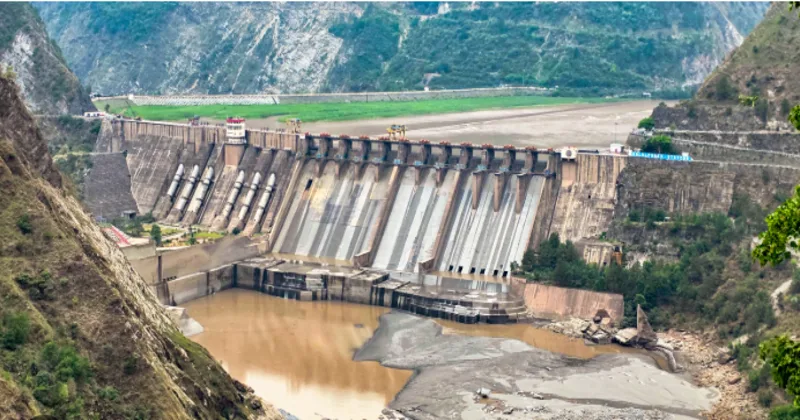
It is something that Pakistan is unable to fathom still, five months after Narendra Modi-led government put Indus Waters Treaty in abeyance on April 23. Our western neighbour is yet to comprehend what has happened, or what is happening, as it was just playing by its old rulebook. Its unstated policy of propping up terrorists and asking them to carry out hit jobs in Jammu & Kashmir. On April 22, terrorists had just killed two dozen Hindu tourists in Baisaran (Pahalgam) and there was no reason for Pakistan to believe India’s reaction would be any different.
The Treaty had run smoothly for nearly 65 years till then after being signed on September 19, 1960. The wars of 1965 and 1971 had failed to harm it. The rampant killings by terrorists in late 1989 and early 1990 which had led to lakhs of Hindus leaving Kashmir had not impacted the Treaty. The Kargil war had not impacted it either.
The Treaty in abeyance and Operation Sindoor were too costly for Pakistan and it is bearing the consequences of both till date.
Pakistan failed to fathom the intentions of the Indian government and misread its cautious approach as signs of timidity. After the Uri terrorist attack of September 2016, Modi had set up a task force to study the Treaty in detail, and minutely. The phrase “Blood and water can’t flow together’’ owes its genesis to that period.
After Pulwama blast of Feburay 14, 2019, India reacted very cautiously, announcing three projects on Ravi river. The tone was almost apologetic as it declared eight days later that it will build Shahpur Kandi dam project and two more to stop Ravi waters, its own share, from going to Pakistan! Our neighbour declared even stoppage as “water terrorism’’! Alas, only Shahpur Kandi project is complete and nothing has been done to take up the other two projects till date.
Pakistan’s prominent politicians, including Prime Minister Shehbaz Sharif, PPP leader Bilawal Bhutto Zardari and Defence Minister Khwaja Asif have spoken about the inviolability of the IWT. They have repeatedly claimed that the Treaty cannot be suspended unilaterally. However, now that India has gone ahead and kept it in abeyance, Pakistan has been able to do nothing, despite claiming repeatedly that any fiddling with IWT would be taken as an act of war.
Data Deficiency
Pakistan is now getting no data from 280 field units (monitoring points etc) on the six rivers of the Indus system. Different type of data sets from 190 stations on the Western Rivers and 90 on the Eastern Rivers have dried up. It is getting no data about precipitation in catchment areas, none regarding river flows or other parameters.
Despite initial bravado displayed by Pakistan, it is progressively becoming problematic as its release of water and predictions of floods were all predicated on the gift of the data it used to receive from India. In late August, India told Pakistan’s Foreign Ministry that floods were imminent in Tawi river and there can be heavy discharge downstream. However, this was not done under the ambit of the IWT but on humanitarian grounds.
Under the IWT, the data was being shared through Permanent Indus Commission (PIC) which comprised the Indus Commissioners of India and Pakistan. The PIC is now in a limbo with visits of the Pakistani engineers being stopped.
Fast Tracking Projects
For the Indian engineers and diplomats, this IWT in abeyance is such a sweet opportunity and a delightful pause. They have used this hiatus for hastening most hydropower projects being planned or built on the Western Rivers, most of all Chenab. The work on 850 MW Ratle project in Kishtwar has picked up added pace.
Another project that has benefited by the Treaty being put in abeyance is the mega 1,856 MW Sawalakote project. The project, to be located downstream of Baglihar and upstream of Salal, was being talked about in the year 1997 or even earlier. However, due to too much of noise by Pakistan, this project could not take off. Now, a global tender was issued in the last week of July, returnable in early September, some days ago. This time, it seems there is no stopping this project.
Tulbul Navigation Project
Of all the projects on the Western Rivers, Tulbul Navigation Project was first to be conceived. At one time, Sheikh Mohammad Abdullah was pushing for its early execution. He said that by raising the water level of Wullar lake, navigation downstream will improve. It could be taken up only in 1984, got embroiled in problems with Pakistan raising objections and remained stalled from 1987. This project has picked up momentum with an office of Inland Waterways Authority of India (IWAI) operating in Srinagar since May.
Pakistan can just throw tantrums and do little of consequence to stall any of Indian projects on the Western Rivers now due to India’s firmness in not listening to it. In the past, it did incalculable harm to India by raising one objection or the other to all projects that we wanted to take up. No longer so as the Treaty is in abeyance.
Present Status
At present, this IWT in abeyance is a golden chance which is being utilised to the hilt by policy planners here in India. Allocation of funds was an issue sometimes for the projects on the Western Rivers. Not any more as top priority is being accorded to them. For short terms, mid-term and long term, fund allocation and planning is being done as if IWT did not exist!
Sediment flushing has been done on all reservoirs on the Western Rivers this year more than once. That has improved the holding capacity and as a result, generation has improved and can only be better even in the days to come.
Pakistan’s use of terror as a weapon against Bharat has an answer now. It is watching and screaming in horror accusing India of weaponisation of water!
















Comments