





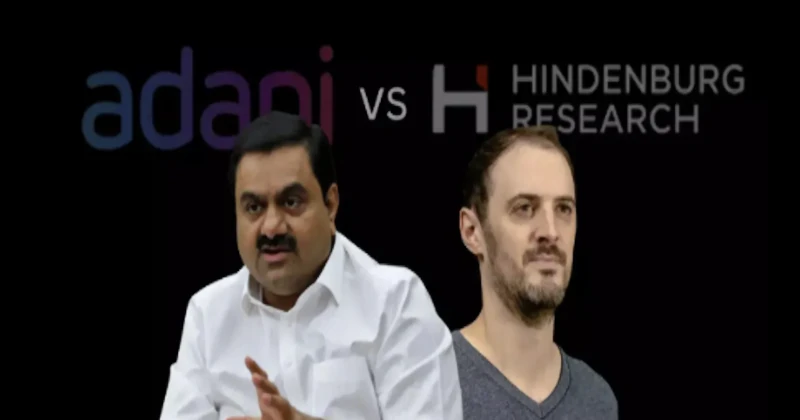
When Hindenburg Research dropped its explosive dossier on the Adani Group in January 2023, the report was hailed in Western media as a classic David-versus-Goliath tale—an independent financial investigator exposing the vulnerabilities of a corporate giant. Within days, Adani’s market capitalization had eroded by over $100 billion, sending shockwaves across India’s financial and political ecosystem.
But a deeper look at the Hindenburg saga reveals something more sinister: the convergence of hedge funds, financial predators, political opposition figures in India, and sympathetic journalists who amplified the narrative. The attack on Adani appears less like a lone research operation and more like a multi-front assault carefully planned for maximum financial and political impact.
https://twitter.com/vijaygajera/status/1621826502533996544
The roots of the Hindenburg report can be traced back to India’s Parliament and media debates of 2021. In June 2021, Adani Enterprises and other group stocks suffered a sharp decline after reports emerged that the Securities and Exchange Board of India (SEBI) was examining the ultimate beneficiaries of offshore funds with large Adani holdings.
At that time, Mahua Moitra, Trinamool Congress MP and former JP Morgan investment banker, made an incendiary comment, “We want to know whose money is it. If it is Adani’s money, then minority shareholders are being screwed.”
Moitra’s pointed questions about entities such as New Leaina, which held stakes in Adani group companies, were later woven into the Hindenburg report almost verbatim. In essence, what Hindenburg claimed as part of its “two-year investigation” was heavily borrowed from the groundwork laid by Moitra in the Indian political space.
Her role is significant, not only because of her political activism but also due to her career at JP Morgan (2000–2008) the same banking giant that has deep ties to hedge funds implicated in Hindenburg’s operations.
Hindenburg itself admitted in its legal disclaimer that it had short positions in Adani debt and equities through U.S.-traded bonds and offshore derivatives. It openly declared that its members, partners, affiliates, employees, consultants, and clients stood to benefit financially from the crash in Adani securities.
The key question: Who are these partners and clients?
Nathan Anderson, Hindenburg’s founder, previously ran ClaritySpring Securities LLC and ClaritySpring Inc. These firms have been named in lawsuits for orchestrated market manipulation. One such case was filed by Yangtze River Port and Logistics Limited (2019), which accused Anderson and his associates of spreading defamatory reports to profit from share price crashes.
Another name repeatedly linked to Anderson is the Anson Funds Group, a hedge fund with entities spread across the U.S., Canada, and Cayman Islands. Canadian court documents (filed by Catalyst Capital Group) name Nathan Anderson, ClaritySpring, and Anson Group in allegations of coordinated short-selling and defamation.
- Moez Kassam, co-founder of Anson Funds, has been accused of using activist short-seller reports to profit from collapses in target companies.
- Kassam’s wife, Marissa Kassam, curiously worked for JP Morgan during the same period as Mahua Moitra.
This overlap raises an uncomfortable question: Were Indian political talking points, Western hedge fund interests, and offshore short-seller strategies intersecting through the JP Morgan nexus?
The hedge funds associated with Hindenburg, such as JH Lane Partners LP, are often structured through Cayman Islands, a notorious tax haven. JP Morgan Clearing Corp serves as the custodian and broker for such funds, ensuring access to global capital.
The Adani case is not the first time Hindenburg and its associates have been accused of targeting companies for financial gain.
- Yangtze River Port and Logistics (2019): Sued Hindenburg and ClaritySpring for defamation, alleging a scheme to depress stock prices.
- Catalyst Capital vs. Anson Funds (Canada): Accused Nathan Anderson, Anson Group, and their associates of collusion in a short-selling strategy to destroy companies’ reputations for profit.
These cases show a clear pattern: release a damning report, spark a sell-off, and profit from short positions. The Adani case simply played out on a much larger stage, with India’s second-largest business conglomerate as the target.
The Hindenburg report did not end with financial allegations. It closed with a victimhood narrative about Paranjoy Guha Thakurta, a West Bengal journalist facing defamation cases from Adani for writing critical pieces. This was no accident. By framing Thakurta as a persecuted truth-teller, the report attempted to shield itself from scrutiny and align with an activist-journalist ecosystem already hostile to Adani.
Other names from this circle include:
Ravi Nair, who co-authored a book on Rafale with Thakurta and later amplified anti-Adani narratives online.
Media platforms such as The Wire and Newsclick, known for their anti-establishment tone, consistently carried Thakurta’s work.
When the BBC documentary critical of Prime Minister Modi was released in early 2023, Moitra aggressively promoted it after the government restricted its circulation. The same activist–journalist ecosystem rallied around it, reinforcing a narrative of India as a captured democracy under corporate-political nexus.
An overlooked detail is that BBC Chairman Richard Sharp under whose tenure the Modi documentary was released worked for JP Morgan for eight years. This fact adds another thread to the already dense web: Mahua Moitra (JP Morgan), Marissa Kassam (JP Morgan), and Richard Sharp (JP Morgan) all appear in the orbit of actors who, directly or indirectly, played roles in the Adani saga.
When pieced together, the story suggests more than coincidence:
- Indian Opposition Politicians like Mahua Moitra raised early allegations against Adani, later echoed in Hindenburg’s report.
- Short-sellers like Hindenburg and its hedge fund partners stood to profit enormously from Adani’s collapse.
- Journalists and media outlets amplified the report and linked it to broader narratives of crony capitalism and democratic decline in India.
- Global media institutions like the BBC added legitimacy with parallel attacks on India’s image.
The question is not whether Adani has questions to answer on corporate governance. The larger and more pressing question is: Did global hedge funds, foreign media, and Indian opposition voices conspire to weaponise financial research for political and economic sabotage?
(The story is based on a tweet by Vijay Patel)














Comments