





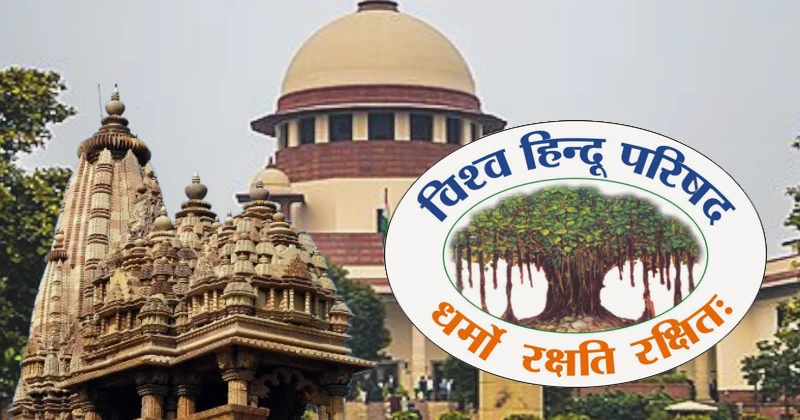
The Supreme Court of India has triggered a storm of anger among Hindu groups after Chief Justice B R Gavai, while dismissing a petition seeking restoration of a beheaded seven-foot murti of Bhagwan Vishnu at Khajuraho’s Javari Mandir, sarcastically told the petitioner to “ask the deity itself” for the repair. The Vishva Hindu Parishad (VHP) has come down heavily on the CJI, calling the remarks an insult to Hindu faith and evidence of a disturbing pattern of judicial mockery directed at India’s majority religion.
परसों सर्वोच्च न्यायालय में खजुराहो के प्रसिद्ध जावरी मंदिर में स्थित भगवान विष्णु की खंडित मूर्ति की मरम्मत के लिए याचिका की सुनवाई थी। सुनवाई के दौरान मुख्य न्यायाधीश ने मौखिक टिप्पणी की, मूर्ति की मरम्मत के लिए भगवान से ही प्रार्थना कीजिए। आप कहते हैं कि आप भगवान विष्णु के…
— Vishva Hindu Parishad -VHP (@VHPDigital) September 18, 2025
On September 16 2025, the petition filed by Rakesh Dalal, a devotee of Bhagwan Vishnu, came up before a bench headed by CJI B. R. Gavai. Dalal pleaded for restoration of the mutilated murti of Bhagwan Vishnu at the Javari Mandir in Khajuraho, Madhya Pradesh, arguing that the murti’s desecration during Mughal invasions was not only a matter of archaeology but also a matter of faith and dignity for Hindus.
The petitioner pointed out that despite repeated representations to authorities, the murti remained unrestored. The Archaeological Survey of India (ASI) had earlier replied that conservation rules barred the replacement of the beheaded murti.
What the devotee expected from the apex court was clarity either a direction to authorities or a reasoned dismissal. Instead, CJI Gavai stunned the petitioner by remarking:
“Go and ask the deity now. You say you are a staunch devotee of Bhagwan Vishnu, so go and pray now.” The court ultimately refused to intervene, ruling that the matter was under ASI’s jurisdiction and not a fundamental rights issue. The VHP reacted sharply to the CJI’s remarks. Alok Kumar, President of VHP, minced no words:
“The court is the Mandir of justice. Indian society places immense faith in its courts. It is our collective duty to strengthen this trust. But when the Chief Justice mocks a devotee’s faith, it shakes that confidence. This remark was unnecessary, hurtful, and avoidable.”
Alok Kumar stressed that while restraint is demanded from lawyers and litigants inside the court, judges must also exercise the same responsibility, “Especially in matters of faith, courts must show sensitivity. A devotee seeking restoration of a desecrated murti deserves dignity, not ridicule. Such comments wound Hindu society deeply.”
The Khajuraho Vishnu murti case has reignited a broader debate about judicial bias against Hindu traditions. Hindu organisations argue that courts have repeatedly intervened in, redefined, or outright dismissed Hindu beliefs, while showing excessive caution and deference when it comes to other religions.
Some key flashpoints include:
- Shirur Mutt Case (1954): Opened doors for state control of Hindu Mandirs and institutions.
- Sabarimala Verdict (2018): Struck down centuries-old traditions at the Ayyappa Mandir, despite massive opposition from devotees.
- Judicial micro-management of Hindu festivals: From fixing the height of Dahi-Handi to limiting the sound levels of Hindu processions, courts have repeatedly “rationalised” Hindu practices.
Now, in 2025, the nation has witnessed the Chief Justice himself mocking a Hindu devotee by telling him to ask his God to repair the murti—something Hindu leaders argue would never have been said to members of any other community.
Critics of the CJI’s remarks argue that such judicial sarcasm reflects a deeper “selective secularism” in Indian courts. They ask would a Muslim petitioner seeking restoration of a mosque or Dargah have been told to “go ask Allah” to rebuild it?
Hindu groups have also drawn parallels with the Ayodhya Ram Janmabhoomi case, questioning whether the judiciary would have dared to dismiss the Muslim side by asking them to rely on divine intervention rather than the courts.
For Hindus, the mutilated murti of Bhagwan Vishnu at Khajuraho is not merely an archaeological artefact but a living reminder of centuries of Mandir desecrations during invasions. The refusal to restore it, compounded by the court’s sarcastic remark, has left many Hindus feeling that their faith is treated as expendable in the corridors of justice. The VHP has asserted that the murti must be restored not only to protect the sanctity of the Mandir but also to heal the civilisational wound left by historical desecration.
Issuing a stern warning, Alok Kumar said that such judicial conduct risks alienating the Hindu majority from the judiciary itself, “Hindus have never demanded special treatment, only equal treatment. If the Mandir of justice itself ridicules Hindu faith, how can trust in the judiciary remain? The CJI’s words have crossed a line. We hope this insensitivity will not be repeated.”













Comments