





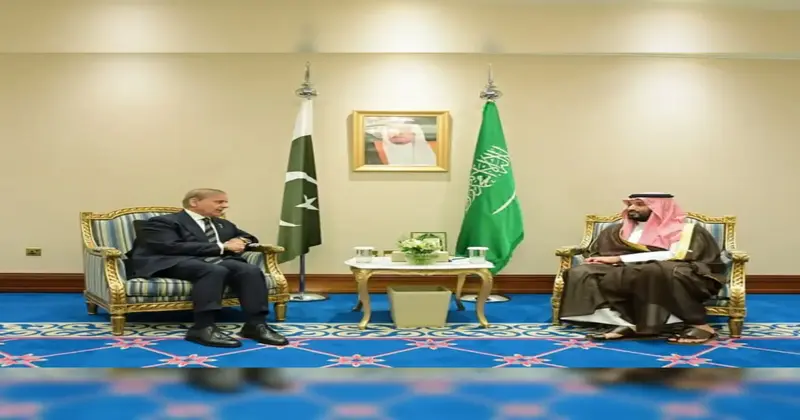
The latest defence pact inked between Pakistan and Saudi Arabia is making headlines in India and has stimulated a serious debate regarding the implications of the defence deal for India. Officially called as the Strategic Mutual Defence Agreement, the deal aims at bolstering defence cooperation between Islamabad and Saudi Arabia. “This agreement aims to develop aspects of defence cooperation between the two countries and strengthen joint deterrence against any aggression”, read the joint statement.
However, a key element in the deal that is triggering debate in India is, Pakistan and Saudi Arabia have acknowledged that ‘an attack on either country will be treated as an attack on both’. Another critical factor is that as per the agreement, Pakistan’s nuclear arsenal is will be available for Saudi Arabia for its defence whenever required.
The defence agreement is also signed at a crucial geopolitical juncture, when more than 40 Islamic states are aligned in Doha, Qatar to discuss on the implications of Israeli attack on Hamas establishments in Qatar. The Summit is said to discuss the prospects of strengthening the regional security architecture in the wake spiking geopolitical turbulence. Interestingly, Pakistan is the only nuclear-equipped Islamic state.
With respect to India, given this crux of the defence pact, will the deal be detrimental to India’s security interests in the region. Will the deal be a pine in India’s counter-terrorism efforts against Pakistan? Or apparently the deal in itself is a trap for Pakistan to fulfill the security and strategic interests of Saudi Arabia?
Strengthening the security architecture of West Asia
Pakistan and Saudi Arabia have a long standing defence relationship. Pakistan being the only Islamic state to have furnished nuclear capabilities, its proximity to Iran and due to increasing fragile security domain of West Asia, Saudi Arabia deems Pakistan as a defence partner to bolster the security architecture of West Asia. Meanwhile, Islamabad sees itself as a security partner to protect the holy Islamic sites of Mecca and Medina in Saudi Arabia.
Most importantly, Saudi Arabia sees Pakistan as a catalyst to contain the nuclear capabilities of Iran given Islamabad’s geographical proximity to Tehran. Apprehension about Iran’s nuclear potential is spiraling day-by-day with spiking levels of uranium enrichment. Riyadh has also repeatedly asserted that it would pursue with developing a nuclear weapon if Iran possess it.
Saudi Arabia’s latest defence pact with Pakistan comes in this background, where Riyadh seeks to strengthen the security architecture and strategic deterrence of West Asia amidst spiking geopolitical threats and uncertainties.
Saudi has access to Pakistan’s nukes, a strategic win or trap?
As per the defence deal, Saudi Arabia has unconditional access to the nuclear arsenals of Pakistan that can be used for Riyadh’s defensive purposes. Here, comes the real catch. If suppose, Saudi Arabia uses Pakistan’s nuclear arsenals against Iran or its proxies such as Houthis in Yemen, then Pakistan will be under the scanner of Iran. At such a circumstance, Pakistan will have to confront a multi-front threat-from India, Iran and Taliban Afghanistan.
Also, by rendering unhindered nuclear access to Saudi Arabia, Pakistan can come under the global scanner and scrutiny amidst conflicting global power politics played by the USA, China and other powers in West Asia. Because apparently, Islamabad has antithetical deals with every country and are accountable to everyone be it in terms of nuclear deals, infrastructure projects or financial assistance!
Thus, the defence agreement with Saudi Arabia can be a hiccup and traps for Pakistan and not a strategic win as deemed by it. Pakistan has to particularly be answerable to the US, as it is predominantly the American nuclear arsenals that is been parked in Pakistan. Can it be used by Saudi Arabia for defensive purposes, is again a big question, given the developments in West Asia and decreasing dependence and apprehension of West Asia regarding US as a credible security partner.
Will Saudi Arabia back Pakistan in case of a conflict with India?
The most critical question is, as per the defence pact between Pakistan and Saudi Arabia, “aggression against one is considered as an aggression against both the countries”. In that case, will Riyadh back Islamabad if there is an outbreak of Indo-Pak conflict? The answer is a firm no and the reasons are many.
- India’s military actions are precisely against terrorism
India never initiates or escalates an offensive attack. There will always be solid reason or evidence for India’s military actions. New Delhi’s defensive operations are always against cross-border and state-sponsored terrorism, in all its forms and manifestations. Meanwhile, India will never target civilian spaces or escalate a mindless attack. In this backdrop, Saudi Arabia cannot back or defend Pakistan against India’s counter-terrorism operations.
- India-Saudi Arabia counter-terrorism agreement
India and Saudi Arabia have signed a comprehensive, multi-faceted counter terrorism and cooperation agreement. As per the treaty, New Delhi and Saudi Arabia considers terrorism as one of the greatest threats to humanity and strongly condemns terrorism and extremism in all its forms and manifestations. Both nations have agreed that there cannot be any justification for any act of terror for any reason whatsoever and have also rejected any attempt to link terrorism to any particular race, religion or culture.
Infact, during the Pahalgam terror attack members of the Gulf Cooperation Council(GCC) including Saudi Arabia had strongly criticized the incident. Additionally, till date, Saudi Arabia has never defended Pakistan’s act of sponsoring terrorism. Thus, Saudi Arabia cannot and will not back Pakistan in case of a conflict with India.
- Enduring India-Saudi Arabia strategic partnership
India and Saudi Arabia also has a long-standing and enduring strategic partnership across multiple domains. India is Saudi Arabia’s second largest trading partner and Saudi Arabia is India’s 5th largest trading partner, with bilateral trade standing at USD 42.98 billion.
Saudi is also India’s third largest source of crude oil, accounting for 14.3% of crude imports. Riyadh is also India’s third largest LPG supplier accounting for 18.2%. India-Saudi Arabia MoUs encompass, defence, culture, tourism, health, energy, technology, space and other strategic sectors.
A senior official of Saudi Arabia has also said that “Our relationship with India is more robust than it has ever been. We will continue to grow this relationship and seek to contribute to regional peace whichever way we can.”
Thus, India-Saudi Arabia shares deep and comprehensive bilateral relations that are too vital to be broken down by a defence pact with Pakistan. And there can be no scope for apprehension regarding Saudi Arabia’s support to Pakistan in case of an attack on India or if India strikes a counter-offensive attack on Pakistan. The defence pact is signed by Riyadh in view of strengthening the security architecture and strategic deterrence of West Asia. And, if the delicate balance falls off, the defence deal can indeed backfire on Pakistan instead of being a strategic win.
India is analyzing the implications of the deal: MEA
In its response to the Pakistan-Saudi Arabia defence deal, Ministry of External Affairs has asserted that it is analyzing the larger implications of the deal for the national and regional security. “The Government was aware that this development, which formalises a long-standing arrangement between the two countries, had been under consideration. We will study the implications of this development for our national security as well as for regional and global stability. The Government remains committed to protecting India’s national interests and ensuring comprehensive national security in all domains,” MEA spokesperson Randhir Jaiswal said.














Comments