





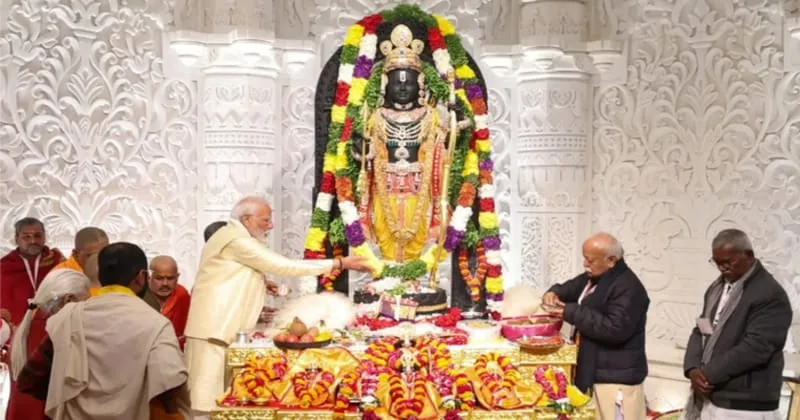
Prime Minister Narendra Modi celebrated his 75th birthday yesterday, on September 17, 2025. Since assuming office in 2014, he has taken several impactful decisions in the areas of economic policy, foreign affairs, and domestic governance. However, one of the most defining features of his leadership has been the revival of India’s religious and cultural identity.
Landmark events such as the construction of the Ram Janmabhoomi Mandir in Ayodhya, fulfilled after a 500-year wait, and the hoisting of a religious flag atop the Pavagadh hills after five centuries, have held deep significance for the Hindu community. These developments under PM Modi’s leadership have ignited a renewed sense of pride and cultural confidence among Hindus across India.
Initiatives such as the revitalisation of the Kashi Vishwanath Mandir, the construction of the Mahakal Lok corridor in Ujjain, and the development of the Kamakhya Shakti Peetha in Assam have infused these important Hindu pilgrimage sites with a renewed sense of identity and grandeur. Consequently, these sites have witnessed a significant surge in the number of pilgrims, reflecting their growing spiritual and cultural importance.
While the long and arduous journey to build the Ram Mandir in Ayodhya is well known to most Hindus, the lesser-known struggle surrounding the Kali Mata Mandir in Pavagadh, Gujarat, remains largely untold. This ancient temple, considered a Shakti Peeth, was desecrated in the 15th century by Abul Fath Nasir-ud-Din Mahmud Shah I, more commonly known as Mahmud Begada. He was the sixth Sultan of Gujarat, who ascended the throne at the young age of 13 and went on to rule for 52 years.
Between 1459 and 1511 AD, Mahmud Begada led multiple military campaigns against various kingdoms. After securing victories, he often compelled the defeated rulers to convert to Islam, and those who refused reportedly faced execution. Following his conquests of Junagadh and Pavagadh, Begada desecrated prominent Hindu Mandirs, including the Mahakali Mandir and the temple in Dwarka, acts seen as efforts to demoralise Hindus and pressure them into abandoning their faith.
Recognition of the Ancient Mandir
The Mahakali Mandir atop Pavagadh Hill holds deep religious significance for Hindus. According to legend, Sage Vishwamitra performed intense penance here to seek the blessings of Maa Kali. It is also believed that the sons of Bhagwan Ram and Maa Sita attained salvation at this sacred site. Centuries ago, the Mandirs spire was demolished by a Sultan, who constructed a dargah in its place. After 500 years, the Mandir was finally restored to its former glory, and on June 18, 2022, Prime Minister Narendra Modi hoisted a religious flag at the site, marking a historic moment of revival and reverence.
The Rise of Spirituality: From Gujarat to Somnath
Under the leadership of Prime Minister Narendra Modi, there has been a significant revival of India’s spiritual and cultural heritage. One of the key initiatives is the Chardham Highway Project, aimed at providing all-weather connectivity to the four sacred Hindu pilgrimage sites, Kedarnath, Badrinath, Yamunotri, and Gangotri in Uttarakhand. Following the devastating natural disaster in Kedarnath in 2013, the Modi government prioritised the Mandirs restoration, bringing it back to life with enhanced infrastructure and spiritual significance.
In J&K, after the abrogation of Article 370, the government began the redevelopment of several Hindu religious sites, including the historic Shankaracharya Mandir and important Shakti Peethas, reinforcing their spiritual and cultural prominence in the region.
To integrate ancient Indian wisdom into modern education, the Modi government introduced the Indian Knowledge System (IKS) in universities and IITs. This initiative incorporates teachings from the Vedas, Upanishads, Yoga, and Ayurveda into academic curricula, fostering a deeper connection with India’s intellectual and spiritual legacy.
Additionally, infrastructural upgrades have been carried out at key cultural and religious centres associated with the Ramayana and PM Modi’s cultural vision, such as Ayodhya, Chitrakoot, Hampi, and Kurukshetra, further cementing their place in India’s spiritual narrative.
Over the past decade, Prime Minister Modi has played a pivotal role in rekindling India’s cultural soul. His tenure has not only led to the restoration of historic Hindu sites but also empowered millions of Hindus to embrace their cultural and religious identity with a renewed sense of pride and confidence. PM Modi’s influence extends beyond political leadership, he has become a symbol of civilisational resurgence for a nation reconnecting with its ancient roots.














Comments