





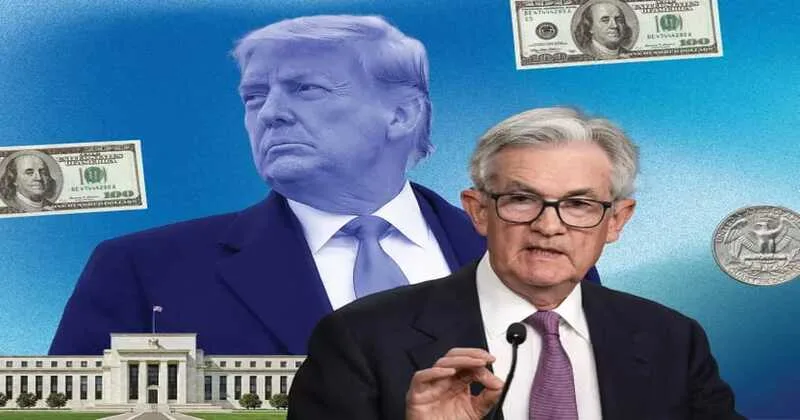
The US central bank, the Federal Reserve, has lowered its benchmark interest rate by a quarter of a percentage point, the first such cut this year. Federal Reserve Chairman Jerome Powell, announcing the decision, said that two further reductions would follow before the end of 2025. With this, the interest rate has been reduced from 4.25-4.50 percent to 4.00-4.25 percent. The move marks a significant shift in US monetary policy after a long pause, with the Fed having left rates unchanged since December while weighing the effects of immigration, tax changes, and other economic policies introduced under President Donald Trump.
Fed’s first cut signals relief amid jobs crisis, markets react uneasily
Markets responded with uncertainty. The Dow Jones Industrial Average initially surged by 410 points, or 0.9 percent, to touch a new all-time high, but the gains quickly evaporated and the index fell back into negative territory. The S&P 500 opened with a modest gain of 0.1 percent before slipping 0.5 percent, while the Nasdaq extended losses from 0.3 percent to 0.9 percent. The mixed reaction underscored investor anxiety about the broader state of the US economy and the limits of interest rate cuts in resolving deep-seated challenges.
BREAKING: 🇺🇸 The Federal Reserve has officially CUT interest rates by 25 basis points in their first rate cut of 2025.#Powell #FOMC #Fed #InterestRates #US pic.twitter.com/Nuyd6V5GIj
— The Market Journal (@MarketJournalX) September 17, 2025
The Federal Reserve said the rate cut was a temporary measure to cushion the economy from a worsening jobs crisis and broader signs of weakness. Powell stressed that the move was not the beginning of a new era of permanent monetary easing but a response to ‘economic shocks’ that have gripped the United States in recent months. The sharp rise in unemployment has been the driving factor behind the decision, with job losses spreading across manufacturing, technology, and services. The cuts are also expected to ease borrowing costs on auto loans, personal loans, student debt, and credit cards, providing some relief to households facing mounting financial pressure.
The Fed indicated that the easing cycle would continue, with two additional cuts planned for 2025 and one more scheduled for 2026. If implemented as outlined, the federal funds rate could fall to at least 3.5 percent by the end of next year, marking a substantial reversal after a long period of elevated rates designed to tame inflation. This new trajectory has already begun to reshape currency and commodity markets, highlighting the far-reaching global implications of US monetary policy.
Dollar slides and bond yields drop as investors reassess US assets
The immediate impact was felt on the dollar. The US dollar index, which tracks the greenback against six major global currencies including the euro, yen, and pound, plunged to a 43-month low of 96.30. The fall reflected investor concerns that lower rates would diminish the appeal of US assets, particularly government bonds, and prompt a reallocation of capital abroad. The dollar’s weakness is seen as a potential boon for emerging economies such as India, where a stronger rupee could attract foreign investment and provide relief against imported inflation.
Bond markets also shifted sharply. The yield on the benchmark 10-year Treasury note slipped from 4.05 percent to 4.03 percent, extending a decline from 4.8 percent in January when Trump took office. Falling yields indicate that investors expect weaker returns from US government securities, a development that could accelerate capital outflows and further weaken the dollar. Lower yields, however, also reduce the cost of borrowing for the US government, even as deficits continue to rise.
Why Trump pushing for a weaker dollar
The interest rate decision passed the Federal Open Market Committee by an overwhelming majority of 11–1. The lone dissenting vote came from Stephen Miran, a Trump appointee to the Federal Reserve Board and a trusted presidential adviser. Miran argued for a steeper cut of half a percentage point, reflecting the administration’s push for a weaker dollar to stimulate exports and protect domestic industry. Miran, who also chairs the administration’s Council of Economic Advisers, has emerged as a key architect of what insiders call the ‘Mar-a-Lago Accord,’ a proposal to coordinate with other countries in lowering the dollar’s value.
Trump has been outspoken in his criticism of Powell, accusing the Fed of keeping rates unnecessarily high and choking growth. He has repeatedly pressed for aggressive cuts to support his broader economic strategy, which includes tariffs, tax reforms, and attempts to renegotiate global trade arrangements. For Trump, a weaker dollar is not just monetary policy but a political priority, tied directly to his promise of reviving American manufacturing and reducing trade deficits. He argues that a strong dollar makes US exports uncompetitive, drives factory closures, and worsens job losses.
Economists remain divided over the merits of Trump’s approach. Kenneth Rogoff, a former chief economist at the International Monetary Fund and now a professor at Harvard, has described the plan as flawed. While acknowledging that a strong dollar can weigh on exports, Rogoff points out that the currency’s role as the world’s dominant reserve asset means demand is driven largely by foreign appetite for safe US government bonds, not simply by trade flows. In his view, the persistent US trade deficit is less a reflection of the exchange rate and more the result of chronic overspending and low savings, exacerbated by large government deficits.
Rogoff also warns that strong investment opportunities in the US attract foreign capital, which boosts demand for the dollar regardless of whether policymakers want it weaker. Attempts to artificially suppress the currency could trigger trade wars, invite retaliation from other economies, and ultimately fail to address the structural imbalances at the heart of the US economy. He adds that even if the dollar were to fall, manufacturing jobs would not necessarily return in large numbers because automation and technological change have permanently altered industrial employment.
The debate highlights a fundamental tension between political goals and economic realities. Trump and his advisers view the dollar as a lever for restoring America’s industrial base, while critics argue that only comprehensive reforms in spending, savings, and investment can deliver lasting change. For now, the Fed’s rate cuts may provide temporary relief to consumers and investors, but they cannot by themselves reverse decades of structural shifts in the global economy.
The dollar’s decline, gold’s surge, and the mixed performance of equities all point to a world still unsure about the direction of the US economy under Trump’s leadership. As the year progresses, attention will focus on whether the Fed continues to resist political pressure or bows further to the administration’s demands. Powell has insisted that the central bank will remain guided by data and its dual mandate of promoting stable prices and maximum employment. Yet with unemployment rising and political pressure mounting, the line between independent policymaking and presidential influence is becoming increasingly blurred. The coming months will reveal whether Trump’s push for a weaker dollar is a bold reset of economic policy or a gamble that leaves America more vulnerable in an uncertain world.














Comments