





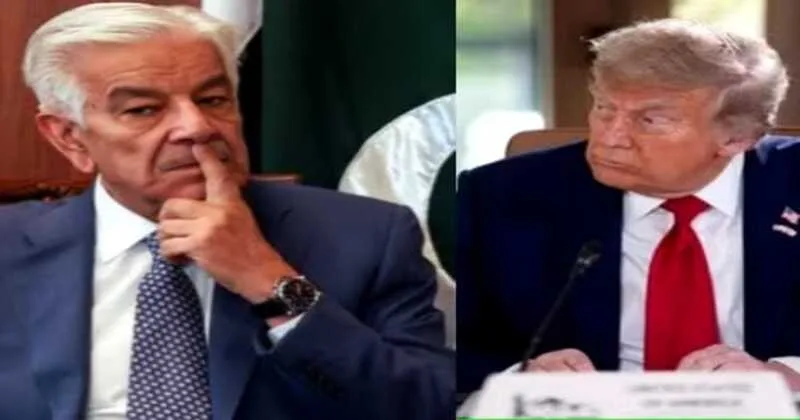
Pakistan’s Defence Minister Khawaja Asif has sparked controversy as Prime Minister Shahbaz Sharif and Army Chief Asim Munir prepare to meet US President Donald Trump later this month. The uproar follows remarks made by Khawaja Asif during a televised interview, where he claimed that US politicians openly accept bribes from Israel and added that he would do the same if required.
In the same interview, Asif criticised ongoing Israeli strikes on Gaza and suggested that Islamic nations should come together to form a military alliance similar to NATO. He further stated that Pakistan was being unfairly defamed for corruption while politicians in the United States continued to accept bribes from Israel without consequence.
The defence minister’s comments come at a time when he faces growing allegations of corruption at home. Earlier, he had alleged on social media platform X that top officials were moving black money from Pakistan to Portugal. Reiterating this line, Asif said the country was being maligned for corruption while practices of bribery by foreign politicians went unchallenged. His remarks were made during a conversation with journalist Shahzeb Khanzada on Geo TV.
Meanwhile, reports suggest that Prime Minister Shahbaz Sharif and Army Chief Asim Munir are scheduled to meet Donald Trump on the sidelines of the United Nations General Assembly on September 25. The agenda is expected to include discussions ranging from the devastating floods in Pakistan to the Israeli strikes on Qatar, though no official confirmation of the meeting has yet been released. Diplomatic tensions with India are also likely to figure in the dialogue.
At the same time, Israel has sharply criticised Pakistan for its stance on recent Middle East conflicts. Responding to Pakistan’s condemnation of Israeli strikes in Qatar, Israel’s representative at the United Nations Security Council lashed out at Islamabad.
The Israeli envoy said Pakistan could not change the fact that it had harboured Al-Qaeda leader Osama bin Laden, who was ultimately killed there by US forces. He added that Pakistan’s protests over Israeli cross-border operations rang hollow in light of its own record.
The envoy drew parallels between the Hamas attack of October 7 and the 9/11 terror strikes in the United States. He argued that when bin Laden was killed, the world did not question the US decision to target a terrorist on foreign soil but instead asked why Pakistan had provided him sanctuary. He further stated that Hamas, like bin Laden, would not be protected.
The diplomatic exchange has added to already strained relations, with Pakistan under pressure both at home and abroad as it navigates corruption scandals, regional conflicts, and high-level meetings on the global stage.











Comments