





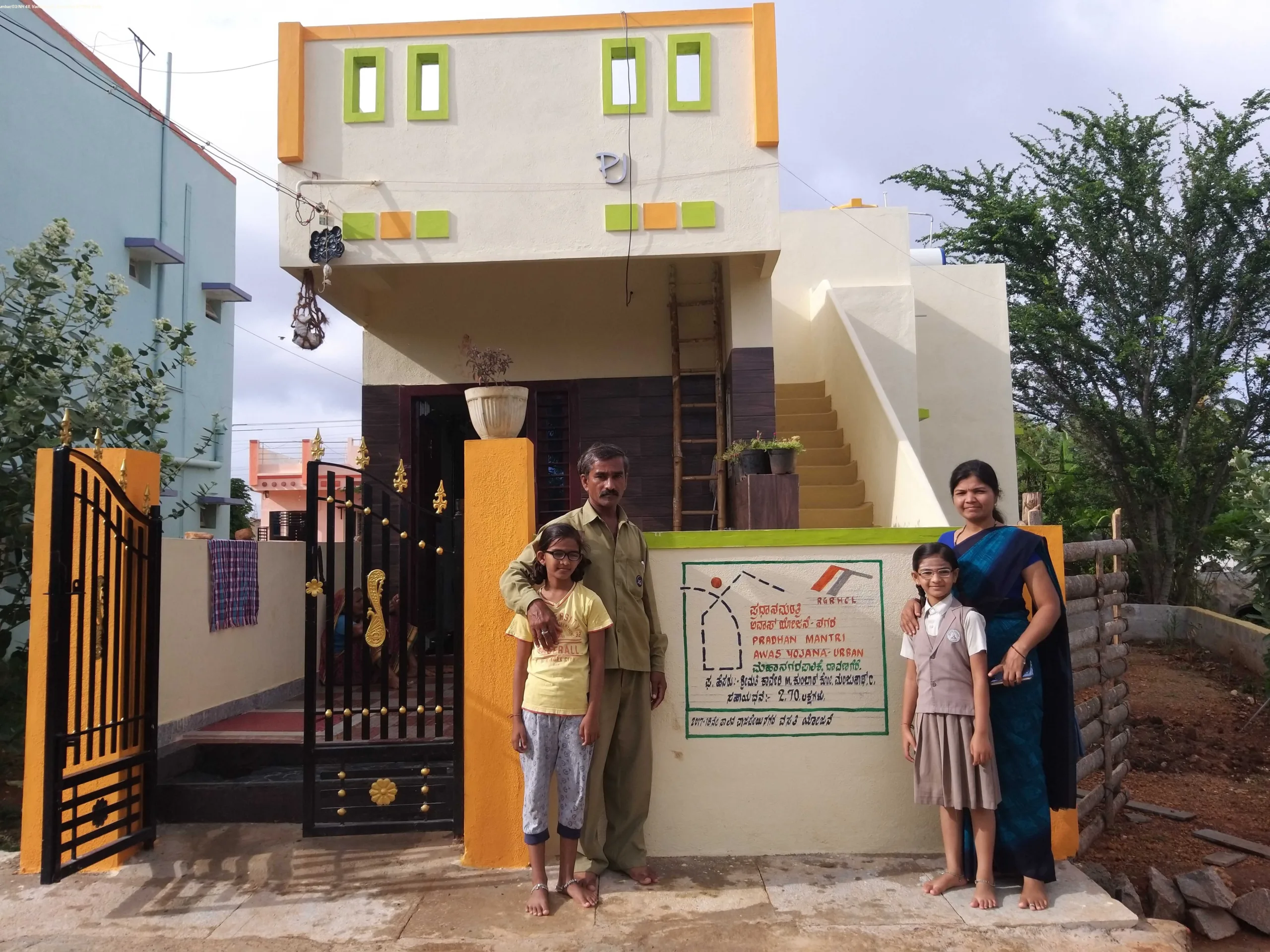
Since its inception, the Pradhan Mantri Awas Yojana, Urban (PMAY-U), has been India’s flagship mission to achieve “Housing for All.” Over the years, millions of low and middle-income urban families have received assistance to build or purchase pucca homes. However, persistent challenges remained, including backlogs in application processing, delays in construction, incomplete houses, and limited awareness among eligible beneficiaries.
To plug these gaps, the government launched PMAY-Urban 2.0 in September 2024, with a bold target of providing an additional 1 crore urban families with financial support of up to Rs 2.5 lakh each. This revamped version places a sharper focus on vulnerable groups such as slum dwellers, street vendors, artisans, and marginalised communities, ensuring that equity and inclusion remain at the heart of the mission.
To further accelerate progress, the Ministry of Housing & Urban Affairs has rolled out Angikaar 2025, a nationwide last-mile outreach campaign running from September 4 to October 31, 2025. The campaign relies on door-to-door drives, housing camps, and community mobilisation across more than 5,000 Urban Local Bodies (ULBs).
It also emphasises on-the-spot verification, document checks, and geo-tagging to minimise delays, while help desks and information kiosks are raising awareness among beneficiaries. Importantly, the campaign integrates with related schemes such as Surya Ghar: Muft Bijli Yojana to ensure that houses are not just built, but equipped with basic amenities like electricity.
A major highlight of the campaign is PMAY-U Awas Diwas on September 17, 2025, which marks one year of PMAY-U 2.0. To complement this, the government has launched the PM Awas Mela, Shehri, running from 17 to 27 September, where citizens can access loan melas, spot registration, and detailed information about scheme benefits.
On the ground, the results are already becoming visible. At a recent Central Sanctioning & Monitoring Committee meeting, 1.47 lakh additional pucca houses were approved across 14 states and UTs, taking the total sanctioned under PMAY-U 2.0 to 8.56 lakh homes. Special focus has been placed on marginalised communities, with 32,551 houses earmarked for Scheduled Castes (SCs), 5,025 for Scheduled Tribes (STs), and 58,375 for Other Backwards Classes (OBCs). Officials note that Angikaar 2025 is designed to clear verification backlogs, fast-track construction, and ensure pending homes reach completion without further delay.
Beyond the numbers, PMAY-U 2.0 and Angikaar 2025 are positioned to deliver more than just shelter. Affordable housing reduces dependence on unsafe or informal dwellings, while convergence with allied schemes ensures improved access to electricity, sanitation, and clean water. Prioritisation of women and marginalised groups also signals the scheme’s role as a driver of social equity, not just infrastructure delivery.
Yet challenges remain. However, a caution remains that ULBs and state bodies must expand capacity to process applications efficiently. Ensuring the quality of construction while racing against deadlines is another hurdle.
Reaching underserved urban pockets, especially informal settlements, requires sustained effort, as does managing infrastructure support like water supply and roads alongside housing. The bigger concern is sustaining momentum beyond the October 2025 campaign window to prevent a return of earlier delays.
Looking ahead, the government’s aggressive outreach under Angikaar 2025 reflects a determination to translate policy into real, measurable outcomes. By blending financial assistance, grassroots mobilisation, and digital tools like geo-tagging, the campaign seeks to make India’s urban housing framework more transparent, inclusive, and efficient.
If implemented successfully, PMAY-U 2.0 and Angikaar 2025 could mark a decisive leap toward realising the promise of Housing for All, not merely as a policy slogan, but as a lived reality for millions of Indian families.
















Comments