





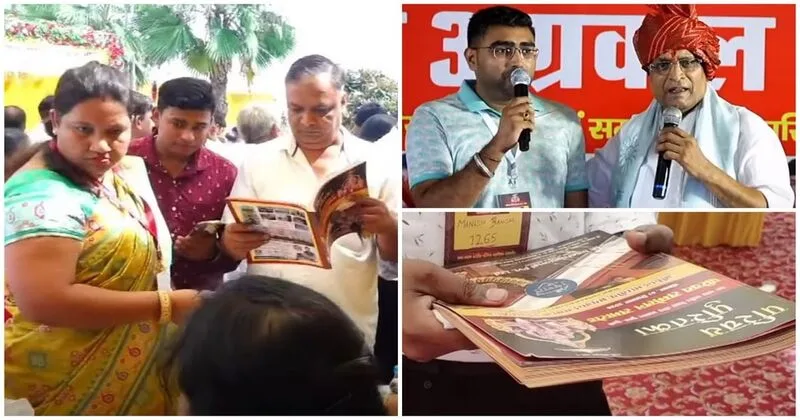
Nirmala stood in silence, tears tracing down her cheeks. Beside her, her son Himanshu and her husband stood quietly, each trying to hold themselves together. The family had journeyed from Narnaul in Haryana to Jind, holding on to a single, fragile hope: that the Aggarwal Sammelan might finally bring a bride for Himanshu. In her hand, 50-year-old Nirmala clutched a worn booklet, its pages filled with names, photographs, and biodata. But once again, they were heading home, just the three of them, hearts weighed down by disappointment, still without a bride.
“We have everything,” Nirmala said, fighting back tears. “His father earns Rs 20,000 a month, and my son makes Rs 40,000. We live comfortably. Still, I don’t understand why no one wants to marry him. He’s already 30. We’re worn out. Coming here was our last hope.”
Nirmala’s pain was shared by many. On September 7, hundreds of families, mothers, fathers, hopeful sons and daughters, gathered at Shri Shyam Garden in Jind for the North India-level Parichay Sammelan (Introduction Gathering), organised by the All India Aggarwal Samaj, Haryana. From 10 am to 5 pm, participants scanned the crowd, united by a single dream: to find the perfect bahu, damaad, or life partner. Over 1,500 eligible candidates arrived from 17 states and even abroad, all searching for ‘the one.’
The event, typically held once every five years, was led by Raj Kumar Goyal, president of the Akhil Bhartiya Aggarwal Samaj-Haryana. Cabinet ministers Vijay Goel (Haryana) and Barinder Goel (Punjab) attended as chief guests, alongside Pradeep Mittal, national chairman of the Akhil Bhartiya Agrawal Sangathan.
In a country where dating apps are gradually replacing traditional family networks, one community is determined to uphold matchmaking based on age-old customs, albeit with a modern touch.
The Aggarwals, one of India’s most prosperous and influential communities, have long been synonymous with success in business, trade, and industry. With a population estimated at 5.6 million, they have built an extensive legacy of enterprise. According to the Hurun India Rich List 2025, the Aggarwal and Gupta surnames lead the pack, each boasting 12 of the country’s most valuable family-run businesses.
Yet, while business remains their stronghold, the marriage market is becoming a challenge. Delayed marriages are on the rise, and despite wealth, education, and progressive mindsets, finding suitable matches has grown increasingly difficult.
From banquet lawns and biodata booklets to bright stage introductions, the community is reshaping matchmaking, one sammelan at a time. At the heart of this movement are Raj Kumar Goyal and Pradeep Mittal, who aim not only to unite Aggarwals in marriage but also to revive the tradition of arranged marriages throughout India.
Despite its large scale, the Parichay Sammelan is guided by a simple philosophy: ‘self-service marriage hunting.’ For a registration fee of Rs 500, each candidate receives a booklet containing details of potential matches. If two families find a suitable match, they are free to take the next steps, without any middlemen involved. Instead, the ‘boy’ and ‘girl’ are encouraged to meet and chat over chai or poori-halwa from the buffet. Women typically arrive dressed in saris or suits, while men wear anything from tees to kurtas.
“This blend of tradition and modernity is what makes these Aggarwal sammelans unique. They appear both traditional and modern, patriarchal, yet flexible enough to allow individual choice and change. When we talk about change in India, it’s important to see it as a movement between tradition and modernity, creating a hybrid,” explained Shiv Visvanathan, professor at OP Jindal University in Sonipat, Haryana.
He noted that the sammelans are gaining popularity because they offer at least a semblance of choice, unlike the old system where the family’s eldest patriarch would make the match without question.
“With evolving occupations, increased migration, and more fragmented families, the idea of ‘my grandparents approved this marriage’ no longer carries the same weight, especially in today’s fast-changing, mobile world,” he added.















Comments