





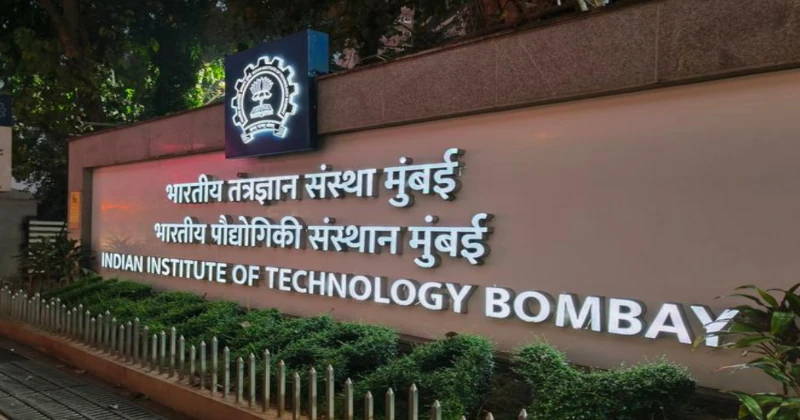
The storm over ideological bias in higher education has intensified after IIT Bombay’s Humanities and Social Sciences Department framed a controversial question on Hindutva in its PhD entrance examination. The question asked:
“What does Antonio Gramsci mean by hegemony? Is Hindutva, hegemony or counter-hegemony? Discuss.”
At first glance, the question appears to be a straightforward academic exercise, testing a candidate’s ability to apply Gramscian theory to contemporary Indian politics. But beneath the surface lies a deeper problem why is Hindutva, a civilisational movement rooted in India’s indigenous traditions, always positioned within Marxist frameworks of domination and power? Why don’t Indian academics have the courage to pose similar questions about the Catholic Church, the very institution that Gramsci himself excoriated in his writings as “the largest reactionary force in Italy”?
IIT Bombay humanities dept asks a leading question about Left’s intellectual icon Antonio Gramsci and Hindutva.
Read up on Gramsci’s views on the Catholic Church, prompted by a @AbhishBanerj post.
IIT Bombay must show guts to ask students what Gramsci wrote about the church👇🏼 https://t.co/OtyQP65EDi pic.twitter.com/aGb7cXMisx— Abhijit Majumder (@abhijitmajumder) September 15, 2025
This selective application of Western Marxist theory not only exposes an entrenched ideological bias in India’s elite institutions but also raises troubling questions about the weaponisation of academia against Hindu civilisational thought.
Antonio Gramsci, the Italian Marxist philosopher imprisoned by Mussolini’s fascist regime, remains one of the most influential thinkers in Leftist academic circles worldwide. His concept of cultural hegemony the idea that ruling classes secure dominance not merely through coercion but by shaping cultural norms and values—became a cornerstone of modern critical theory.
In Indian academia, Gramsci has become a staple of social sciences syllabi, invoked routinely to critique nationalism, religious traditions, and Hindutva. But rarely do professors or examiners confront students with what Gramsci actually wrote about the Catholic Church then the most powerful institution in Italy.
What Gramsci said about the church
In passages often ignored in Indian classrooms, Gramsci described the Vatican in scathing terms:
- “Many of these men embody the most ancient (and tested) traditions concerning the control of the masses—and, in consequence, constitute the largest reactionary force in Italy.”
- “Before attempting its coup, fascism had to reach an understanding with this powerful institution.”
- “The Vatican is an international enemy of the revolutionary proletariat.”
He even alleged that the Vatican demanded the rescue of the Bank of Rome, where Church funds were deposited, costing Italian taxpayers more than a billion lire.
For Gramsci, the Catholic Church was not merely a religious body it was an entrenched institution of power, reactionary by nature, and opposed to revolutionary change. If Indian academia is so invested in “applying Gramsci,” why is this blistering critique of the Church never subjected to the same intellectual spotlight that Hindutva routinely faces?
The IIT Bombay exam question reveals the double standards at play. Hindutva is always the preferred test subject, framed through the lens of Marxist critique as a hegemonic, oppressive force. But a more balanced engagement with Gramsci would have allowed candidates to ask: could Hindutva in fact represent counter-hegemony?
Unlike the Vatican, Hindutva was not born as a tool of the ruling class. It emerged as a civilisational response to centuries of colonial humiliation, cultural erasure, and intellectual dominance. Far from consolidating elite power, it challenged entrenched hegemonies whether colonial, missionary, or Marxist.
When seen this way, Hindutva fits more as a counter-hegemonic movement, asserting indigenous narratives against alien frameworks. But the structure of the IIT Bombay question leaves little room for such interpretation. In a screening examination, it effectively filters candidates by ideology, privileging those who parrot Left-liberal critiques and sidelining those who approach Hindutva from a perspective of civilisational affirmation.
The IIT Bombay episode is not an isolated incident it reflects a larger malaise in Indian higher education. For decades, humanities departments across the country have been dominated by Marxist-Leninist frameworks, where Western thinkers like Marx, Gramsci, and Foucault are deployed selectively to interrogate Indian traditions while sparing scrutiny of global institutions of power.
When it comes to Hindutva, every concept from hegemony to fascism is applied freely. But when it comes to the Catholic Church, the Vatican, or even global Islamism, the same frameworks suddenly disappear. This selectivity reveals not intellectual courage but ideological cowardice.
If academia truly values free inquiry, it should have the guts to ask: “How do Gramsci’s views on the Vatican compare with the role of religious institutions in the modern world?” or “Could Hindutva represent a form of counter-hegemony against colonial and Marxist domination?” But these questions are carefully avoided, lest they break the ideological monopoly that has long dominated social sciences in India.













Comments