





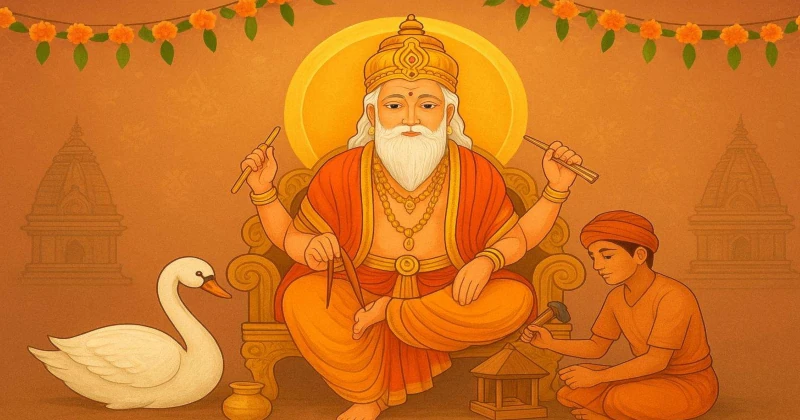
The festival of Vishwakarma Puja 2025, dedicated to Bhagwan Vishwakarma the divine architect of the universe and patron deity of artisans, engineers, and craftsmen was celebrated across India and Nepal with devotion and grandeur on September 17. Marking the Kanya Sankranti, which coincides with the last day of the Hindu month of Bhadra, the observance witnessed prayers, rituals, and cultural programs across factories, industrial hubs, workshops, and workplaces.
Bhagwan Vishwakarma, revered as the son of Brahma and the creator of celestial cities and divine weapons, is celebrated as the symbol of innovation, technical skill, and creativity. According to Hindu scriptures, he is credited with constructing Dwarka for Bhagwan Krishna, Indraprastha for the Pandavas, Sudamapuri, Swargaloka, and even the golden Lanka of Ravana. His craftsmanship is further reflected in divine weapons such as Vishnu’s Sudarshan Chakra, Shiva’s Trishul, Kartikeya’s spear, and Indra’s Vajra.
On this occasion, devotees across industries—from mechanics, smiths, welders, carpenters, and artisans to engineers, architects, and factory workers—paid tribute to their tools, machinery, and instruments, acknowledging them as embodiments of Shakti (divine power). Temporary shrines were set up in workplaces where rituals were conducted, and prasada was distributed among workers.
The festival holds particular importance in industrial regions of eastern and northern India, as well as in West Bengal, Odisha, Jharkhand, Bihar, Uttar Pradesh, and parts of the North East. In Nepal, Vishwakarma Puja is observed as a full public holiday, whereas in India it is recognised as a restricted holiday in several states.
Scholars highlight that the celebration carries timeless lessons for modern life. Vishwakarma’s coordination with various deities in celestial constructions is seen as an early example of project management, planning, and teamwork. His life’s work teaches that innovation, discipline, and efficiency, when combined with devotion, lead not only to physical creations but also to social and cultural progress.
Beyond its religious significance, Vishwakarma Puja states India’s cultural appreciation of labour, craftsmanship, and innovation. From shop floors to engineering institutions, the festival is seen as an occasion to inspire youth towards skill development, creativity, and entrepreneurship.
As workplaces were decorated and workers prayed for safety, success, and better productivity, the festival once again highlighted the continuing relevance of Bhagwan Vishwakarma in an era dominated by science and technology. He remains not only a religious figure but also a symbol of knowledge, technical expertise, and innovation.










Comments