





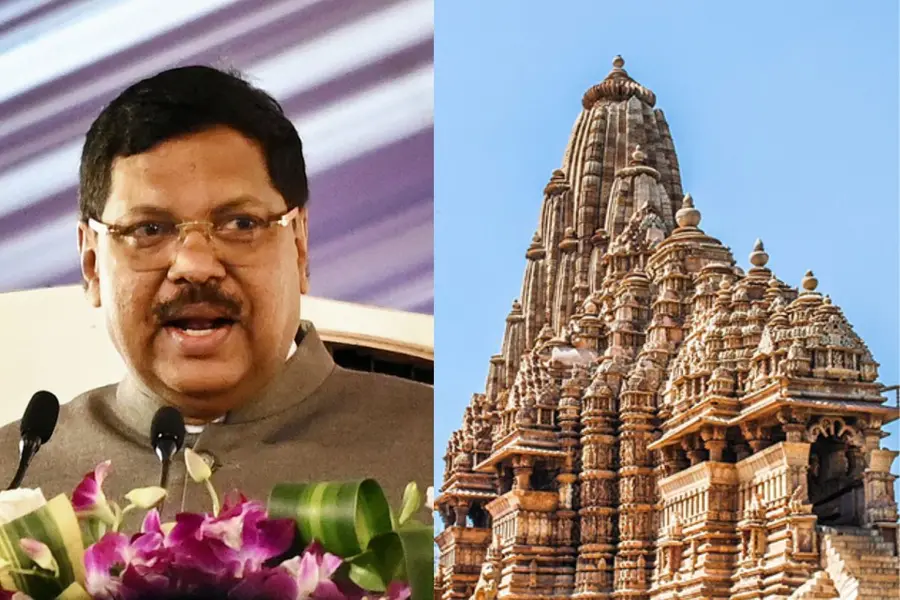
The Supreme Court on September 16 declined to hear a petition seeking reconstruction and reinstallation of a seven-foot beheaded idol of Bhagwan Vishnu at the historic Javari Temple, part of the UNESCO World Heritage Khajuraho group of monuments in Madhya Pradesh.
A bench of Chief Justice of India (CJI) B.R. Gavai and Justice Augustine George Masih held that the matter fell under the jurisdiction of the Archaeological Survey of India (ASI), not the court.
“Go and ask the deity itself to do something now. You say you are a staunch devotee of Lord Vishnu. So go and pray now. It’s an archaeological site and ASI needs to give permission etc. Sorry,” CJI Gavai told petitioner Rakesh Dalal.
“It’s an archaeological find, whether the ASI would permit such a thing to be done or not… there are various issues. In the meantime, if you are not averse to Shaivism, you can go and worship there – there is a very big linga of Shiva, one of the biggest in Khajuraho,” the court added.
The petition, filed by Dalal, sought directions for the replacement, reconstruction, and consecration of the mutilated idol at the Javari Temple in Chhatarpur district. The plea stated that the idol was destroyed during Mughal invasions and has remained in a damaged condition despite multiple representations to authorities, including the ASI and state government.
The petitioner had sought the relief for directions for ” replacement/ reconstruction/ rejuvenation of the idol of the Lord Vishnu and install/ consecrate the same at the Javeri temple, Khajuraho, Chhatarpur District, Madhya Pradesh in place of the headless 7-foot-long Idol of Lord Vishnu”
The petitioner argued that the refusal to restore the idol violated devotees’ fundamental right to worship under Article 25 of the Constitution. He also pointed out that repeated protests, memoranda, and campaigns over decades had yielded no response.
The Khajuraho temples, built by the Chandravanshi kings between the 9th and 12th centuries, are globally recognised for their intricate architecture and spiritual significance. The plea alleged that colonial-era neglect and post-independence apathy had left many idols, including the Javari temple’s Vishnu murti, in a state of ruin — even 77 years after independence.
The bench’s comments, telling the petitioner to “go and pray” instead of seeking judicial remedy, sparked immediate backlash from devotees, advocates, and religious organisations.
Eminent lawyer Vineet Jindal, identifying himself as a follower of Sanatan Dharma, wrote to the Supreme Court expressing deep anguish over what he termed “inappropriate, insensitive and disrespectful” remarks.
In his submission, Jindal said: “While the court has every right not to entertain a petition, it must exercise its discretion without hurting religious sentiments. The words ‘Go and ask the deity himself to do something’ have caused immense hurt and anguish to millions of Hindu devotees.”
He further argued that Article 25 guarantees freedom of religion, which includes respect for the faith of Hindus, and urged the court to reconsider and withdraw the remarks “in the interest of national religious harmony and judicial dignity.”
The case has reignited a stormy debate over judicial restraint, constitutional secularism, and the need for sensitivity towards religious faith. While legal experts acknowledge that the ASI is the competent authority to decide on archaeological restoration. By telling the petitioner to “go and pray to the deity,” the bench’s response has been widely condemned as insensitive and dismissive of the faith of millions of Hindus who revere the Khajuraho temples as sacred spaces.
Religious leaders and devotees argue that such language not only trivialises centuries of trauma endured through temple desecrations but also risks delegitimising Hindu beliefs in a court of law. For them, this was not simply a question of heritage management but of restoring dignity to a living deity whose mutilation remains a painful reminder of historical injustice.
Several Hindu groups have amplified demands for stronger protections of temples and idols, pointing out that while other faiths often receive judicial sensitivity in matters of belief, Hindu petitions are too easily brushed aside. They contend that rectifying centuries-old desecrations is not a matter of publicity but a legitimate question of cultural justice and civilisational continuity.












Comments