





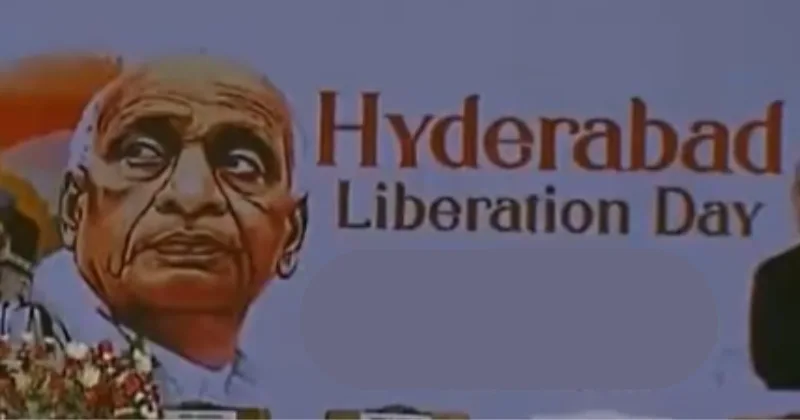
September 17 marks a historic chapter in the story of Hyderabad a region that today spans Telangana, parts of Karnataka’s Kalyana Karnataka, and Maharashtra’s Marathwada. It was the day when the erstwhile princely state of Hyderabad was freed from the clutches of the Nizam and his tyrannical rule.
And yet, every year, instead of unanimous remembrance, the date sparks a heated debate in Telangana.
● The BRS calls it “National Integration Day”. Ironically, during the Telangana agitation, the party president K. Chandrashekar Rao promised to officially commemorate it as “Hyderabad Liberation Day.” Once in power, however, it shifted its stance a move widely seen as appeasement of certain vote banks.
● The Congress labeled it “Prajapalana Dinotsavam” .
● The AIMIM, as expected, deliberately avoids using the word “liberation.”
● The Bharatiya Janata Party frames it as “Hyderabad Liberation Day” and the Central Government officially commemorates it under the same name.
This raises a pressing question: What is the right way to remember September 17
Life Under the Nizam – A Forgotten History
To understand the weight of September 17, we must revisit the reality of people under the Nizam, who was presiding Hyderabad State, one of the largest princely states in India. But beneath the grandeur of palaces and pearls lay a deeply oppressive system. The Hindu majority faced systemic discrimination. Their culture, language, and religious freedoms were suppressed.
When the independence movement swept across India, Hyderabad remained an island of feudalism. The Nizam, bolstered by his militia the Razakars, led by Qasim Razvi unleashed a reign of terror on those who dared to question his rule. Villages were burned, Hindu men were slaughtered, Women were raped, and fear became a way of life. For the Hindu community, Hyderabad was like a prison.
Integration v. Liberation – The Play of Semantics:
At the center of today’s debate is the battle of two words: Integration and Liberation.
Integration literally means the act of merging two or more entities into a unified whole. At a purely administrative level, this could describe Hyderabad’s accession to India. The Nizam did eventually sign the Instrument of Accession, formally merging with the Indian Union.
But framing September 17 merely as “integration” strips away the blood-soaked reality of how that accession came about. It reduces a turbulent history to paperwork. It risks whitewashing the atrocities of the Razakar terror and the oppression endured by millions.
Liberation, by contrast, means freeing someone from oppression, control, or tyranny. And that is exactly what Operation Polo achieved. Hyderabad did not glide into the Union of India on its own accord; it was freed from a despotic ruler who refused to respect the aspirations of his people.
Those who push the “integration” narrative often argue that the Nizam joined legally by signing an instrument of accession. But why did he sign at all? Was it a peaceful decision? Clearly not.
As V.P. Menon documents in The Story of the Integration of the Indian States, Qasim Razvi once threatened: “If the Indian Dominion comes to Hyderabad, it will find nothing but the bones and ashes of one and a half crore Hindus.” This was not the language of consent it was the language of terror.
It was only through Operation Polo, a five-day military action launched by the Indian Army in September 13-17, 1948, that the Nizam surrendered. For the people, those five days ended centuries of oppression. It was not integration they experienced, it was liberation.
Why Semantics Matter:
Some dismiss this debate as “just semantics.” But words are not mere decoration; they shape how history is remembered. To call September 17 “Integration Day” is to reduce a story of blood, sacrifice, and survival into a consensual merger. It is to erase the lived trauma of communities that suffered under the Nizam’s rule. It is also a deliberate act of political convenience a way to soften history, to avoid offending certain constituencies, and to whitewash uncomfortable truths.
To call it “Liberation Day,” however, is to honour that suffering. It recognizes that freedom did not come through paperwork but through sacrifice and struggle. It ensures that future generations know that Hyderabad’s story was different from India’s 1947 independence it was a struggle against internal tyranny, not just colonial rule.
Why the Words Matter Today:
More than 75 years later, the politics of naming September 17 still divides parties. But beyond party lines, what matters is how ordinary people remember their past. For the younger generation of Telangana and Hyderabad many of whom are unaware of the Razakar atrocities terminology is not a small matter. “Liberation” signals a story that demands to be remembered, a story of pain and courage that shaped this region. History must be told as it happened, not as it is convenient to recall.
The Final Word
Hyderabad’s merger with India was not a smooth administrative act of integration. It was a hard-won liberation, made possible by the Indian Army and by the resilience of ordinary people who endured unspeakable suffering.
On September 17, 1948, Hyderabad was freed from tyranny, oppression, and fear. That is why the day deserves to be remembered as Hyderabad Liberation Day.
Anything less is a distortion of history.
The author is final year law student in Hyderabad.












Comments