





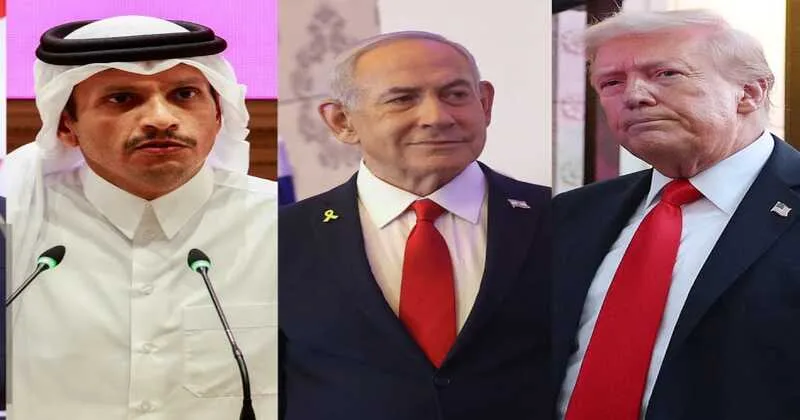
Israeli Prime Minister Benjamin Netanyahu has defended the recent airstrike on the Hamas political office in Qatar, describing it as an independent decision taken by Israel. He made these remarks in Jerusalem after meeting US Secretary of State Marco Rubio, who visited Israel following the September 9 strike in Doha. Netanyahu insisted that Israel alone bore responsibility for the action and rejected international criticism as unwarranted.
The Israeli air force targeted a building in the Qatari capital believed to be housing senior Hamas officials, an operation that killed six people. The strike drew condemnation from Gulf countries and concern from the United States, which maintains strong security and economic ties with Qatar. Nevertheless, Netanyahu argued that the attack was part of Israel’s broader campaign to dismantle Hamas terror networks across the region.
During a joint news conference with Secretary of State Rubio, Netanyahu linked the Doha strike with Israel’s ongoing operations in Gaza. He referred to Israel’s demolition of high-rise structures in Gaza City, which Israel claims are Hamas strongholds. According to him, the attacks were intended to weaken the militant group’s operational capabilities and to signal that no safe haven would be tolerated for organisations engaged in anti-Israeli violence.
Netanyahu further invoked earlier international precedents to justify Israel’s actions. He argued that no state could claim sovereignty while simultaneously sheltering groups that engage in acts of terrorism. He emphasised that Israel’s actions were directed at Hamas infrastructure and insisted that ordinary residents of Gaza were not the target. He urged the international community to recognise what he described as the need to prioritise the security of civilians by dismantling Hamas.
Washington caught between backing Israel and depending on Qatar
Secretary of State Rubio expressed solidarity with Israel during his meetings in Jerusalem, while also acknowledging the concerns raised by Gulf countries. Rubio stressed that the focus should now shift to the future, particularly to the release of hostages and the humanitarian situation in Gaza. He stated that Gaza’s long-term prospects could only improve once Hamas was removed from power. He also highlighted Iran’s role in supporting Hamas, framing it as a threat not only to Israel but also to the wider region, Europe, and the United States. Rubio underlined Washington’s commitment to sustaining pressure on Tehran until its support for Hamas is withdrawn.
At the same time, the United States continues to back Qatar’s role as a mediator in the Gaza conflict. Rubio said he would encourage Doha to play a constructive role in negotiations, noting Qatar’s longstanding position as an interlocutor in talks between Israel, Hamas, and other regional actors. Reports suggested that Rubio may travel to Doha after his visit to Israel to meet Qatari officials, with discussions expected to focus on the aftermath of the strike and the broader Gaza conflict.
The Doha airstrike has complicated regional diplomacy. An emergency Arab-Islamic summit was convened in Qatar under the chairmanship of Prime Minister and Foreign Minister Sheikh Mohammed bin Abdulrahman bin Jassim Al Thani. The meeting, attended by members of the Arab League and the Organisation of Islamic Cooperation, strongly criticised Israel’s actions and warned of further instability if the conflict escalates.
Meanwhile, the condition of Hamas has deteriorated as Israeli operations intensify. The Israeli military has been advancing into Gaza City with the stated aim of bringing the entire territory under its control. Despite Israeli aircraft dropping leaflets urging civilians to evacuate, the majority of residents remain in place, citing the lack of safe alternatives. The coastal strip of Al-Mawasi in southern Gaza, designated by Israel as a humanitarian refuge, is already overflowing with displaced people. United Nations agencies estimate that only one in ten residents of Gaza City have managed to evacuate since Israel began its push a month earlier.
US faces strategic crossroads in Israel–Qatar standoff
The strike in Doha also prompted a rare public rebuke from US President Donald Trump. Speaking at Morristown Airport in New Jersey, Trump urged Netanyahu to act with greater caution when dealing with Qatar, describing the Gulf nation as a key American ally. He underlined that Israel’s operations against Hamas were justified but warned that striking inside Qatar carried significant risks for US regional partnerships.
Trump’s remarks came just days after hosting Qatari Prime Minister Sheikh Mohammed bin Abdulrahman Al Thani for a private dinner. The American president described the Qatari leader in positive terms and encouraged Qatar to strengthen its public diplomacy efforts to counter international criticism. Trump’s careful balancing act highlighted Washington’s challenge in supporting Israel’s security operations while safeguarding relations with Doha, which hosts the largest US military base in the Gulf.
The convergence of these developments points to heightened geopolitical tensions in the Middle East. Israel remains committed to its campaign to dismantle Hamas, expanding its military actions both in Gaza and beyond. The United States, while continuing to back Israel, has sought to temper its ally’s actions to avoid jeopardising relations with Qatar. At the same time, Gulf and Arab states have rallied behind Qatar in condemning Israel’s strike, underscoring the deep regional divisions over the conflict.











Comments