





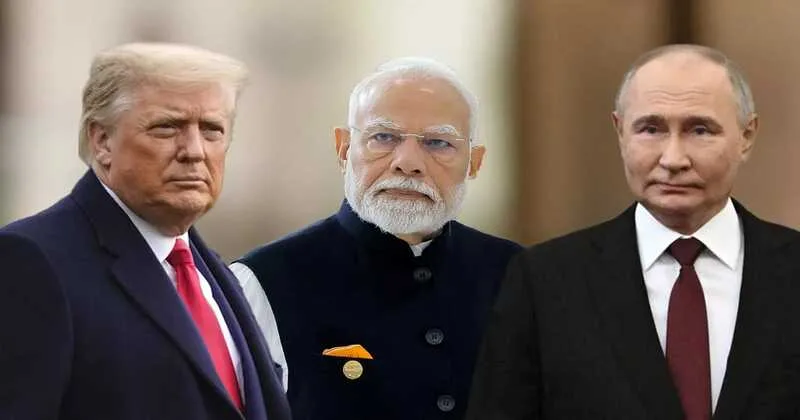
In a three-pronged development on the global stage, Russia has reiterated its unwavering friendship with India, US President Donald Trump has admitted that mediating the Russia-Ukraine conflict is proving more difficult than he had earlier projected, and Washington is moving to revive stalled trade negotiations with New Delhi. Together, these episodes underline India’s central position in the international order, where it is both a steadfast partner to Moscow and an indispensable player in Washington’s economic calculus.
Russia’s Assurances on India Ties
The Russian Foreign Ministry has firmly dismissed any attempts by external powers to disrupt its long-standing relationship with India, declaring that such efforts are bound to fail. In a statement issued to the state-run media outlet RT, the ministry welcomed New Delhi’s approach of sustaining cooperation with Moscow despite what it described as “pressures and threats” from the Western world.
“India-Russia relations are progressing steadily and confidently, and any attempt to disrupt this process will fail,” the ministry asserted. It highlighted India’s continued commitment to multilateral cooperation with Russia, reflecting what Moscow called the “spirit and tradition of long-standing friendship” between the two nations.
The statement outlined a broad range of ongoing joint projects that span critical sectors. These include civilian and defence collaborations, nuclear energy development, manned space missions, and significant Indian investments in Russian oil exploration. The two countries are also working closely to expand payment systems using national currencies and to create alternative transport and freight routes, initiatives described as long-term strategies, not reactive measures to current geopolitical tensions.
Russia also singled out India’s resilience against Western pressure to halt oil purchases from Moscow, praising New Delhi for standing firm in its sovereign decision-making. “India’s approach represents strategic autonomy in international affairs,” the ministry said, stressing that the partnership prioritises sovereignty, national interests, and durable diplomatic ties.
This reassertion of solidarity comes at a time when the US President Trump has been pressing countries, including India, to mirror Washington’s tariffs and sanctions on Russia, particularly on oil imports. Yet India has remained committed to maintaining its energy links with Moscow, reinforcing what Russia calls a “trust-based, long-term partnership.”
Trump Softens Tone on Ukraine Mediation
Meanwhile, US President Donald Trump has signalled a softening of his earlier assertive claims about swiftly ending the Russia-Ukraine war. Speaking to the media, Trump admitted that the conflict between Russian President Vladimir Putin and Ukrainian President Volodymyr Zelensky was “very serious” and more complicated than he had anticipated.
“The feud between Zelensky and Putin is deep. They are suffocating with their mutual hostility. So they can’t even talk to each other,” Trump remarked, acknowledging the limits of his ability to intervene. The statement marks a departure from his campaign promise, and subsequent post-inauguration insistence, that he could resolve the war within 24 hours of taking office.
Nine months into his presidency, Trump has made little progress on the matter, despite previously boasting, “I have ended seven wars. For me, ending the Russia-Ukraine war would be trivial.” His latest comments suggest a recalibration of expectations, both for the American public and for international partners observing Washington’s diplomatic manoeuvres.
Trump’s stance is particularly significant given his earlier demands that India and other nations cease buying Russian crude oil, which Washington argues helps sustain Moscow’s war effort. His administration even imposed a 25 percent tariff on India, later followed by a steeper 50 percent levy, in a bid to pressure New Delhi. However, those measures failed to compel India to shift its energy policy, underscoring the limits of Washington’s leverage in this domain.
Trade Talks Back on Track, Sixth Round of Trade Discussions in New Delhi
Despite tensions over tariffs and energy policy, there are now signs of renewed engagement between Washington and New Delhi on trade. After a prolonged freeze, bilateral negotiations are set to resume with the arrival of a high-level US delegation in Delhi.
Brendan Lynch, the chief US trade negotiator, will lead the American team, while Special Secretary in the Ministry of Commerce Rajesh Agarwal will represent India. This sixth round of discussions is seen as a breakthrough, being the first direct meeting since Washington imposed punitive tariffs on Indian exports.
The talks had originally been scheduled for August 25 but were postponed amid escalating disputes over oil purchases and tariff hikes. Last week, Trump hinted that progress was being made to address trade barriers with India, and Prime Minister Narendra Modi responded by describing the two countries as “natural partners.” The resumption of talks suggests both sides are keen to restore momentum and prevent disputes from overshadowing broader strategic cooperation.
Trump’s earlier tariff moves had cast a shadow over bilateral relations, especially after he coupled the duties with public criticism of India’s Russian oil imports. Nevertheless, Washington’s willingness to re-engage signals a recognition of India’s indispensable role in global trade, supply chains, and strategic partnerships. For New Delhi, reopening the talks offers an opportunity to balance its ties with both Washington and Moscow while safeguarding its economic and strategic autonomy.
Together, these developments underscore the complex but resilient role India plays in global geopolitics. Russia’s endorsement of the bilateral partnership, Trump’s recalibrated rhetoric on Ukraine, and the revival of India-US trade talks all point to the same conclusion that New Delhi’s choices carry weight well beyond its borders.
For Russia, India is a dependable partner whose cooperation spans critical sectors and provides ballast against Western isolation efforts. For the United States, India remains a pivotal trade and strategic partner, even amid differences on Russia. And for India itself, maintaining autonomy while nurturing long-term relationships with both powers remains the cornerstone of its foreign policy.













Comments