





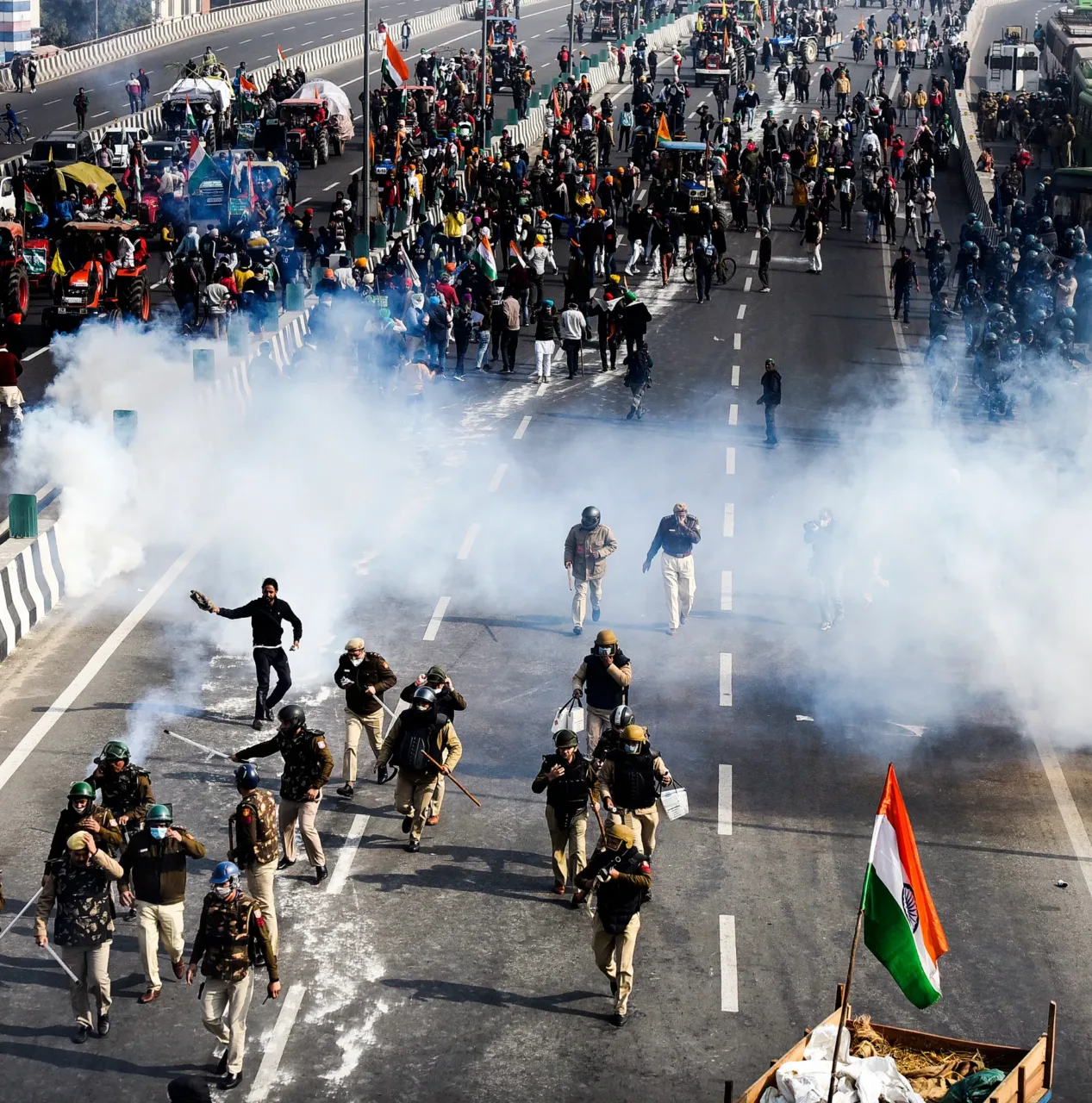
At the National Security Strategies Conference 2025 in New Delhi, Union Home Minister Amit Shah reportedly called on the Bureau of Police Research and Development (BPR&D) to undertake a comprehensive study of major protests in India since Independence, with a special focus on the period after 1974.
The exercise, he stressed, should not only examine the causes behind these agitations but also identify the networks that financed them, the political or social objectives they achieved, and the hidden forces that orchestrated them. The findings, Shah noted, would ultimately form the foundation for drafting a Standard Operating Procedure (SOP) to prevent future agitations that may be “driven by vested interests.”
Why 1974 became a historical marker
The idea of governments studying unrest is not entirely new, but Amit Shah’s emphasis on protests after 1974 is deeply significant. That year marks the beginning of one of the most defining chapters in independent India’s political journey, the JP Movement. Led by Jayaprakash Narayan, what began as a student agitation in Bihar quickly transformed into a nationwide call for accountability, morality in public life, and an end to authoritarian excesses.
The Indira Gandhi government’s response to this mass mobilisation exposed the darkest face of India’s democracy. Instead of engaging with dissent, Indira Gandhi declared the Emergency in 1975, suspending civil liberties, jailing opposition leaders, silencing the press, and weaponising state machinery against citizens. It was a period that left deep scars on India’s democratic fabric. Families of political activists still recount the trauma of those 21 months when basic freedoms were snatched away, and India was pushed into a state of undeclared dictatorship.
By narrowing the study to the post-1974 timeline, Shah has chosen to focus on the era when mass movements began reshaping the very character of Indian politics. It was after the Emergency that India realised both the potential and perils of mass mobilisation. On one hand, it showed how collective protest could challenge authoritarianism and restore democracy; on the other, it also revealed how powerful forces could misuse such mobilisations for political destabilisation.
Subsequent decades only reinforced this reality. The Mandal Commission protests of the 1990s redefined caste equations and unleashed social churn that continues to shape electoral politics. The anti-corruption movement of 2011, fuelled by widespread anger against scams, shook the foundations of the ruling establishment and eventually paved the way for the rise of Narendra Modi at the national stage. More recently, the farmers’ protests of 2020-21 tested the government’s ability to handle long-drawn agitations, amplified by misinformation and international interference.
Many argue that Shah’s decision is strategic, but it is also historically logical. The post-1974 era represents a phase when protests stopped being isolated, localised expressions of anger and started becoming instruments capable of altering national politics. For a government committed to safeguarding democracy, studying these movements is not about stifling dissent, but about learning how to distinguish genuine public grievances from orchestrated disruptions driven by vested interests.
In many ways, Shah’s directive is also a reminder of why the Emergency must never be forgotten. It serves as a warning against unchecked power and underscores the importance of building robust safeguards that ensure India’s democracy remains strong, resilient, and responsive. By revisiting this timeline, the Modi government is not only analysing the past but also protecting the future from the mistakes of authoritarian regimes like Indira Gandhi’s.
Multi-agency involvement in the study
The scale of the task makes it unlikely that the BPR&D will act alone. Instead, a range of agencies will contribute to the study. State police forces will dig into case files and provide historical records of protests. Financial watchdogs such as the Enforcement Directorate, Financial Intelligence Unit, and Central Board of Direct Taxes will trace the flow of funds linked to major agitations. Agencies like the National Investigation Agency, Border Security Force, and Narcotics Control Bureau will analyse overlaps between protests, extremism, infiltration, and organised crime.
This multi-agency approach shows the government’s view that mass protests today are not merely issues of public order but also matters of national security.
The common spark behind protests
Protests in India, past and present, often follow a familiar script. They emerge from long-standing grievances, corruption, unemployment, or inequality, before being triggered by a single event such as the 2G scam, fee hikes, or the introduction of farm laws. Once triggered, these grievances are amplified through heavy funding, coordinated misinformation campaigns, and, in today’s age, the viral power of social media.
India’s experience is not isolated. In neighbouring Nepal, the Gen-Z anger that erupted in 2024 after the government banned social media apps was not merely organic; it was fuelled by external actors eager to exploit youth discontent. Similarly, in Bangladesh, protests over job reservations for freedom fighters families spiralled into chaos, with intelligence reports hinting at foreign-backed networks amplifying dissent. Sri Lanka too saw how one abrupt policy decision, forcing compulsory organic farming amid a collapsing economy, became the trigger for nationwide unrest, a situation worsened by vested international interests.
It is in this regional context that Amit Shah’s emphasis on carefully studying India’s protest culture becomes sharper. Unlike India’s neighbours, where weak institutions and foreign meddling often drive instability, Bharat has remained resilient. Yet, the Congress’s troubling history cannot be ignored. Reports have repeatedly highlighted the party’s connections with China, with even senior Congress leaders admitting to a secret MoU signed between the INC and the Chinese Communist Party in 2008. Questions also persist about Rahul Gandhi’s frequent closed-door meetings with Chinese officials abroad, meetings shrouded in secrecy and never explained to the Indian public.
Notably, these covert interactions raise legitimate concerns about the possibility of external forces attempting to fuel domestic unrest in India through political conduits. For a government determined to safeguard India’s sovereignty, tracing the timeline of protests since the mid-1970s is not just academic; it is strategic. It allows a deeper understanding of how mass mobilisations, when exploited by vested interests, can threaten democratic institutions.
Why India absorbs protests differently
Yet, unlike its neighbours, India’s democracy has not collapsed under the weight of recurring protests. This resilience is attributed to multiple factors. Electoral legitimacy ensures that governments are regularly renewed with popular mandates, as demonstrated by record voter turnouts such as 67 percent in 2019.
Strong institutions like the Election Commission, the Supreme Court, and the Comptroller and Auditor General act as safety valves, channelling dissent into constitutional frameworks.
Federalism and the presence of powerful regional parties allow citizens to vent anger locally, reducing the risk of nationwide instability.
Between 2009 and 2019 alone, India witnessed more than 20,000 protests, yet the democratic system absorbed them without regime collapse. Protests, therefore, have disrupted governance at times but rarely destabilised the state itself.
Criticism over selectivity and political motives
The proposed study has already attracted criticism from political analysts. Speaking to media, Abhay Dubey, a scholar formerly associated with the Centre for the Study of Developing Societies (CSDS), argued that the project risked being selective in scope. “The BJP and RSS believe there are too many protests in India and claim protest is not part of Indian tradition. They want to curb protests by identifying which kinds could threaten them. But movements like the Ram Janmabhoomi agitation, which suits them politically, will be conveniently excluded,” Dubey was quoted as saying.
The government’s dual objective
For the government, the exercise serves two simultaneous purposes. At one level, it is about drawing lessons from history to shield Bharat from future turmoil, especially at a time when global geopolitics, digital media warfare, and cross-border interference make agitations harder to predict and easier to manufacture. The government recognises that not every protest is homegrown; some are deliberately fuelled with funding, misinformation, and international backing to weaken India’s stability.
At another level, the project sends out a clear political signal: to distinguish between genuine democratic dissent, which is an integral part of India’s ethos, and orchestrated disruptions designed to destabilise governance. By systematically studying protests since the 1970s, the state aims to ensure that India never slips into the dark phase of the Emergency again.
If the study succeeds, it will enhance the government’s ability to anticipate unrest, counter external meddling, and protect India’s democratic institutions. But if critics are to be believed, it risks being misinterpreted as curbing democratic space, ironically, a charge more befitting of the Congress era, when protests were silenced not by study but by state repression.
Balancing security and democratic freedoms
Ultimately, Amit Shah’s directive sits at a delicate intersection between national security and democratic freedoms. By revisiting decades of protest history, the government hopes to guard against instability while facing a new era of unpredictable mobilisation.
The true test, however, will lie not in the data collected but in how the findings are applied. India’s democracy has thrived because it could absorb and even benefit from protest movements, not because it silenced them.
Whether this study becomes a playbook for stability or a manual for control will determine its legacy in the years ahead.
(Views expressed are personal, the author holds a PhD in political communication from India Gandhi National Tribal University, Amarkantak)












Comments