





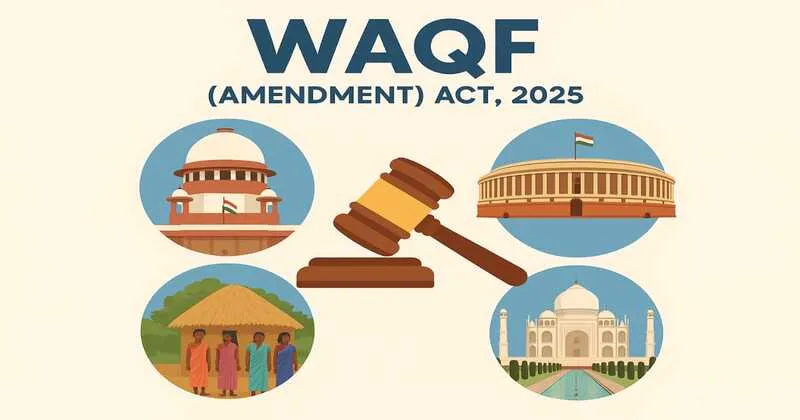
On September 15, 2025, the Supreme Court Bench led by Chief Justice BR Gavai and Justice AG Masih delivered a verdict that has shaken the foundations of decades of misuse. The Court, while safeguarding fairness, refused to derail the Waqf (Amendment) Act, 2025, thereby endorsing the NDA government’s bold strike against land mafias, encroachers, and opaque waqf dealings.
This judgment is a historic setback for vested interests that thrived on ambiguity and exploitation, and a decisive victory for the ordinary citizen whose public land, tribal resources, and national monuments are now better protected. For the BJP-led NDA, it is proof that courageous reforms in sensitive domains can withstand judicial scrutiny when rooted in constitutional principles and national interest.
While the petitions had challenged the constitutionality of the Act, the Bench struck a careful balance: it refused to suspend or strike down the core provisions of the reform while laying down safeguards to protect procedural fairness, third-party rights, and constitutional guarantees.
The ruling is not just a legal event. It is a political and governance landmark that validates the NDA government’s bold reformist move, led by the Bharatiya Janata Party (BJP) under the leadership of Prime Minister Narendra Modi, to bring transparency, accountability, and balance in the administration of waqf properties.
NDA’s Reformist Legislative Step
The Waqf Amendment Bill, 2025, enacted by the NDA government, was introduced to address longstanding concerns:
- Encroachments of public land through claims of “waqf by user.”
- Lack of financial accountability and opaque waqf administration.
- Endless litigation between citizens, governments, and waqf boards.
- Unregulated religious claims affecting protected monuments.
- Risks to tribal land and constitutional protections under the Fifth and Sixth Schedules.
The Amendment sought to modernise waqf governance while respecting religious freedoms, and to re-establish the principle that public interest must prevail over unchecked institutional powers.
The Supreme Court’s Verdict: Balanced but Firm
The Bench recognised the legitimacy of the NDA’s reformist intent while carefully setting out judicial safeguards.
Key Technical Findings: –
Section 3C (Correction of Records)
The Court upheld the power of authorities to correct revenue records when public or government land is wrongly shown as waqf.
However, it clarified that during such inquiries no dispossession of third parties or creation of new rights would be permitted.
This ensures administrative efficiency without violating property rights.
Section 3D (Protected Monuments)
The Court held that religious practices at protected monuments can continue, but only under the regulatory framework of the Ancient Monuments and Archaeological Sites and Remains Act, 1958.
This balances faith and heritage conservation, ensuring monuments remain part of Bharat’s cultural legacy.
Central Waqf Council Oversight
The expanded advisory role of the Central Waqf Council was upheld as secular and administrative, not theological.
Parliament was found to be within its rights to assign supervisory functions in the interest of transparency.
Tribal Land Safeguards
The Court endorsed the amendment’s protection of Scheduled Tribe lands, calling it a constitutionally valid step aligned with the Fifth and Sixth Schedules.
This prevents vulnerable communities from being dispossessed under expansive waqf claims.
Tribunals and Dispute Resolution
The Court allowed tribunal mechanisms to operate, noting that quicker, specialised adjudication serves both efficiency and justice.
Safeguards were imposed to ensure fair hearing and appeal rights are not diluted.
Why the Reform is in the Larger Interest of Bharat
1. Protection of Public Land:-Ensures government and public land cannot be arbitrarily declared waqf.
2. Transparency in Religious Endowments:- Stronger audits and registrations prevent misuse and channel resources toward genuine charity.
3. Empowerment of Tribals :- Protects tribal lands from encroachment, reinforcing constitutional guarantees.
4. Civilisational Heritage Protection:-Preserves monuments while permitting regulated religious practices.
5. Reduced Litigation :-Streamlined processes lessen burdens on courts and citizens.
Political and Governance Gains for NDA
Reformist Credentials: The NDA has shown that it can legislate bold reforms even on sensitive subjects.
Public Goodwill: Citizens benefit directly from protection of public land and transparent waqf governance.
Nationalist Narrative: The Act ties governance reform to the preservation of Bharat’s civilisational identity.
Inclusive Governance: By safeguarding tribal and marginalised interests, the NDA has reinforced its “Sabka Saath, Sabka Vikas” promise.
The Waqf Amendment Act, 2025, and the Supreme Court’s ruling on it, mark a historic moment in reformist governance. The Court’s technical clarifications ensure fairness, while the core reform remains intact.
The Waqf Amendment Act, 2025, and the Supreme Court’s verdict on it, represent a historic turning point in Bharat’s governance. For decades, loopholes in waqf administration were misused by encroachers and vested interests, leading to large-scale loss of public and tribal land. Under the visionary leadership of Prime Minister Narendra Modi ji, the BJP-led NDA government dared to confront this misuse head-on and brought in a reform that many previous governments never had the courage to touch.
The Supreme Court’s ruling has now vindicated this bold step. It affirms that in New India, public interest will always outweigh vested claims, transparency will replace opacity, and heritage will be preserved for future generations.
This is not just a legal victory. It is a civilisational correction and a political triumph. It shows that when reforms are guided by national interest, constitutional principles, and visionary leadership, they can withstand every challenge.
Ultimately, the verdict is a victory for Bharat under the transformative leadership of Prime Minister Narendra Modi ji, a victory for good governance, national integrity, and the future of a strong, self-confident India.
















Comments