





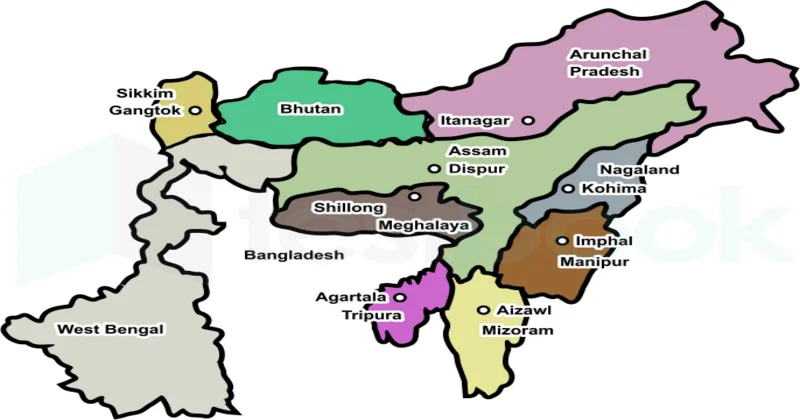
India is brewing a connectivity masterstroke in the Northeastern part with the goal of boosting the national security architecture. The decision comes amidst the altered geopolitical dynamics in Bangladesh since the takeover of the country’s administration by the interim government in 2024. With the new regime in power, anti-India sentiments are witnessed with changed geopolitical alignments. For example, enhanced bonhomie is witnessed between Dhaka and Islamabad. This is against the security interests of New Delhi as Pakistan can potentially exploit the fragile and comparatively porous Indo-Bangladesh border, to fulfill its anti-India goals.
The Chief Advisor of the Bangladesh interim government, Muhammad Yunus, had called out the Northeast India as “landlocked” while speaking from the Chinese soil and had asserted that Bangladesh is the only “guardian of the ocean” in the region. Thereby he had urged China to spike investments in Bangladesh as a boon to the entire region and to spur economic activity. If deemed as a reality, China’s Belt and Road Initiative(BRI) in India’s backyard is indeed a concern from India’s security perspective and strategic interests.
These statements are highly unreasonable and raise serious national security concerns for India, if foreign players root their foot in India’s backyard. India is thus, charting a path of strategic autonomy and is strengthening national security with solid and stupendous connectivity projects in the Northeast coupled with suspending the projects that were intended to connect the region via Bangladesh.
Ceasing multiple connectivity projects in Bangladesh
With Delhi-Dhaka bilateral relations hitting an all-time low and as an impact of the spiking anti-India sentiments, New Delhi has halted multiple multi-crore connectivity projects passing via Bangladesh. The total cost of the halted projects is esteemed at approximately Rs. 5,000 crores. This move by India is characterized as a sharp diplomatic response to growing anti-India rhetoric in Bangladesh.
- Akhaura-Agartala rail link
The halted connectivity projects include the flagship and ambitious Akhaura-Agartala rail link. The rail link was said to connect Akhaura in Bangladesh with Agartala in Tripura. The rail was said to traverse 5.46 km in India and 6.78 km in Bangladesh with the aim of propelling trade between the two countries. The total cost of the project stood at Rs. 972.52 crores with India bearing Rs. 708.73 crores.
However, with latest spine in India-Bangladesh relations, the project is halted since April 2025.
- Khulna-Mongla port rail line
This is a port connectivity project of Bangladesh with the developmental assistance from India. New Delhi gives a concessional line of credit of USD 388.92 million to this project, which is a 65 km broad-gauge railway line in Bangladesh that would connect the country’s second largest port Mongla port with the existing railway link in Khulna.
New Delhi has halted even this project and has cut down the developmental assistance to Bangladesh.
- Dhaka-Tongi-Joydebpur expansion project
This project is as well an India funded developmental initiative in Bangladesh with the aim of constructing two major bridges and 22 minor bridges/culverts. This rail link was aimed at increasing connectivity in central Bangladesh, in and around Dhaka. However, this project set to be completed by 2027, is now indefinitely halted since April, 2025 due to the geopolitical developments. As of now, only 35 per cent of the project is completed as the future of the rail link hangs in doldrums.
Totally, 8 large-scale connectivity projects were in calibration between India and Bangladesh. These infrastructure projects, once fully operational was said to render a massive momentum to the trade connectivity, mobility and people-to-people movement between both the countries. These projects would have significantly leveraged the economic prospects in the Northeastern India and Bangladesh. There would have been highly profitable economic traffic particularly for the Northeastern region with time and cost-effective connectivity through state-of-the-art railway links and ports.
Despite these merits, New Delhi decided to suspend all the projects as national security and territorial integrity is the apex priority beyond business boom. There are alternatives to reap the economic goals but there are no alternatives to the safety and security of the Indian officials and workers involved in the project and India’s backyard cannot be a platform to reap anti-India goals. With this strategic motive and calculation, India has suspended the developmental and connectivity projects.
Weaving alternative routes to reap the Northeast economy
Halting the connectivity projects in Bangladesh doesn’t mean there is a derailment in the developmental momentum of the Northeast India. New Delhi indeed has Plan B. Government is rapidly boosting the railway and other connectivity projects in the Northeast. It is ensured that during critical and unpredictable geopolitical scenarios Northeast doesn’t become isolated or their growth pace doesn’t be thwarted. In this direction, from both the security and economic perspective, India is strengthening the infrastructure in the 22km wide Siliguri Corridor, what is popularly called as the Chicken’s neck that connects Northeast with the rest of the India.
Efforts are underway to rapidly multiply the existing rail lines in Bihar and Uttar Pradesh that are key to connect the Siliguri corridor. It is also planned to further enhance the connectivity via Bhutan. Works are also underway to harness the Siliguri corridor as a robust, dual-use and swift logistics corridor.
The railway budget allocated to the Northeast has multiplied by fivefold since 2014 reaching a cumulative of Rss. 62,477 crores. Rs. 10, 440 crores have been allocated in the current financial year itself. Prime Minister Modi in his latest visit to the region just a couple of days ago, inaugurated Bairabi-Sairang broad gauge project. Built at a cost of Rs. 8,070 crore, the 51.38 km railway line has 45 tunnels, 55 major bridges, 87 minor bridges and 10 road over and underpass.
The Bairabi-Sairang railway line is said to be a game-changer in the Northeast connectivity goal, as the line for the maiden time since independence has connected Aizwal, capital of Mizoram to the national railway network. This will boost passenger convenience, improve fright movement and will open local markets for the local produces with easy and timely accessibility.
Prime Minister also flagged off three new train services connecting the Northeast with New Delhi, Kolkata and Guwahati. Meanwhile, Prime Minister also laid foundations for the new road and rail projects that will improve all weather connectivity, cost-effective and timely accessibility for the masses in the Northeast. Such solid infrastructure also helps India to ensure balance of power in South Asia along with shielding the Northeast from geopolitical volatilities.
Knee-drop to Bangladesh
India indeed is ascending with alternative projects to propel the connectivity and growth prospects of the Northeast. Challenges do exist, however India is marching with strategic autonomy and visionary infrastructure projects. Meanwhile, the halt of projects in Bangladesh, infact derails the connectivity and economic momentum of Bangladesh. Mongla project and Dhaka rail link would have been engines of growth for Bangladesh with increased port or market access. Thus, the halting of projects is a strategic jerk and developmental disguise for Bangladesh.
The political instability and a lapse in economic growth lately, further adds to the trouble-pile of Bangladesh. The future of the Indo-Bangladesh infrastructure projects and the larger diplomatic relations between New Delhi and Dhaka depends on the upcoming elections in Bangladesh scheduled for February 2026 as of now and also depends on the political affiliations of those who assumes the seat of power in Dhaka.
The ultimate message is, connectivity is the key to economic prosperity especially among neighbours who share the cultural and economic relations since centuries. However, such relations cannot be sprouted at the cost of strategic autonomy, national security and territorial integrity of India.
















Comments