





When the tricolor soared over Delhi on August 15, 1947, Hyderabad, the jewel in the crown of princely India, stood defiant. The Nizam, blinded by his immense wealth and intoxicated with feudal arrogance, refused to join the Union, plotting instead to carve out his own dominion while his Razakars terrorized common people with blood and intimidation.
Yet the danger to India’s unity did not come from the Nizam alone. From within, another force was gathering strength: the Communists, who, riding on the back of the Telangana peasant revolt, dreamed of turning Hyderabad into a “Red Republic.” By 1948, their armed squads had taken nearly 1,500 villages, set up shadow administrations, and openly challenged the Indian state’s sovereignty.
What began as a genuine uprising against bonded labour and feudal exploitation was hijacked by Communist ideology, transforming Telangana into a pawn in a far more sinister game where both the Nizam and the CPI, though sworn enemies, converged on one dangerous point: resisting Hyderabad’s liberation and its rightful place in a free and united India.
The Communist Vision: A Separate Hyderabad!
Unlike the Congress, which unequivocally demanded Hyderabad’s liberation into the Indian Union after Operation Polo in 1948, Communists split—some hailed liberation and others clung to a reckless fantasy of carving out a separate “people’s state.” Exploiting peasant unrest and the cracks in Hyderabad’s ties to India, the Communist Party of India (CPI) imagined the Nizam’s domain as a fertile breeding ground for their revolution. In this warped vision, an autonomous Hyderabad would serve as a Red laboratory, a so-called “people’s republic” within India, betraying the national cause and placing ideology above the historic necessity of true liberation.
Courting Stalin
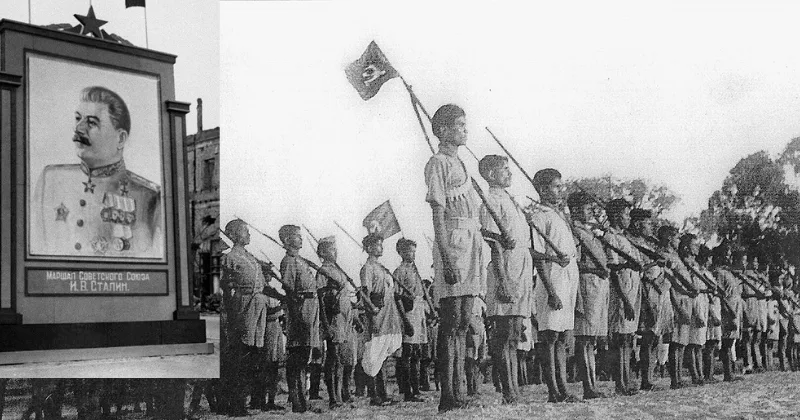
The CPI’s international loyalties were never a secret. Aligned ideologically with Moscow, Indian Communists looked to the Soviet Union for direction.
Historical records confirm that a CPI delegation, Ajoy Ghosh, S.A. Dange, C. Rajeswara Rao, and M. Basava Punnaiah, met Joseph Stalin and Soviet leaders in February 1951. The transcript, published by Revolutionary Democracy, reveals discussions on India’s revolutionary prospects and the Telangana struggle.
Yet, while Stalin offered strategic advice and criticized CPI’s errors, there is no evidence that he endorsed a “separate Hyderabad.” That claim seems to have emerged from Communist propaganda at the time—an attempt to inflate their international stature and justify their rebellion.
Opposing Operation Polo
The defining moment came in September 1948, when the Indian Army launched Operation Polo, a swift five-day campaign that ended the Nizam’s rule and integrated Hyderabad into the Indian Union. For the Congress and nationalists, this was a liberation. For the CPI, it was an “imperialist invasion.”
The Communists characterized Operation Polo not as a liberation but as a counter-revolutionary assault on the Telangana peasant movement, arguing that the Indian Army’s intervention was aimed at suppressing agrarian reforms and dismantling the parallel administrations established by village-level struggles. In effect, the Communists opposed India’s sovereignty and sided—albeit indirectly—with the Nizam by rejecting the Union’s action.
This stance exposed the CPI’s ideological blind spot: in their obsession with revolution, they failed to recognize the historic necessity of Hyderabad’s democratic integration into India.
Collapse of the Red Dream
Operation Polo not only smashed the Nizam’s autocratic defiance but also shattered the Communists’ dangerous illusion of carving out a “separate people’s state” on Indian soil. Their revolutionary gamble collapsed overnight as the Indian Army marched in, liberated Hyderabad, and ended centuries of feudal tyranny in just five days. With the Nizam’s humiliating surrender on September 18, 1948, both the Razakars’ terror was buried for good and the CPI’s reckless ambitions were wrecked—proving that India’s unity and sovereignty would not be held hostage to either autocrats or ideological adventurists.
Yet the CPI clung to its armed struggle until 1951. It was only after Stalin’s guidance, internal defeats, and growing isolation that the Communists formally withdrew the Telangana struggle.
The Communist Contradiction
By opposing Operation Polo, the Communists placed themselves against the tide of history. Instead of supporting India’s unification, they condemned it as “bourgeois aggression.” Instead of siding with the democratic aspirations of millions, they sought revolutionary experiments detached from national reality.
Their flirtation with Moscow and their misplaced opposition to Hyderabad’s integration remain a stark reminder: ideology, when blind to national interest, can turn liberation into betrayal.













Comments