





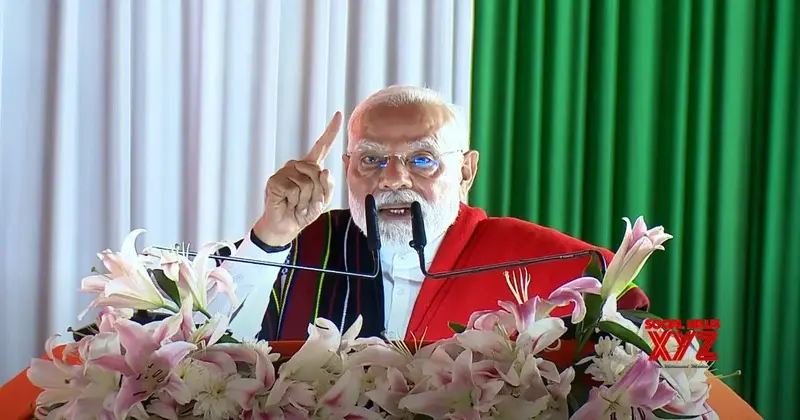
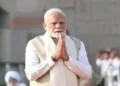
On September 13, 2025, as torrential rains battered Manipur’s rugged hills and valleys, Prime Minister Narendra Modi descended into the heart of a state scarred by over two years of ethnic bloodshed. It wasn’t just another political visit or token optics. Modi’s arrival in Churachandpur, the epicenter of Kuki unrest, was a deliberate act of symbolism and strength. For 1.5 hours, his convoy snaked through treacherous, mud-laden roads instead of taking a helicopter, signaling to Manipuris that he wasn’t there for comfort or spectacle. Former Chief Minister N. Biren Singh aptly described it as a “rare show of affection” for a state long neglected by Delhi’s political gaze.
But the true fireworks weren’t in the journey; they were in the speech. Modi’s 20-minute address to the rain-soaked crowd was a masterclass in nationalistic optics. He uttered the word “Manipur” 33 times once every 36 seconds. This wasn’t rhetorical filler. It was a carefully calculated strike at the heart of a separatist narrative that has sought to erase the very name of the state from Kuki strongholds like Churachandpur and Kangpokpi.
For years, Kuki leaders and civil society organizations have pushed for a separate administration, floating names like “Kukiland,” “Zogam” or “Lamka” to replace Churachandpur. Public spaces were systematically stripped of the word “Manipur”; buses had their signage altered, billboards erased and government installations vandalized to symbolically partition the state. Against this backdrop, Modi’s relentless invocation of “Manipur” was more than semantics; it was an ideological sledgehammer.
The context of conflict
To understand the potency of Modi’s words, we must rewind to May 3, 2023, when ethnic clashes erupted between the Meitei and Kuki communities. The immediate trigger was the eviction of illegal encroachers from state reserve forests and a crackdown on rampant poppy cultivation. What began as a land dispute quickly spiraled into full-blown ethnic violence, with over 200 dead, thousands displaced and villages razed to the ground.
Kuki leaders seized this chaos, amplifying calls for a separate Union Territory. Churachandpur was rechristened “Lamka” in official communications by CSOs like the Kuki Inpi Manipur (KIM). The Suspension of Operations (SoO) pact with militant groups became a sticking point because it contained a clause emphasizing “territorial integrity.” For separatists, even this phrasing was intolerable.
Modi’s decision to travel directly to Churachandpur was therefore a bold move. In a district where the very word “Manipur” had become taboo, the prime minister stood firm and declared, again and again, that the state was indivisible. His speech invoked Manipur’s courage, natural beauty and shared history. Most tellingly, he offered aid for reconstruction, pledging 7,000 new homes for internally displaced families.
But he never once mentioned “Lamka,” “Zogam,” or “Kukiland.” It was as if he was redrawing the map with his voice, reminding everyone that no matter the propaganda, Churachandpur was and remains part of Manipur.
Paolienlal Haokip and the separatist frustration
This direct challenge infuriated Kuki political elites. BJP MLA Paolienlal Haokip, a leading voice for Kuki-Zo separatist demands, called Modi’s visit a “wastage of public resources.” He blasted the Prime Minister for not spending “even 10 minutes” listening to their grievances. This, despite Kuki-Zo MLAs submitting memorandums demanding a separate Union Territory with its own legislature.
Haokip’s outrage was echoed by CSO leaders like Henlianthang Thanglet, who expected Modi to validate their separatist aspirations. Instead, they were forced to sit through a lecture on unity. Their frustration wasn’t just about being ignored; it was about being publicly undermined. Modi’s repeated invocation of Manipur was a subtle but powerful repudiation of their cause.
Even Congress leader Dr. Lamtingthang Haokip joined the chorus of criticism, accusing Modi of failing to provide a “healing touch.” But these critiques miss the larger point: Modi’s visit wasn’t about placating separatist factions; it was about reaffirming national integrity.
Borders, infiltration and sovereignty
Another striking moment came when Governor Ajay Kumar Bhalla declared that “we cannot allow our land to be encroached by people from beyond the borders.” This was a direct reference to the influx of Chin and Kuki kin from Myanmar, whose illegal settlements have been linked to forest destruction and poppy cultivation. For decades, this cross-border migration has been an open secret, fueling militancy and demographic instability in Manipur’s hills.
By addressing it openly, Modi elevated the issue from a local grievance to a matter of national security. The Kukis cried foul, alleging they were being scapegoated. But the data is clear: unchecked migration has destabilized the region and emboldened separatist demands. Bhalla’s warning was a clear signal that Delhi would no longer turn a blind eye.
Article 371C and the hill-valley divide
Modi also touched upon the deeper structural fault lines dividing Manipur. Article 371C reserves 90% of the state’s land for hill tribes, effectively excluding Meitei from owning land in those areas. This colonial-era arrangement has entrenched mistrust, with Kukis viewing any repeal as a threat and Meitei’s seeing it as a barrier to equality.
While Modi didn’t directly call for constitutional reform, his emphasis on unity implicitly rejected the Kuki demand for a separate Union Territory. By invoking “Manipur” 33 times, he sent a message that fragmentation is not an option.
The human face of conflict
Modi’s visit wasn’t just about speeches and symbolism. He also met internally displaced persons (IDPs), listening to their harrowing stories. Families from both the Meitei and Kuki communities have been living in temporary camps for over two years. His pledge of housing and economic support was a small but meaningful step toward healing.
One poignant moment came when Samananda, an IDP from Moreh, handed Modi a list of demands for rehabilitation and security. These interactions offered a of hope to communities devastated by conflict.
A rallying cry for unity
Modi’s visit provided a blueprint: unity through clarity and strength. Those 33 mentions of Manipur weren’t mere words; they were stakes in the ground, a declaration that India will not permit its northeastern jewel to be fractured. As the rains recede and the echoes of that rally fade, one truth remains: Manipur’s future will be shaped not by those who seek to divide it, but by those who dare to keep it whole.










Comments