





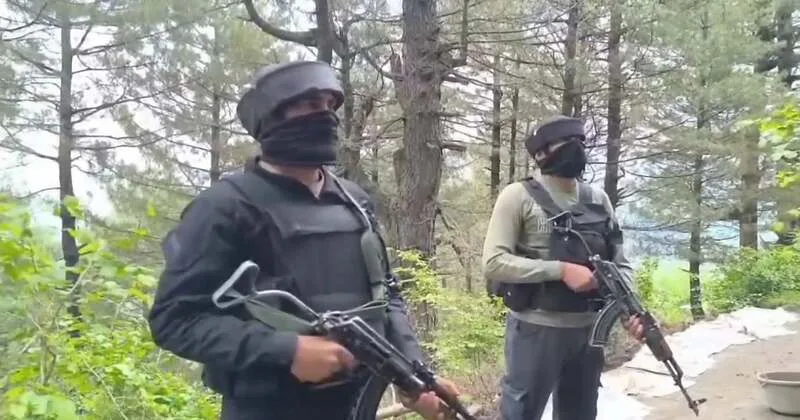
Terrorists in J&K are increasingly shifting their operations to underground bunkers, marking a significant change in their tactics, according to the Army. Previously, militants often hid in local homes, but heightened security and lack of local support have pushed them to seek refuge in dense forests and mountainous regions.
The shift came to light after an encounter in Kulgam district last week, in which two terrorists were killed. During the operation, security forces discovered a hidden bunker stocked with food, cooking equipment, weapons, and ammunition, highlighting the militants’ preparedness for extended stays. The Army described these bunkers as widespread across Kulgam, Shopian, and the southern Pir Panjal region of Jammu, taking advantage of the dense terrain for cover.
Lieutenant General D.S. Hooda noted that the militants’ reduced reliance on local support has limited intelligence agencies’ access to information, posing new challenges for counterterrorism efforts. Earlier, residents often provided tips about militant hideouts, but the shift to remote bunkers has forced security forces to rethink their strategies.
These underground hideouts are designed to allow terrorists to remain concealed for several days. After carrying out attacks, militants retreat to these shelters, maintaining communication with handlers across the border to coordinate subsequent operations. This mobility and secrecy make neutralising threats more difficult, as militants can strike and disappear before security forces can respond.
In response, the Army and other security agencies are increasingly turning to advanced technology. Plans are underway to deploy drones equipped with ground-penetrating radar (GPR) and seismic sensors to detect hidden bunkers. Enhanced surveillance and intelligence gathering in forested areas are also being prioritised to anticipate and intercept militant movements.
Senior Army officers stressed that while several hideouts have been discovered, the threat is far from fully contained. Security forces are continuously adapting tactics to counter the militants’ evolving methods, combining technological tools with traditional intelligence operations. The move towards underground bunkers indicates a shift in the operational landscape in J&K, requiring constant vigilance and strategic innovation from security agencies to prevent further attacks.
















Comments