





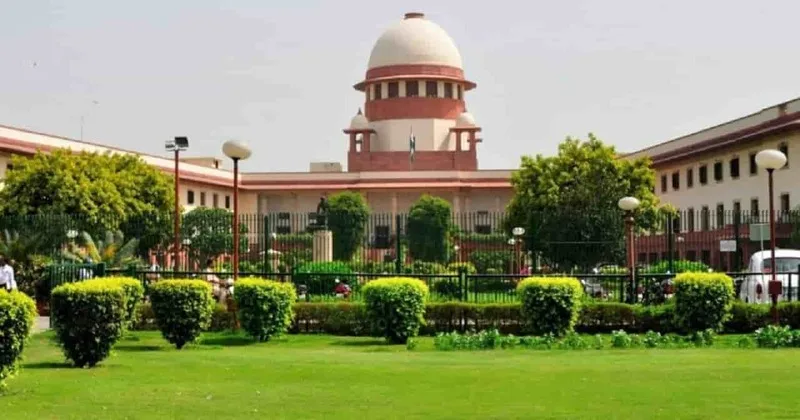
A bench of Chief Justice BR Gavai and Justice AG Masih will deliver its ruling on applications seeking a stay on the Waqf (Amendment) Act, 2025 tomorrow (September 15). The court had reserved its order on May 22 after extensive hearings on a clutch of petitions filed by various groups and individuals challenging the validity of the new law.
The petitions specifically questioned three provisions, including the power to denotify properties that had been declared as waqf by courts, waqf-by-user, or waqf by deed.
The Waqf (Amendment) Bill, 2024, was passed during the Budget Session of 2025 (Jan 31-Apr 4) after an intense 12-hour debate in Parliament.
In the Lok Sabha, the bill was cleared with the support of 288 MPs, while 232 opposed it.
In the Rajya Sabha, it received 128 votes in favour and 95 against.
The law amends the Waqf Act, 1995, with the government arguing it is aimed at bringing greater transparency and accountability in the management of waqf properties. However, opposition parties accused the government of trying to weaken Muslim institutions and alleged the move was politically motivated.
During the hearings, the Centre strongly defended the amendments. Solicitor General Tushar Mehta argued that waqf, by its very nature, is a “secular concept” and does not constitute an essential part of Islam.
He added, “Nobody has the right over government land… There is already a Supreme Court judgment which says the government can protect its property even if it has been declared as waqf.”
On April 25, the Union Ministry of Minority Affairs filed a 1,332-page affidavit opposing any blanket stay, insisting that a law passed by Parliament carries a presumption of constitutionality.
Senior advocate Kapil Sibal, appearing for the petitioners, criticised the law as a “complete departure from historical legal and constitutional principles.” He argued that the amendments enable the government to capture waqf properties through a non-judicial process, warning of a systematic erosion of community rights.
The petitioners maintained that the amendments undermine the traditional autonomy of waqf institutions and amount to a violation of minority rights guaranteed under the Constitution.
The Supreme Court’s ruling tomorrow is expected to have far-reaching consequences for both the management of waqf properties and the Centre’s reform agenda. While the government has positioned the Act as a necessary measure for transparency, critics view it as part of a broader attempt to bring waqf institutions under tighter state control.
















Comments