





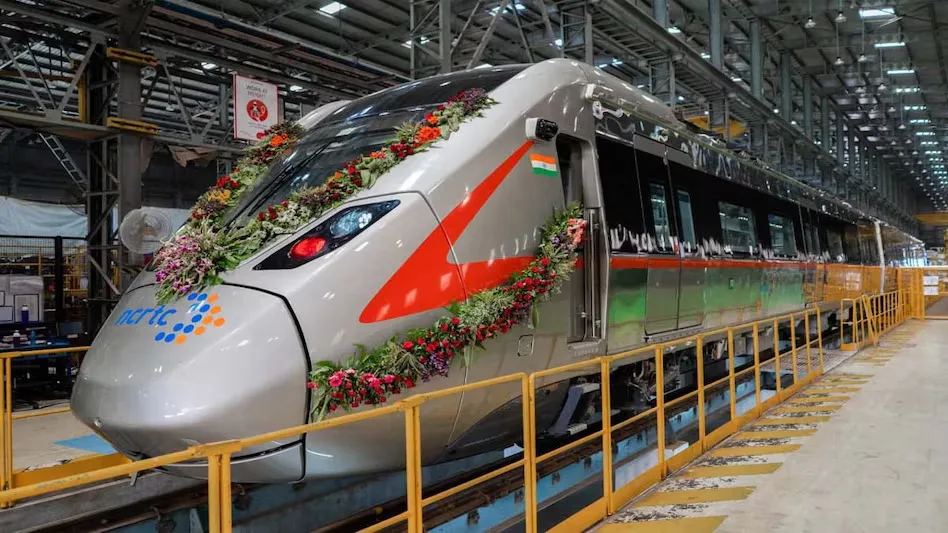
The Namo Bharat Regional Rapid Transit System (RRTS) has achieved a record speed of 160 kilometres per hour on the Delhi-Meerut stretch, making it the fastest train service in India. According to a report by India Times, the new service has outpaced the country’s earlier semi-high-speed trains, including Gatimaan Express and Vande Bharat Express, which generally operate at around 130 kmph.
Covering 55 kilometres between New Ashok Nagar in Delhi and Meerut South in Uttar Pradesh, the Namo Bharat service is part of a planned 82.15 km corridor extending from Sarai Kale Khan in Delhi to Modipuram in Meerut, featuring 16 stations in total.
Once fully operational, Namo Bharat will cut down travel time between Delhi and Meerut to under an hour, even with intermediate stops, significantly reducing congestion on roads and enhancing daily commutes for lakhs of passengers.
The trainsets, manufactured at Alstom’s Savli plant in Gujarat, are designed with advanced aerodynamic technology and equipped with cutting-edge safety systems such as Automatic Train Protection (ATP), Automatic Train Control (ATC), and Automatic Train Operations (ATO) to ensure reliable high-speed travel.
Currently, trains run every 15 minutes, connecting commuters efficiently across the corridor. The design of the stations, spaced five to eight kilometres apart, allows trains to accelerate and maintain top speeds over longer stretches of track.
In addition, plans are underway to integrate the 23-km Meerut Metro corridor—which has 13 stations—with the RRTS network. This integration will provide seamless transfers and improved last-mile connectivity for passengers.
The project is operated by the National Capital Region Transport Corporation (NCRTC), a joint venture between the Government of India and the state governments of Delhi, Uttar Pradesh, Haryana, and Rajasthan. Since the launch of the initial 17-km Priority Section in October 2023, more than 1.5 crore passengers have already travelled on the Namo Bharat service.
Notably, the Namo Bharat RRTS will not only revolutionise inter-city travel but also significantly reduce pollution and congestion caused by road traffic between Delhi and Meerut. With upcoming phases, the corridor is expected to serve as a model for future regional rapid transit projects across India, bringing faster, safer, and more sustainable connectivity to millions of passengers.
















Comments