





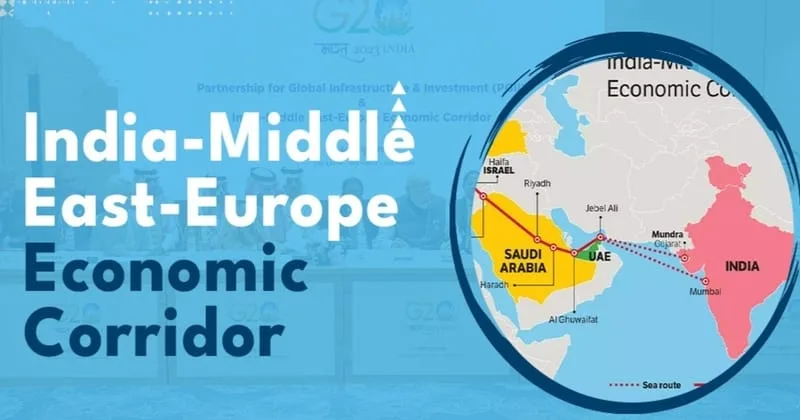
One wonders why the India-Middle East-Europe Corridor project has not yet really taken off! At the G20 Summit held in New Delhi in September 2023, India, the United States, the United Arab Emirates, Saudi Arabia, France, Germany, Italy and the European Union signed a memorandum of understanding to this effect. The idea for this project was conceived at the inaugural I2U2 Business Forum, held in February 2023, in Abu Dhabi, UAE.
The IMEC route is supposed to run from India to Europe through the UAE, Saudi Arabia, Israel, and Italy/Greece. It seeks to link all these regions by ports, rail networks, highways and digital infrastructure. It is to enable their supply chain to avoid the Suez Canal. According to an estimate, this route would bring down the logistics costs of its signatory states by up to 30 per cent. It would reduce the transportation time of their goods by 40 per cent.
The observers say the delay in the project is utterly regrettable. It is attributable to several factors. The United States, an important member of the project, prefers to see it as part of its larger strategic framework related to the implementation of the Abraham Accords. The allegiance of Greece to the project is doubtful. Authoritarian China manages its port of Piraeus. Besides, the ongoing conflicts in the Middle East hinder the project.
The observers counsel that the leader of the IMEC-signatory would do well to take steps aimed at speeding it up. Prime Ministers of India and Israel, Narendra Modi and Benjamin Netanyahu, may make efforts to have Japan on board the forum.
Japan is likely to reciprocate any such initiative. It is in the interest of Japan to be part of this project. The East Asian nation is export-oriented and energy-dependent upon the Middle East. The Suez Canal and the Bab el-Mandeb Strait are the primary routes through which its trade occurs with Asia and Europe.
The Japanese leadership is likely to heed Prime Ministers Modi and Netanyahu. Relations between India and Japan have improved significantly since Modi took over the reins of government in India in 2014. At the summit meeting he had with his then Japanese counterpart Ishiba Shigeru last month-end, the two leaders issued the “Japan-India Annual Summit Joint Statement” and the “Japan-India Joint Vision for the Next Decade. ”
Relations between Israel and Japan have improved a lot in recent years. According to an estimate, Japan’s investments in Israeli technological firms increased from 2019 to 2020 by twenty per cent to $1.1 billion . It grew to $2.9 billion in 2021. Today, over 15 per cent of all foreign investment in Israeli technology is by Japanese enterprises. In August 2022, Israeli Defence Minister Benny Gantz visited Tokyo and signed a memorandum of understanding on defence cooperation with his Japanese counterpart.














Comments