






We formed a colonial attitude because the Macaulay education that is being provided in schools and universities is insufficient to develop both national and personal character. Rashtriya Swayamsevak Sangh (RSS) Shakha offers these crucial perspectives to develop total personality and character to build the youth that every nation aspires to, as these life skills and a nation-building mindset are never taught in our educational institutions.
How does Shakha serve to develop personal and national character?
A strong spiritual, intellectual, and emotional quotient is necessary for the development of both personal and national character. Only then can a character be formed that channels its energy in accordance with the “The Nation first” principles, enabling it to readily take on any challenge for the benefit of society and the country. In this case, the one-hour Shakha is crucial to developing the required level of intellectual, emotional, and spiritual quotient. The physical, mental, social, historical, and spiritual aspects of the various Shakha activities foster leadership, the ability to enjoy challenges, a single-minded focus on serving Bharat Mata, teamwork, belongingness, and project management skills. They also foster social equanimity, encourage selfless seva activities on a regular basis and during natural disasters, and decolonise the Indian mindset.
“Bharatiyatva” is closely related to the teacher’s instructions in Sanskrit, as well as to the Sanskrit hymns and prayers in Shakha. The first reason is that learning Sanskrit can help us comprehend the Vedic and ancient wisdom that forms the basis of humankind’s scientific and technological advancements if we are truly interested in understanding the glory of Bharat. The second part of studying Sanskrit has to do with our memory and cognitive capacities. Researchers have demonstrated that repeating mantras in Sanskrit on a daily basis improves memory and cognitive function. The main goal of the activities played at Shakha is to foster a variety of qualities, including cooperation, the value of being present, dynamism in action, leadership, problem-solving ability, improved communication, enjoying challenges together, and working together to build a nation.
Intellectual discourse or discussion in Shakha: Each Swayamsevak gains knowledge of the factual history, current issues and actions, issues of national importance and solutions, and the development of good speakers who participate in various social activities, address the public on a variety of topics factually, and bring people together to work with the “Nation first” perspective. Shakha is solely responsible for the numerous successful speakers who develop the ability to connect with members of society, such as all Sarsanghchalaks, PM Modi, Deendayal ji Upadhyay, Dattopant ji Thengadi, and thousands of Swayamsevaks. Shakha produced the founders and several officials of more than 50 of the largest organisations that serve the nation on a larger scale, enabling them to construct such a vast effort for the nation’s improvement. Strengthening the body and mind is aided by yoga and pranayama. The entire day is revitalising as the mind gets strong and serene.
What is Shakha? How does it work? How does Shakha shape an individual while also contributing to the development of society and the nation?
A “Shakha” is a local unit or branch within the Rashtriya Swayamsevak Sangh. Where regular activities and meetings are held for one hour. In literal terms, “shakha” means to use the English word “branch”. These meetings are the RSS’s operational and foundational entities and are essential to the organisation’s composition and operation. The system of Shakha is essential to the RSS’s grassroots, decentralised organisational structure. It permits the organisation to establish a local presence and help spread the word about its nationalistic and cultural values.
The shakha is a venue for both physical and intellectual training, encouraging discipline, nationalism, and a sense of duty among its members. The RSS’s main goal is to develop people with high moral standards and a feeling of unselfish assistance. Through “shakhas,” or daily meetings, the organisation disseminates its message to its members, known as swayamsevaks, who get moral, intellectual, and physical instruction that instils qualities of community service, discipline, and patriotism. The RSS considers itself a driving force behind building a nation. It seeks to instil in its members and, consequently, in society a profound feeling of love and devotion to the country.
Through a number of programs, the Shakha aims to develop citizens who are dedicated to the nation’s unity and well-being. One of the RSS’s most important goals is to foster social harmony and unity. Despite having Hindu cultural roots, the organisation promotes a pluralistic and inclusive society. Interfaith discussion and To promote harmony and understanding amongst various populations, cooperation is encouraged. Bharat’s cultural history is something that the RSS is committed to protecting and advancing. By means of initiatives that honour literature, traditional arts, and festivals, the group aims to revitalise and maintain cultural customs that are essential to the nation’s identity.
Preparing people and communities for challenges is important to the RSS. The goal is to provide Swayamsevaks with crisis management skills, physical fitness, and the capacity to respond efficiently during emergencies, demonstrating the organisation’s dedication to the resilience of society. The RSS’s philosophy and goals are firmly anchored in the ideas of Integral Humanism, Hindutva, and cultural nationalism. Through its diverse mission, the RSS aims to help create a robust, peaceful, and culturally lively nation. By placing a strong emphasis on social service, cultural nationalism, the RSS is still a major force in forming the national culture.
The RSS’s daily meetings, or “shakhas,” are renowned for emphasising physical drills, talks, and exercises. This routine helps to develop character by instilling discipline and encouraging participants’ sense of accountability. The structured activities provided by the RSS offer a distinctive opportunity for young people seeking overall personal development. Disaster assistance is one of the many social projects in which the RSS is actively involved. Young people frequently express a desire to make a significant contribution to society, and the RSS offers a venue for these initiatives. The dedication of the organisation to serve without expecting anything in return corresponds with young people’s goals of making a real and constructive influence on their local communities.
The RSS’s emphasis on fostering morals and ethics is another aspect of its influence on society, among its constituents. This focus on character development has a beneficial knock-on effect. Impacting society at large by fostering the development of conscientious citizens who exhibit moral behaviour in their interactions and behaviours. Through its regular meetings or through “Shakhas,” the RSS helps its members develop a feeling of belonging and solidarity. Beyond social, religious, and geographic barriers, communal spirit fosters harmony and a shared feeling of obligation to society. The RSS’s focus on fostering community helps create a social fabric that is more harmonious and tightly linked.
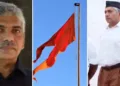
According to the RSS, the idea behind Shakha is as follows: “A saffron flag, known as the Bhagwa Dhwaj, flutters in the middle of an open playground.” Boys and young people of all ages play a variety of native games. There is unbridled excitement in the air. Exercises such as Suryanamaskar, a form of yoga, and occasionally instruction in the proper use of the Danda (a wooden stick) are included. Every activity is conducted with complete discipline. Group patriotic song singing takes place after the physical training classes. Exposition and discussion of national issues and events are also a part of the routine. When the group leader blows a single whistle, the participants gather in neat rows in front of the flag to conclude the day’s activities. They then respectfully recite the prayer Namaste Sada Vatsale Matrubhoome, which means “My salutation to you, loving Motherland.” All of the group leader’s instructions and the prayer verses are in Sanskrit. The inspirational phrase Bharatmata Ki Jai is uttered with sincerity as the prayer comes to a close. In summary, this is the RSS Shakha. The Sangh Swayamsevaks are the participants. Every activity in the RSS’s “Daily Shakha” has a set time on the schedule. The daily routine of a Shakha is broken down as follows:
Shakha commencement, followed by a five-minute jog or run to warm up. Games, yoga, and Suryanamaskar (40 minutes). Sanskrit Shlokas, often called patriotic hymns or Subhashit/Amrit Vachan, are recited. The RSS employees themselves have written thousands of songs that are quite well-liked within the organisation. Poetry, songs, and Sanskrit hymns are recited every four to five days of the week. At least twice or three times a week, there are discussions about current events or ideological topics. These activities are interchangeable, and the Shakha Karyavah, who is in charge of the Shakha, is free to decide which one should be done on any given day of the week. (10 minutes). The day’s Shakha concludes with prayer. (5 minutes) The Shakha also teaches the traditional skill of fighting with a wooden stick, known as Dand yudh, and Bharatiya martial arts, called Niyudh. Though it is not part of the Shakha’s daily routine, the amount of time spent with them varies.
It is imperative that all parents send their children to Shakha in order to foster national character. To do this, parents, young people, and older citizens should first join Shakha in their area so they may experience the change and get the confidence to persuade others. RSS runs around 83000 Shakhas in Bharat.












Comments