





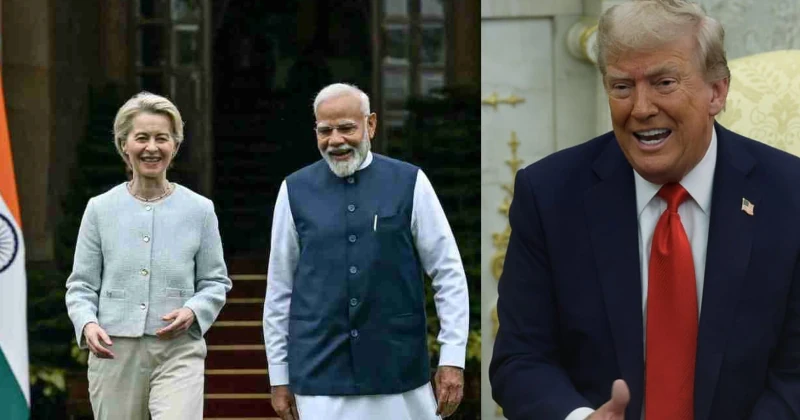
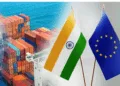
The European Union has decisively ignored US President Donald Trump’s demand to impose 100 percent tariffs on India which continue to import large volumes of Russian oil. However, spokesman Olof Gill reiterated that India will remain important trading partner for the bloc, signalling that Brussels is not willing to be drawn into Washington’s tariff confrontation. The rebuff came even as India and the EU entered the final stages of negotiations for a comprehensive free trade agreement that both sides hope to conclude by the end of the year.
Trump had also pressed the G7 countries to follow his line on sanctions and tariffs but found little support. His inability to convince European powers to turn against India has turned into a major diplomatic win for New Delhi. For India, this is not just about deflecting pressure on Russian oil purchases but also about strengthening its position in global trade partnerships.
On one hand, Trump has sought to maintain a personal rapport with Prime Minister Narendra Modi, describing him as a friend and hinting at a possible trade deal with India in the future. On the other hand, the imposition of heavy tariffs has escalated into a trade confrontation that risks damaging bilateral ties. In a recent interview to an American news outlet, Trump admitted that his own decision to impose a 50 percent tariff on Indian goods had worsened relations between the two countries. He justified the move by citing India’s Russian oil imports, declaring that his action was intended to address what he viewed as India funding Putin’s war effort. He conceded, however, that it was not an easy decision and that the relationship with India had suffered as a result. Trump also underlined that the Russia-Ukraine conflict was primarily a European problem, not an American one, further raising questions about why Washington was targeting New Delhi so aggressively.
India holds firm on Russian oil as US pressure mounts
The United States has repeatedly accused India of providing Moscow with economic lifelines through crude purchases. But India has made no secret of the fact that Russian oil is critical for its energy security, particularly at a time when global energy markets remain volatile. Data from August showed India imported 3.1 billion dollars’ worth of Russian crude, matching China’s purchases for the month. China remained the largest single consumer of Russian oil overall, but its imports had declined to 3.3 billion dollars in August, down from 4.4 billion dollars the previous month.
India, however, increased its Russian oil intake compared with July, when imports stood at 2.9 billion dollars. When other energy commodities such as coal are factored in, China’s total energy imports from Russia were valued at 6.09 billion dollars in August, while India’s amounted to 3.85 billion dollars. Turkey, meanwhile, remained the largest buyer of Russian natural gas. Despite these figures, Trump’s trade offensive singled out India, leaving Beijing and Ankara largely untouched.
India and EU push towards a groundbreaking free trade pact
While the American approach has deepened friction in Washington- Delhi ties, Brussels has taken the opposite course. EU Trade Commissioner Maros Sefcovic announced that a free trade agreement between India and the European Union could realistically be concluded by December. He described the negotiations as being in their final stretch and stressed that the effort was to deliver a groundbreaking deal that would reshape economic ties. Union Commerce and Industry Minister Piyush Goyal also underscored India’s commitment to a balanced agreement that would benefit both partners. He met Sefcovic, European Union Commissioner for Agriculture and Food Christophe Hansen, and other members of the EU delegation in New Delhi as part of the ongoing push to wrap up the FTA talks. After the discussions, Goyal emphasised that both sides remained committed to securing a mutually beneficial pact that would open new avenues for businesses and maximise opportunities for shared growth.
Yesterday, addressing the Joint Ministerial Business Interaction on the India–EU Free Trade Agreement in New Delhi, Goyal stated that India viewed Europe as a trusted partner, a strategic ally, and a friend committed to principles of fair play, rule of law, sustainability, quality standards, and inclusive growth. He made clear that the India–EU partnership should not be viewed merely in transactional terms of trade expansion, but also as a global force for positive impact. The minister underlined that India and the EU complemented each other rather than competing, making it easier to arrive at a framework that would promote win-win outcomes. He expressed confidence that the final agreement would be robust, fair, equitable, balanced, and mutually advantageous, helping to set the stage for an enduring partnership between two of the world’s largest economic regions.
At the annual session of the Automobile Component Manufacturers Association of India (ACMA), Goyal went further, assuring Indian industry leaders that the possibilities being unlocked by the India–EU agreement would prove attractive, exciting, and beneficial for businesses. He pointed to the innovation and collaborative opportunities the agreement would bring, particularly in advanced sectors.
Sefcovic, present at the same event, highlighted the complementary nature of the automotive markets of India and Europe, the third and fourth largest in the world respectively. He noted that a comprehensive free trade agreement would facilitate two-way trade flows and tariff liberalisation across components, from engines to brakes, thereby enabling joint advances in cutting-edge technologies. The commissioner expressed confidence that the final pact would deliver significant benefits for both economies, even if not every single issue could be agreed upon in its entirety.
India- EU concludes 13th round of negotiations
The 13th round of negotiations on the FTA was held in New Delhi between September 8 and 12. Sefcovic and Hansen were in the capital to review the progress of talks with Goyal and his team. Officials described the discussions as intensive and focused on resolving the remaining sticking points in order to meet the December target.
Goyal pointed out that every agreement involves give and take, and that it would be unwise to allow the pursuit of perfection to delay or derail what could be a transformative accord. He said the agreement was being designed not just to facilitate trade but also to encourage innovation, foster collaboration, and promote growth in new sectors, particularly in clean technologies and smart mobility.
He emphasised that by combining the strengths of their respective automotive industries, India and the EU could jointly develop next-generation combustion engines, electric vehicles, advanced battery technologies, and intelligent mobility solutions that would meet the demands of a rapidly changing world.
For India, the trajectory is clear. While Washington has sought to penalise New Delhi for pursuing independent energy and foreign policy choices, Europe has recognised the potential of closer partnership with India. The EU’s refusal to be drawn into Trump’s tariff agenda demonstrates a pragmatic approach to global trade and a clear understanding of India’s strategic importance.
The unfolding scenario underlines a major geopolitical shift. The United States may try to pressure India under the pretext of controlling Russia, but Europe has charted its own course. For New Delhi, the failure of Washington’s attempt to isolate it has opened the door to a far more significant and constructive partnership with Europe. If the FTA is concluded as expected by December, it will mark not just a trade milestone but also a diplomatic victory, affirming India’s place as a central player in the evolving global economic order.











Comments