





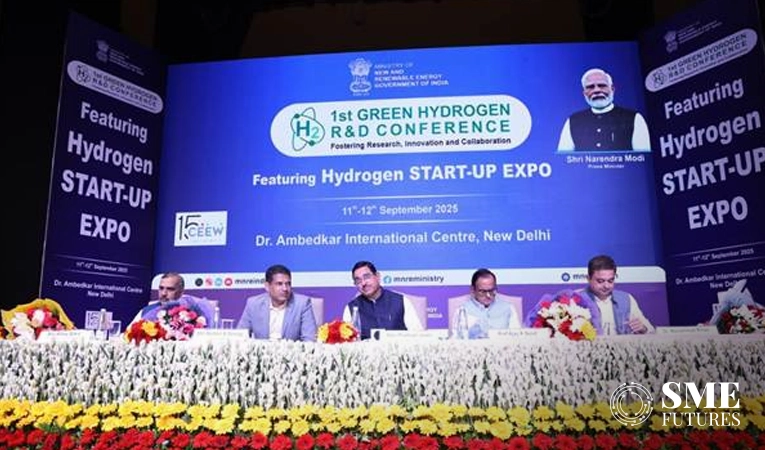
India has accelerated its clean energy agenda with a big push for green hydrogen R&D, innovation, and industry partnerships. At the first-ever Green Hydrogen R&D Conference in New Delhi, Union Minister of State for New and Renewable Energy Pralhad Joshi declared a chain of measures under the National Green Hydrogen Mission (NGHM), including a Rs 100-crore window for start-ups.
Under the new program, new technology start-ups engaged in hydrogen production, storage, transport, and end-use technologies will be able to receive grants of up to Rs 5 crore per project. “This will provide a healthy fillip to indigenous innovation and facilitate our shift towards a green hydrogen economy,” Joshi said at the event.
23 projects already awarded
The Ministry of New and Renewable Energy (MNRE) disclosed that 23 R&D projects have already been contracted in the first round of proposals under NGHM. The projects are in varied domains like hydrogen production through biomass and non-biomass pathways, hydrogen storage and transport, safety and integration, and hydrogen-based applications.
Institutions such as IITs, CSIR labs, IISERs, and industry collaborators are engaged in these projects. A second call for proposals, launched in July 2025, will close on September 15, offering additional opportunities to researchers and innovators.
Pilots and infrastructure on the ground
India is also shifting from planning to action through a number of pilot projects. The nation’s first green hydrogen pilot at a port has been initiated at V.O. Chidambaranar Port in Tamil Nadu. In the steel industry, five pilot projects have been initiated to pilot hydrogen-based decarbonisation techniques.
The government informed that retrofitting of ships and installation of hydrogen refuelling units are already in progress at Tuticorin Port. Hydrogen buses and refuelling stations are in operation in some sections of the country.
Most importantly, India has successfully conducted its first green ammonia auction, finding a price of Rs 49.75 per kg, close to half the price found during the first round. Green ammonia production is expected to start at Paradeep Phosphates in Odisha.
Standards and skills in building
In the interest of safety and worldwide competitiveness, India has notified its Green Hydrogen Standard and Certification Scheme linking it with more than 140 international standards.
The government has also approved five hydrogen testing labs and certified over 5,600 personnel with hydrogen certification. Regulatory policies like exemptions from transmission charges and ease in clearances have been put in place in order to lower project costs and delays.
Hydrogen hubs are being established in Kandla, Paradip, and Tuticorin ports to enhance domestic production and make India a future green hydrogen and its derivatives exporter.
Ambitious mission targets
With an investment of Rs 19,744 crore, the National Green Hydrogen Mission will generate 5 million metric tonnes of green hydrogen annually by 2030, supported by 125 GW of other renewable energy capacity. The mission will have investments of Rs 8 lakh crore, generate 6 lakh jobs, and eliminate nearly 50 million tonnes of carbon dioxide emissions every year.
Global Collaboration
India is also pursuing global collaborations to make its hydrogen ecosystem stronger. Under the EU-India Trade and Technology Council, more than 30 joint proposals have been submitted, ranging from waste-to-hydrogen technologies to innovative production techniques.
Although the announcements by the government indicate a firm drive, experts warn that the journey forward will involve drastic cost reductions, infrastructure preparedness, and demand generation to make large-scale adoption possible. Electrolysers production, safety norms, and assured supply of renewable power are still key drivers for increasing production volumes.
India’s inaugural Green Hydrogen R&D Conference therefore represents a sea change in the nation’s clean energy policy. By combining finance with regulatory blessings and international alliances, New Delhi is going all out on hydrogen as the pillar of its energy security and climate objectives.










Comments