Great Nicobar Project: Building maritime future
December 5, 2025
  • Read Ecopy
  • Circulation
  • Advertise
  • Careers
  • About Us
  • Contact Us
Android AppiPhone AppArattai
Organiser
  • ‌
  • Bharat
    • Assam
    • Bihar
    • Chhattisgarh
    • Jharkhand
    • Maharashtra
    • View All States
  • World
    • Asia
    • Europe
    • North America
    • South America
    • Africa
    • Australia
  • Editorial
  • International
  • Opinion
  • RSS @ 100
  • More
    • Op Sindoor
    • Analysis
    • Sports
    • Defence
    • Politics
    • Business
    • Economy
    • Culture
    • Special Report
    • Sci & Tech
    • Entertainment
    • G20
    • Azadi Ka Amrit Mahotsav
    • Vocal4Local
    • Web Stories
    • Education
    • Employment
    • Books
    • Interviews
    • Travel
    • Law
    • Health
    • Obituary
  • Subscribe
    • Subscribe Print Edition
    • Subscribe Ecopy
    • Read Ecopy
  • ‌
  • Bharat
    • Assam
    • Bihar
    • Chhattisgarh
    • Jharkhand
    • Maharashtra
    • View All States
  • World
    • Asia
    • Europe
    • North America
    • South America
    • Africa
    • Australia
  • Editorial
  • International
  • Opinion
  • RSS @ 100
  • More
    • Op Sindoor
    • Analysis
    • Sports
    • Defence
    • Politics
    • Business
    • Economy
    • Culture
    • Special Report
    • Sci & Tech
    • Entertainment
    • G20
    • Azadi Ka Amrit Mahotsav
    • Vocal4Local
    • Web Stories
    • Education
    • Employment
    • Books
    • Interviews
    • Travel
    • Law
    • Health
    • Obituary
  • Subscribe
    • Subscribe Print Edition
    • Subscribe Ecopy
    • Read Ecopy
Organiser
  • Home
  • Bharat
  • World
  • Operation Sindoor
  • Editorial
  • Analysis
  • Opinion
  • Culture
  • Defence
  • International Edition
  • RSS @ 100
  • Magazine
  • Read Ecopy
Home Bharat

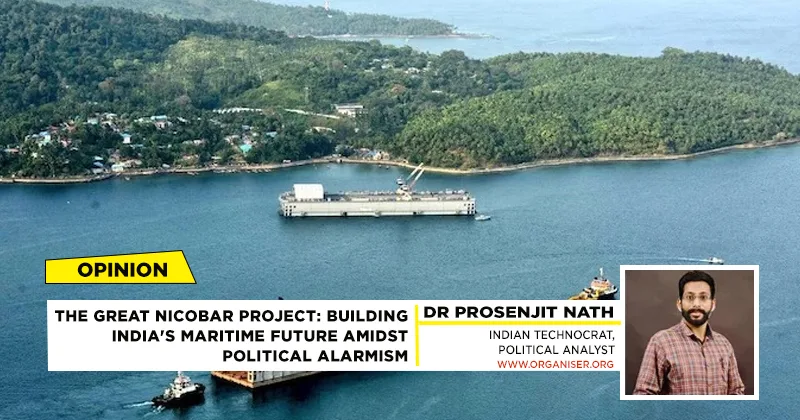
The Great Nicobar Project: Building maritime future amidst political alarmism in India

The Great Nicobar Project stands at the crossroads of strategic ambition and political controversy. As critics decry ecological harm, supporters argue it's vital for India's maritime future and national security

Prosenjit NathProsenjit Nath
Sep 12, 2025, 05:20 pm IST
in Bharat, Opinion
Follow on Google News
FacebookTwitterWhatsAppTelegramEmail

Why Sonia Gandhi’s opposition to the Galathea Bay port reflects political expediency, not environmental stewardship

In her editorial, “The making of an ecological disaster in the Nicobar” (The Hindu, September 8, 2025), Sonia Gandhi launches a blistering attack on the Modi government’s ambitious Rs 72,000 crore Great Nicobar Project. She calls it a “totally misplaced expenditure” that poses an “existential danger” to the island’s indigenous communities and “threatens one of the world’s most unique ecosystems.” Furthermore, she accuses the government of “trampling on tribal rights” and making “a mockery of legal and deliberative processes.” This is vintage Congress rhetoric development painted as destruction, progress recast as betrayal of the Constitution. But a closer look shows that these claims are not only selective and alarmist but also deeply political.

Gandhi asserts that the project will “permanently displace” the Nicobarese and Shompen tribes. This sweeping claim does not stand up to scrutiny. The designated development zones for the port and township have been carefully demarcated to minimise overlap with tribal settlements. The fear of total uprooting is more a rhetorical flourish than a reflection of ground realities. Ironically, it was during the 2004 tsunami, when Congress was in power, that the Nicobarese lost many of their ancestral villages. Little was done then to rebuild or provide modern infrastructure to these communities. Today, when the government proposes roads, healthcare, schools, and power connectivity, Congress paints it as an “existential threat.” The question is simple: Is isolation true empowerment, or is integration with safeguards the real path to progress?

Sonia Gandhi argues that the project has evaded due process, citing flaws in the Social Impact Assessment (SIA). What she omits is that the project has passed through multiple regulatory layers, including the National Green Tribunal (NGT), a High-Powered Committee of the Environment Ministry, and the National Centre for Sustainable Coastal Management (NCSCM). The NCSCM’s ground-truthing exercise confirmed that the project site falls under CRZ 1B, where ports are permitted, and not CRZ 1A, where construction is prohibited. Far from bypassing safeguards, this is an example of adherence to environmental law, not its violation.

Also Read: Shradha: The untold science of ancestral remembrance

Gandhi ridicules the project’s compensatory afforestation plan, dismissing it as a “gross environmental catastrophe.” This argument conveniently forgets that compensatory afforestation is legally mandated under the Forest Conservation Act, with strict monitoring and accountability. For decades, Congress-led governments themselves approved projects using the same framework. To now discredit afforestation altogether is disingenuous. If implemented correctly, it can offset ecological loss and even expand forest cover, a goal successive governments have supported.

Most telling is what Sonia Gandhi does not say. Nowhere in her editorial does she mention that 25 per cent of India’s cargo is transshipped through foreign ports, with Colombo alone handling 40% of it. Nowhere does she point out that China operates a terminal at Colombo Port, giving Beijing a direct foothold over India’s maritime lifelines. Nor does she acknowledge that Galathea Bay, with its 18-20 meter natural depth and prime location on the East-West shipping route, is one of the few places in India where a deep-draft transhipment hub can be built. This port represents a once-in-a-century opportunity to rival Singapore and break free from dependence on Chinese-linked facilities. Gandhi’s silence on these national security stakes is striking and revealing.

This opposition to strategic development is part of a pattern. Congress governments have repeatedly blocked airstrips, radar facilities, and port expansions in the Andaman and Nicobar Islands under the pretext of ecological fragility. The result was decades of strategic neglect and economic stagnation. By opposing the Great Nicobar Project, Sonia Gandhi is continuing this pattern. The “ecological concerns” are real, but they are selectively invoked to stall transformative projects, never to block corruption or illegal exploitation under Congress rule.

In 2024, the Modi government designated Galathea Bay as a major port, placing it under the Ministry of Ports, Shipping, and Waterways. This makes it eligible for central funding and accelerated development. Phase 1 of the project, expected to be completed by 2028, will have a capacity of 4 million TEUs, while Phase 4, scheduled for 2058, aims for a capacity of 16 million TEUs. Currently, most Indian east coast ports have drafts of only 8-12 meters, insufficient for modern mega-vessels that require 16-20 meters. This forces India to rely on Colombo, Singapore, and Klang, leading to losses of around Rs 1,500 crore annually in direct port revenue and another Rs 3,000-4,500 crore to the broader economy.

With its natural deep waters, Galathea Bay can reverse this dependence, attracting cargo from Bangladesh and Myanmar, where over 70 per cent of trade currently goes through foreign hubs. Strategically, it will allow India to compete with Singapore and other regional giants while safeguarding its own maritime interests.

Perhaps the most glaring omission in Sonia Gandhi’s piece is the national security dimension. Sri Lanka, deeply indebted to China, has allowed Chinese surveillance ships to dock at its ports. India’s reliance on Colombo in such a scenario is a strategic vulnerability of the highest order. A self-sufficient transhipment hub in the Nicobars would reduce Chinese leverage over India’s critical maritime supply chains. Opposing it under the guise of environmentalism is strategic naivety, if not willful blindness.

Sonia Gandhi ends her article with dire warnings about the “survival” of the Nicobarese and Shompen tribes and the supposed “destruction” awaiting future generations. But the truth is starkly different. India cannot afford to remain hostage to foreign ports and Chinese-controlled infrastructure. The Great Nicobar Project is not just about commerce; it is about national security, economic growth, and maritime sovereignty. By crying “disaster” at every bold step, Congress shows not vision, but fear of change. The real disaster would be to let alarmism derail a project that can secure India’s strategic future and uplift some of its most isolated communities.




Topics: CongressMaritime securityGreat Nicobar ProjectGalathea Bay PortEnvironmental DebateStrategic InfrastructureTransshipment HubAndaman Nicobar
ShareTweetSendShareSend
✮ Subscribe Organiser YouTube Channel. ✮
✮ Join Organiser's WhatsApp channel for Nationalist views beyond the news. ✮
Previous News

Silence on UGC by Supreme Court on appointment of VC: Judicial activism over academic autonomy

Next News

Z+ security protocol violated, CRPF raises alarm over foreign trips of Rahul Gandhi

Related News

Representative image

Navy Day 2025: Celebrating valour & strategic role of the Indian Navy in maritime security; PM Modi extends greetings

Sanchar Saathi vs. Manufactured Panic: Why Congress’ ‘Snooping’ charge crumbles under facts

Delhi MCD Bypoll results: BJP emerges big winner, grabs 7 of 12 seats; AAP suffers setback, Congress wins one

Chief of Naval Staff Admiral Dinesh Tripathi

India to commission third ballistic submarine INS Aridaman soon: Chief of Naval Staff Admiral Dinesh Tripathi

Karnataka Congress MLAS with Deputy CM DK Shivakumar

Karnataka: Kolar MLAs’ back-to-back meetings with DK Shivakumar trigger political calculations amid power tussle

Vessels of the Indian Navy and the Royal Saudi Naval Force during the second edition of bilateral Al-Mohed Al-Hindi exercise in 2023

Gulf Navies deepen partnership with India while Pakistan experiences a reduced maritime role in the region

Load More

Comments

The comments posted here/below/in the given space are not on behalf of Organiser. The person posting the comment will be in sole ownership of its responsibility. According to the central government's IT rules, obscene or offensive statement made against a person, religion, community or nation is a punishable offense, and legal action would be taken against people who indulge in such activities.

Latest News

RSS Akhil Bharatiya Prachar Pramukh Shri Sunil Ambekar

When Narrative Wars result in bloodshed, countering them becomes imperative: Sunil Ambekar

Ministry of Civil Aviation mandates emergency action: IndiGo ordered to stabilise flight operations by midnight

Chhattisgarh CM Vishnu Deo Sai at Panchjanya Conclave, Nava Raipur, Image Courtesy - Chhattisgarh govt

Panchjanya Conclave: Chhattisgarh CM Sai shares views on development projects in Maoist hotbed, women empowerment

Union Finance Minister Nirmala Sitharaman

‘TMC is holding Bengal back’: Sitharaman slams Mamata govt over industrial & healthcare setbacks

Karnataka: Muslim youth Mohammed Usman accused of sexual assault, blackmail & forced conversion in Bengaluru

Social Justice Is a cover; Anti-Sanatana dharma is the DMK’s real face at Thirupparankundram

Karnataka: Hindus demand reclaiming of Anjaneya Mandir at the site of Jamia Masjid; Setting wrongs of Tipu Sultan right

Assam govt proscribes all forms of Jihadi literatures in state; Islamic terror groups trying to recruit Muslim youth

Retired Subedar held for leaking Army details to Pak handlers posing as Indians

Gujarat ATS dismantles spy network involving Ex-Army personnel and woman for sharing information with Pakistan

Economic freefall of West Bengal: Mamata’s “Paribartan” turns to crisis; 207 Companies gone in six months

Load More
  • Privacy
  • Terms
  • Cookie Policy
  • Refund and Cancellation
  • Delivery and Shipping

© Bharat Prakashan (Delhi) Limited.
Tech-enabled by Ananthapuri Technologies

  • Home
  • Search Organiser
  • Bharat
    • Assam
    • Bihar
    • Chhattisgarh
    • Jharkhand
    • Maharashtra
    • View All States
  • World
    • Asia
    • Africa
    • North America
    • South America
    • Europe
    • Australia
  • Editorial
  • Operation Sindoor
  • Opinion
  • Analysis
  • Defence
  • Culture
  • Sports
  • Business
  • RSS @ 100
  • Entertainment
  • More ..
    • Sci & Tech
    • Vocal4Local
    • Special Report
    • Education
    • Employment
    • Books
    • Interviews
    • Travel
    • Health
    • Politics
    • Law
    • Economy
    • Obituary
  • Subscribe Magazine
  • Read Ecopy
  • Advertise
  • Circulation
  • Careers
  • About Us
  • Contact Us
  • Policies & Terms
    • Privacy Policy
    • Cookie Policy
    • Refund and Cancellation
    • Terms of Use

© Bharat Prakashan (Delhi) Limited.
Tech-enabled by Ananthapuri Technologies