





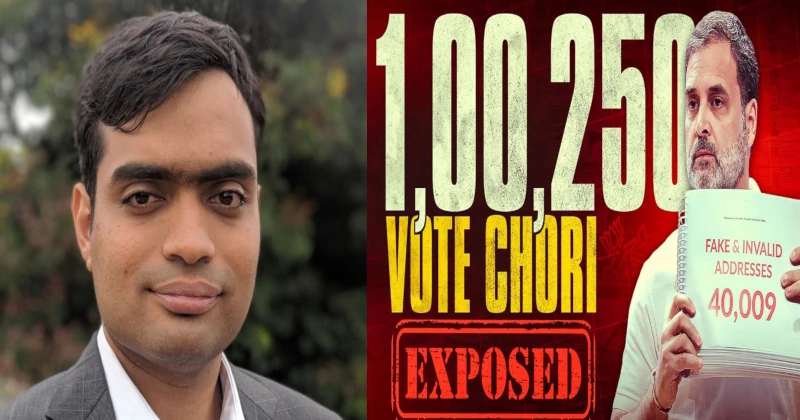
The Congress party’s latest attempt to malign India’s democratic institutions through its “Vote Chori” campaign has hit a wall of credibility, as the role of Vikram Srinivas a former senior researcher at the controversial Centre for Policy Research (CPR) has come to light.
Srinivas, who holds a B.Tech from IIT Madras and a Master’s in Public Administration from Harvard University, has worked with multinationals like Nvidia and organisations like Mapunity before joining CPR’s Accountability Initiative. However, what should have been a respectable academic and professional journey has now been tainted with allegations of preparing propaganda material for the Congress party.
On August 7 2025, Rahul Gandhi dramatically unveiled a presentation alleging that more than 100,000 votes were manipulated in the 2024 Lok Sabha elections. Packaged in slick PDFs and PowerPoint slides, the so-called “Vote Chori” exposé was marketed as hard evidence of electoral fraud.
But investigations have revealed that one of the creators of this presentation was none other than Vikram Srinivas, a man tied to foreign-funded think tanks and leftist ecosystems that have long attempted to influence India’s political narrative.
The presentation, however, was light on facts and heavy on insinuations, lacking credible data and offering no legally admissible proof. Instead of approaching the courts, as would be expected in a democracy, Congress chose the route of public spectacle undermining the Election Commission of India (ECI) and creating doubts about the integrity of India’s elections.
The deeper issue is not just Srinivas’s role in designing Congress’s toolkit but his institutional affiliations. The Centre for Policy Research, where he worked, has been repeatedly scrutinised for receiving funds from the Ford Foundation and other Western entities. The Ford Foundation, notorious for operating as a front for the CIA’s India operations, has pumped money into think tanks and NGOs that critics argue promote Western interests over India’s sovereignty.
By placing a CPR-trained researcher at the heart of Congress’s anti-ECI campaign, the party has effectively opened itself up to charges of outsourcing its political propaganda to foreign-funded operatives.
The Srinivas episode has also reignited concerns about ideological subversion in India’s premier institutes. Once celebrated purely for producing world-class engineers, IITs have in recent years come under the scanner for harboring leftist and anti-national networks. Social media activists have highlighted how student groups, faculty members, and external collaborators push narratives that align with globalist agendas.
Srinivas’s own online posts on issues like CAA-NRC reveal a strong bias toward leftist positions. That his wife has been an assistant professor at IIT Delhi since 2021 only adds to fears of an entrenched ideological cartel within India’s most prestigious institutions.
The most damning revelation, however, lies in the digital forensic investigation of the very documents Rahul Gandhi presented. The PDFs uploaded to his official website carried metadata not from New Delhi, but from Myanmar.
This is not the first time Congress has been linked to propaganda “toolkits.” From orchestrated campaigns against the ECI to previous instances targeting the armed forces and government policies, Congress has consistently preferred political theatrics over judicial redressal.
If Rahul Gandhi and his party were genuinely concerned about electoral irregularities, they had every opportunity to present evidence before the courts of law. Instead, they chose to weaponise unverified data, aided by operatives like Srinivas, to spread distrust among the masses.













Comments