





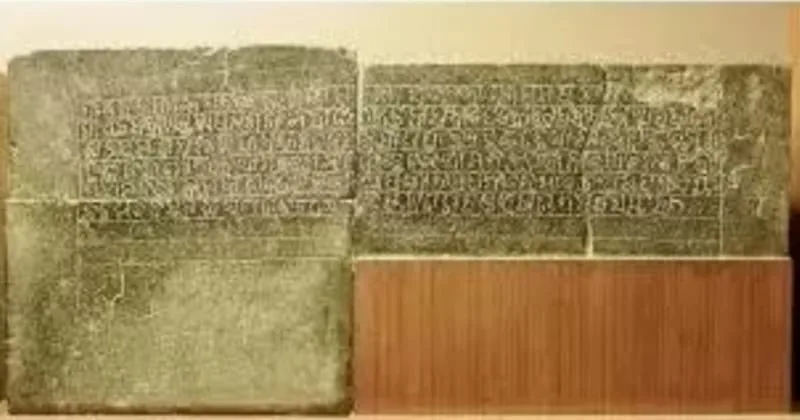
In a historic discovery, the first-ever Odia inscriptions of Gajapati Kapilendra Deva have been found at the Srikurmam Mandir in Andhra Pradesh’s Srikakulam district.
The Mandir, originally built by the Eastern Ganga dynasty of Kalinga, has a rich legacy of royal patronage. The inscriptions were uncovered by renowned epigraphist Bishnu Mohan Adhikari, who identified them on two pillars of the Swetapuṣkariṇī Maṇḍapa within the Mandir complex. As part of his extensive research, Adhikari has deciphered over 200 inscriptions from across Eastern India.
“This is the first time Odia inscriptions from the era of Kapilendra Deva have been discovered at Srikurmam. It marks a significant development in understanding his cultural and administrative reach into Andhra,” epigraphist Bishnu Mohan Adhikari told this correspondent.
In total, three inscriptions linked to Kapilendra Deva, written in Telugu and Sanskrit scripts, have been identified at the site. A 1455 CE inscription details the renewal of land grants by Kuṇḍaleśvara Mahāpatra. Another, dated 1461 CE, records the installation of a bronze lamp in the Mandir by Chamu Rauta of Dahale. Earlier, a separate record had noted that Mandir officials from Kalinga had donated perpetual lamps for the King’s success.
The newly discovered inscriptions, written in Odia script, provide rare and valuable evidence of cultural continuity from Odisha into Andhra. One inscription states that in the 21st Anka year of Gajapati Kapilesvara Deva, also known as Kalipilendra Deva of Odisha, Mahapatra Kuṇḍaleśvara Dāsa Jena, identified as the Kalinga Parikhya, and Bhoga Parikhya Sukuru Muduli, issued orders for the Chandana Lepana Seva (sandalwood paste ritual).
Another inscription, etched onto a lion pillar and dated to the 34th regnal year of Kapilendra Deva (1463 CE), records that the Mandir’s administration was under the authority of the Kalinga Parikhya, officials of the Kalinga Dandapata. This inscription is also marked with traditional royal symbols, the sun and crescent moon.
Kapilendra Deva (1435–1467 CE), the founder of the Suryavamsi Gajapati dynasty, ruled a vast empire that extended from the Ganga in Bengal to the Kaveri in Tamil Nadu. While inscriptions in various languages have been discovered across this expansive region, this marks the first known inscription in Odia script found outside Odisha. It offers compelling evidence of the shared cultural and religious traditions between Odisha and Andhra.
The inscription not only confirms the practice of rituals like the Chandana Lepana Seva but also connects key officials mentioned across different records, reinforcing the administrative cohesion of Kapilendra’s reign. This significant discovery underscores the deep historical ties between the regions and highlights the enduring legacy of Kalinga’s cultural and political influence in eastern India.
















Comments