






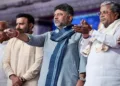
Bengaluru: The Siddaramaiah-led Congress government in Karnataka has found itself at the center of a fresh controversy after Chief Minister Siddaramaiah and Deputy Chief Minister DK Shivakumar indicated that the demand to rename Shivajinagar Metro Station after St. Mary would be considered. The proposal, made during the annual festival of St Mary’s Basilica in Shivajinagar, has drawn strong condemnation, most notably from Maharashtra Deputy Chief Minister Devendra Fadnavis, who termed the move “an insult to Chhatrapati Shivaji Maharaj” and accused the Congress of continuing its tradition of belittling the Maratha warrior.
A politically charged decision
Shivajinagar, located in the very heart of Bengaluru and just two kilometers from Vidhana Soudha, is a historic and bustling neighborhood. The area not only houses Russell Market, mosques, temples, and churches but is also a living testimony of the city’s plural culture. The metro station, named after Chhatrapati Shivaji Maharaj, serves as a landmark that honours one of India’s most celebrated icons of resistance against oppression and foreign rule.
The Congress government’s willingness to replace this historically rooted name with St. Mary’s inspired by a local religious festival has opened up a Pandora’s box of religious appeasement politics. Critics argue that this is yet another example of the Siddaramaiah government pandering to vote-bank considerations at the cost of Karnataka’s cultural identity.
Fadnavis: “An insult to Shivaji since the Nehru era”
Reacting sharply from Mumbai, Maharashtra Deputy CM Devendra Fadnavis minced no words:
“I condemn the renaming of the Shivajinagar Metro Station. This is an insult to Chhatrapati Shivaji. The Congress has maintained the tradition of insulting Shivaji since the Nehru era.”
His remarks were not without historical context. Fadnavis reminded that Jawaharlal Nehru’s book The Discovery of India allegedly carried disparaging references to Shivaji, a sore point that has often been highlighted by pro-Hindu and Maratha groups. The renaming attempt, he said, was in continuity with the Congress party’s past approach of undermining nationalist icons in favor of selective minority appeasement.
Why Shivajinagar matters
Naming a metro station after Chhatrapati Shivaji Maharaj in a state outside Maharashtra was not a mere administrative choice but a symbolic recognition of Shivaji’s pan-Indian legacy. The Maratha warrior is celebrated not just in Maharashtra but across India for his valor, governance, and resistance against the Mughal empire. In Karnataka too, Shivaji’s history resonates, especially in border regions like Belagavi where Maratha-Kannada sentiments intersect.
By proposing to erase his name from a prominent metro station, the Siddaramaiah government risks being seen as undermining the contribution of a figure revered across caste, community, and regional divides.
Congress’s defense and the charge of appeasement
Chief Minister Siddaramaiah, speaking at the St. Mary’s Basilica festival, justified his openness to the proposal by saying that “people pray to St. Mary for health and peace” and that the government would respect community sentiments. Deputy CM D.K. Shivakumar further added that “there is nothing wrong in responding to such requests.”
But this very argument is what has drawn the sharpest criticism. Why should the name of a public infrastructure project funded by taxpayers’ money be altered to please a section of the population? And why should this change come at the cost of erasing the legacy of one of India’s greatest historical figures? The Congress’s move, many believe, reflects selective minority appeasement politics, especially at a time when the party is struggling to consolidate its voter base ahead of upcoming elections.
The proposal has not yet been finalized, but the very willingness of the Congress government to entertain it has triggered anger among pro-Hindu groups, historians, and citizens alike. In Karnataka, where identity politics around language, culture, and history already run deep, this decision threatens to polarize the public further.











Comments