





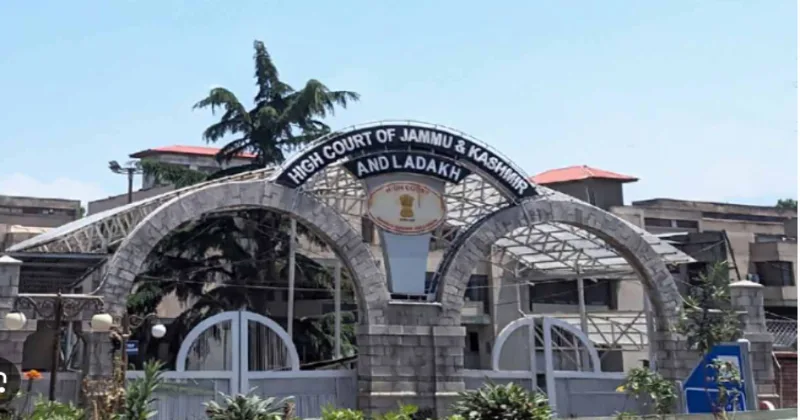
The Jammu and Kashmir High Court has ordered the deportation of Pakistani citizens Mohammad Khalil Qazi and Arifa Qazi, out of Bharat to Pakistan. They arrived in Bharat in July 1988 with their minor son on Pakistani passports on a 14-day visa. After the expiry of this period, their visa was extended thrice for periods of 30 days each. Their application for a fourth extension of the visas was rejected, and they were asked to leave the country and go back to Pakistan.
When they applied for an extension of their visas for the fourth time, Khalil Qazi also approached the authorities urging that he be allowed to revive his Indian citizenship. Incidentally, he was a State Subject holder as a Permanent Resident of J&K who was born in Srinagar city, before independence. However, at the time of Partition, he was living with his father in Rawalpindi where he was doing business. Subsequently, he became a Pakistani citizen, and it was only in 1988, over four decades after the creation of Pakistan, that he came to India, and onwards to Srinagar.
He was then accompanied by his wife Arifa Qazi, a Pakistani citizen, and a minor son, another Pakistani citizen. All three had valid Pakistani passports and were given a visitor visa for 14 days initially. After three extensions, when their request for fourth extension was rejected, the Home Department issued their Deportation Order No. Home/156/Visa/88 dated 13.09.1989. But they have continued to live in Srinagar merrily there after till this day as this order has not been executed till date.
Legal Loopholes
Does it say anything about the loopholes that prevail in our judicial system as these Pakistani citizens continued to live in Bharat illegally for over 35 years? Does it say something about the judicial officers who heard their cases and indirectly facilitated their illegal stay in the country? Isn’t it amazing that after coming to India on a legally valid visa document for mere 14 days, three Pakistani citizens spend next 35 years in this nation illegally?
This Pakistani couple had first approached the high court in 1990 and got a stay which facilitated their continued illegal stay in India for over three and a half decades. It appears this may be one of the longest pending cases in the court where the correct executive order of deportation passed in 1989 was easily frustrated on the strength of a stay order.
If this is not travesty of justice and a rampant misuse of legal remedies available to citizens what is?
A Division Bench High of the court comprising Chief Justice Arun Palli and Justice Rajneesh Oswal dismissed their appeal which they had filed against the order of the trial court. The court upheld the writ court judgment on deportation of wife and husband to Pakistan and directed that they have to return to their own country. The writ court in August had dismissed the plea of both and vacated 35-year-old stay on their deportation to Pakistan.
It was some months ago that the case was widely reported when it came to be heard by Justice Sindhu Sharma.
Double Bench Order
The Division Bench said that any foreign national having entered into India is required to leave the country immediately at the expiry of visa period. If such a person doesn’t leave India, the Central Government is well within its powers to issue any directions or instructions, as may be necessary, with regard to staying of such person in India in terms of Section 7 of the Act of 2025, including his removal from India.
“We have reached to an ineluctable (inescapable) conclusion that the appellants have miserably failed to make out any good ground for interference with the impugned judgment,” the court concluded. “Rather, the appellants have suppressed the material facts from this court and approached this court with unclean hands, just to prolong their stay in India and they succeeded to large extent because they continued to stay in India pursuant to interim direction issued by the learned writ court. Accordingly, the appeal is dismissed being bereft of any merit,” the court added.
The brief facts of the case are that petitioner-Mohammad Kahlil Qazi born in Srinagar in the year 1945, belongs to a family of permanent residents and landholders of J&K State. His grandfather was issued a State Subject Certificate by His Highness Government of J&K vide order No. 111 of 1977. During the partition of India, his father was doing business in Rawalpindi, Pakistan and due to the 1948 India-Pakistan war, the petitioner-Qazi, then a four-year-old child, was in Pakistan with his father. Neither he nor his family returned to Srinagar and acquired Pakistani nationality.
The Pakistani couple had been residing in Srinagar since 1988 on the strength of visa extensions and a 1990 order that had stayed their deportation out of Bharat. On May 9, Justice Sindhu Sharma dismissed a decades-old writ petition filed by the couple in 1990, after noting that even though they may have had Indian roots, they have voluntarily acquired Pakistani citizenship since then.
The Court relied on Section 9(1) of the Citizenship Act, 1955, to highlight that any Indian citizen who voluntarily acquires citizenship of another country ceases to be an Indian citizen.
In this case, the Court found that there was nothing to suggest that the couple’s repeated requests for Indian citizenship had been accepted, nor had they formally applied for Indian citizenship under the Citizenship Act.
“Petitioner No. 1 ceased to be a citizen of Bharat as he migrated to Pakistan and is a citizen of Pakistan. Petitioner No. 2 has voluntarily acquired the citizenship of Pakistan after her marriage and their son is a citizen of Pakistan by birth. Therefore, immediately upon acquiring the citizenship of Pakistan, they ceased to be citizens of Bharat. Thus, voluntary acquisition of citizenship of another country by an Indian citizen results in the termination of his Indian citizenship,’’ the court said.
The Court, therefore, upheld the Indian government’s 1989 decision to deport the petitioners, namely Mohammad Khalil Qazi and Arifa Qazi, out of Bharat to Pakistan.














Comments