





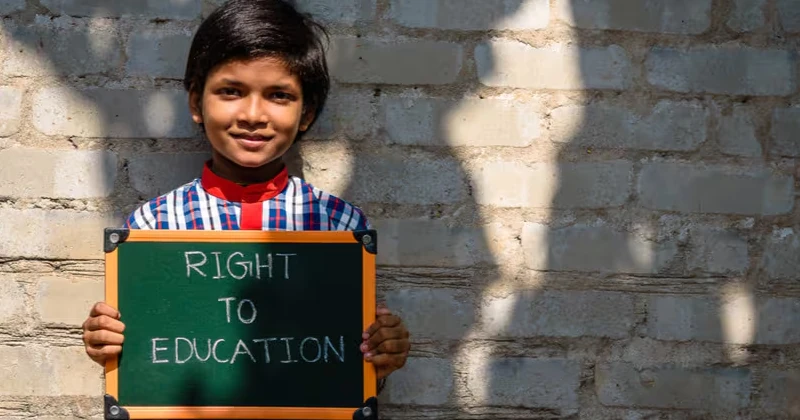
The Uttar Pradesh government has taken a major step to ensure that no child from an economically weaker section (EWS) or disadvantaged group is deprived of quality education. Under the provisions of the Right to Education (RTE) Act, the state has decided to strengthen the monitoring system for admissions in private schools, ensuring that every eligible child gets admission without any irregularities. The move is to eliminate malpractices, hold both schools and parents accountable, and ensure that the constitutional right to free and compulsory education is implemented effectively.
The Education Department has announced that a district-level monitoring committee will keep a close watch on the admission process of poor children in private schools. This committee, comprising more than a dozen members, will oversee the entire procedure, from applications to admissions and ensure transparency and fairness at every step.
In case of disputes related to applications or admissions, the matter will be resolved by a four-member sub-committee. This committee has been specifically tasked with handling grievances and providing quick resolutions to ensure that genuine applicants do not suffer because of procedural delays. The committee will consist of education officers, child rights officials, and other administrative members. They will be responsible for verifying student details, monitoring fee reimbursements, and ensuring that the children admitted under this scheme actually receive the promised facilities.
In line with the RTE norms, the state government has also clarified the age criteria for admissions.
- For pre-primary classes, children between the ages of three to six years will be eligible.
- For Class 1 admissions, the age limit has been fixed between six to seven years.
This will most likely bring uniformity across schools and prevent any disputes related to the age of children.
अब कोई भी बच्चा गुणवत्तापूर्ण शिक्षा से वंचित नहीं रहेगा, पात्र बच्चे को RTE के तहत दाखिला मिलेगा, कमेटी रखेगी नजर
👉🏻 प्री-प्राइमरी कक्षाओं में दाखिले के लिए आयु सीमा तीन से छह वर्ष की होगी, कक्षा एक में दाखिले के लिए आयु सीमा छह से सात वर्ष होगी
👉🏻 विद्यालयों को अपनी उपलब्ध… pic.twitter.com/vTfLNRqv2V
— Government of UP (@UPGovt) September 10, 2025
To ensure transparency and efficiency, the government has made it clear that applications will be accepted only through the online system. This digital process will help prevent manipulation, delays, or favoritism in the admission cycle. Private schools have been directed to upload details of their available seats on the designated UDISE portal. This digital step will allow parents to know in advance how many RTE quota seats are available in each institution. Parents will be able to apply online through the state’s official portal rte25.upsdc.gov.in.
This centralised system will reduce the scope of manipulation and ensure that schools cannot hide or misreport seat availability. Once the admission process is completed, schools will have to verify the student’s documents and only then will the fee reimbursement be released.
Uttar Pradesh government has made it clear that the admission process will not be left unchecked. District-level monitoring committees have been constituted, which will keep track of every admission under the RTE quota. If any irregularity is found, whether by the school administration or by parents providing false information, strict action will be taken.
Under the RTE admission system, private schools receive reimbursement from the government against the cost of educating students admitted under the scheme. However, the government has made it mandatory that reimbursement will only be released after the proper verification of each admission. This step has been introduced because in previous years, there were several reports of fraudulent admissions, fake documents, and misuse of the scheme by both schools and parents. By tightening the verification process, the Uttar Pradesh government aims to make the system foolproof and transparent.
Mandatory Biometric Updates of Students
In addition to the admission reforms, the state government has emphasized the need for biometric updates of all students. This decision is in line with the central government’s directive for accurate record-keeping in schools.
Biometric data, linked with Aadhaar, will ensure that each child’s identity is authentic. This will prevent duplicate or ghost entries. This system will also help the Uttar Pradesh government to track attendance, monitor dropout rates, and ensure that funds are utilised properly.
Bringing Equality Through Education
Officials have reiterated that the primary objective of the RTE scheme is to bridge the gap between children from privileged backgrounds and those belonging to weaker sections of society. By mandating private schools to admit children under the 25 per cent RTE quota, the state aims to create an environment of inclusivity, equality, and social justice in education.
For decades, access to quality private education has been a privilege reserved for families who can afford high fees. With these reforms, the CM Yogi government wants to ensure that poor children also get the same opportunity to study in reputed institutions.
The Education Department has warned that if any private school refuses to admit children under the RTE quota or tries to manipulate the admission data, strict punitive action will follow. This could include heavy fines, cancellation of recognition, or legal proceedings against the management. Similarly, if parents are found misusing the scheme by submitting false income certificates or other documents, they too will face legal consequences. The government is determined to make this a two-way responsibility where both schools and parents must act honestly.
The government has appealed to parents to cooperate with the authorities during the admission process. They have been advised to keep documents such as income certificates, age proofs, Aadhaar cards, and residence proofs updated and accurate. Any attempt to forge or misrepresent any details will directly harm the chances of applicants who are genuine. Parents have also been informed that they will not have to pay any fees to the schools for RTE admissions. All costs will be borne by the Uttar Pradesh government, and reimbursements will be made directly to the schools after verification.
To ensure that maximum eligible families can benefit from this scheme, the Education Department will launch awareness campaigns across districts. Community meetings, local advertisements, and information drives will be organized to inform parents about the admission process, eligibility criteria, and necessary documentation. Special attention will be given to rural and underprivileged areas where awareness about Uttar Pradesh government schemes is often low. By spreading correct information, the government hopes to increase participation and reduce exploitation by middlemen or agents.
District-level education officers have been directed to conduct inspections at least once every academic year. These inspections will not only verify admissions but also check whether schools are providing facilities such as free books, uniforms, and other learning materials to RTE students.
If any discrepancy is found, immediate corrective action will be taken. This system of annual inspections is expected to make schools more accountable and prevent negligence.
The Uttar Pradesh government’s decision to strengthen the RTE admission process in private schools is a landmark step toward educational equality. With strict monitoring, age-based criteria, digital transparency through the UDISE portal, mandatory biometric updates, and verification before reimbursement, the state is ensuring that the benefits of the scheme are enjoyed only by genuine applicants. By doing so, the CM Yogi government is sending a clear message: No child in Uttar Pradesh will be left behind in the pursuit of quality education.













Comments