





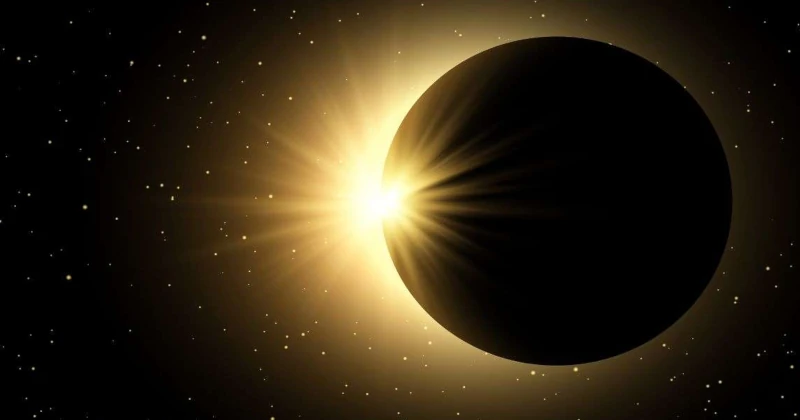
The last Surya Grahan of 2025 will occur on September 21, coinciding with Mahalaya Amavasya, a day already considered deeply sacred in Hindu tradition. The celestial event comes just 15 days after the lunar eclipse of September 7, making September 2025 a month of back-to-back astronomical and astrological events.
According to astronomers, the Surya Grahan will begin late on September 21 and stretch into the early hours of September 22:
- Eclipse begins: 10:59 PM, September 21
- Maximum phase: 1:11 AM, September 22
- Eclipse ends: 3:23 AM, September 22
The entire eclipse will last for 4 hours and 24 minutes.
The Surya Grahan will not be visible in India or its neighboring South Asian countries. Instead, the phenomenon can be observed in parts of eastern Australia, New Zealand, Fiji, the South Pacific, and Antarctica.
For skywatchers in India, this means missing the direct visual spectacle, but the timing and alignment still hold astrological and spiritual importance.
Since the Surya Grahan will not be visible in Indian skies, the Sutak period—traditionally observed as an inauspicious phase before an eclipse—will not apply in India. However, many households may still follow customary practices, such as refraining from cooking or eating, and instead engage in prayers, chanting, and meditation.
Astrologers point out that this eclipse occurs in Virgo (Kanya Rashi) under the Uttara Phalguni Nakshatra. During the Surya Grahan, the Sun, Moon, and Mercury will all align in Virgo, while Saturn casts its aspect from Pisces. Other planetary positions include Mars in Libra, Rahu in Aquarius, Jupiter in Capricorn, and Venus with Ketu in Leo.
This alignment is believed to impact areas of career, business, relationships, and health, particularly for those born under Virgo or with placements in Uttara Phalguni Nakshatra. Astrologers advise caution, mindfulness, and spiritual grounding during this phase.
What makes this Surya Grahan especially significant is its connection with Pitru Paksha, the fortnight dedicated to honouring ancestors. Interestingly, Pitru Paksha in 2025 both begins and ends with an eclipse—a rare occurrence considered powerful in Vedic astrology.
The September 21 eclipse, falling on Mahalaya Amavasya, marks the conclusion of Pitru Paksha. Spiritual experts suggest that such cosmic alignments push individuals towards introspection, resolving past issues, and offering gratitude to ancestors. It is seen as a period of spiritual cleansing, preparing the ground for new beginnings after the eclipse.
While India won’t witness the eclipse directly, many devotees are likely to observe the day with fasting, prayers, mantra chanting, and meditation. Traditional practices discourage eating, cooking, cutting nails or hair, or plucking Tulsi leaves during the Grahan.
For those in regions where the eclipse is visible, experts stress safety precautions:
- Only use certified solar eclipse glasses.
- Never view the Sun directly without protection.
- Avoid makeshift filters or ordinary sunglasses.
With two eclipses a Chandra Grahan on September 7 and a Surya Grahan on September 21—falling within Pitru Paksha, astrologers believe September 2025 carries extraordinary cosmic weight. The alignment is seen as a reminder to balance material pursuits with spiritual duties and to reconnect with one’s roots.
















Comments