





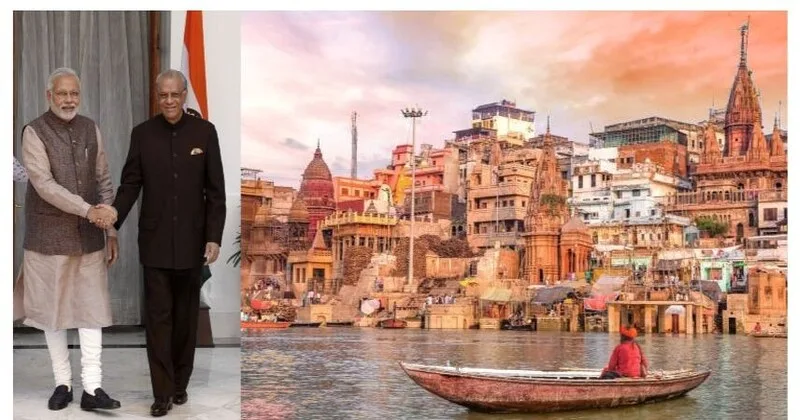
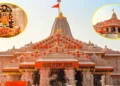
The Prime Minister of Mauritius is on three-day visit to Kashi from September 10-12, 2025. The visit is diplomatic and profoundly symbolic, representing the civilizational connection between India and Mauritius. On Thursday, 11 September, Prime Minister of India Shri Narendra Modi and Mauritian leader Navinchandra Ramgoolam will take part in bilateral discussions in Kashi, emphasizing development cooperation, trade, maritime safety and cultural interaction. On Friday morning, the Prime Minister of Mauritius will visit the holy Kashi Vishwanath Mandir for darshan, spiritually linking up with a land that influenced the heritage of the majority of Mauritius population.
The trip is not only about formal meetings it is about going back to roots. For Mauritius, where nearly 70% of citizens have their origins in India. India treats Mauritius as family and partner, thus this visit to Kashi is not only meaningful but also symbolic for both countries.
Shared Heritage Across the Ocean
India and Mauritius have a connection based in history, demography and culture. Almost seven in every ten Mauritians have Indian origin. This is apparent in daily life languages, cuisine, festivals and customs, as all have Indian origins.
The cultural odyssey started centuries earlier. In 1729, under French rule few Indians from Puducherry were imported to Mauritius as artisans and masons. Under British colonization, over half a million Indian slave labourers came to Mauritius between 1834 and the early 1900s. Approximately two-thirds of them remained behind and established new lives on the island. The very first group of 36 individuals, disembarked on November 2, 1834, on the ship Atlas. This day is now celebrated as Aapravasi Diwas in Mauritius and Aapravasi Ghat is marked as a UNESCO World Heritage Site.
They brought along with them their songs, the religions and their traditions. Majority have Bhojpuri folk culture along with Tamil traditions, Marathi celebrations and Hindi oral traditions found new ground in Mauritius. Combined with Creole and French additions, it created a rich multicultural identity that is peculiar to the island.
Kashi the Spiritual Bridge between Same civilizational Roots
Kashi, the city of eternity, has a special meaning for Indian-origin Mauritians. As the sacred Ganga is a site of spiritual power in India, the Ganga Talao or Grand Bassin in Mauritius is a sacred site for Hindus on the island. In 1972, Indian Ganga water was ritually poured into the lake, linking the two holy geographies eternally.
Each year, thousands of Mauritians trek to Ganga Talao carrying kanwars and reciting prayers, not unlike Indian pilgrims in Varanasi or Haridwar. The Mauritian P forthcoming darshan at Kashi Vishwanath Mandir is therefore not only an individual act of worship, it represents the common spiritual world that binds the two countries together.
Mauritius keeps Indian festivals with the same format. Diwali is a national festival, Holi paints the island with colours and Ganesh Chaturthi processions take to the roads. Tamil customs such as Cavadee and Pongal are widely observed, as are Bhojpuri “Geet Gawai” wedding songs, which UNESCO has declared Intangible Cultural Heritage. The beat of Bollywood music, Bharatanatyam rhythms and yoga practice enforce how Indian customs continue to be the core of Mauritian identity.
Bilateral Discussions in Kashi
The bilateral discussions in Kashi will take place on, Prime Minister Modi and the Mauritian Prime Minister will discuss cooperation in various sectors. Their talks will be indicative of the unprecedented trust characterizing India–Mauritius relations. Be it maritime security or economic development, be it cultural interaction or education, the relationship is going from strength to strength.
India has always been Mauritius’ “first responder” in moments of crisis whether it was the Covid-19 pandemic, the Wakashio oil spill during 2020 or Cyclone Chido in 2024. The bilateral relationship has also been extending to infrastructure, trade and capacity-building as a joint expression of both countries desire for growth. The discussion will reaffirm the India–Mauritius relationship as not transactional but historically derived, culturally connected and people-to-people-derived.
Development Partnership Under PM Modi
Under Prime Minister Modi, India has made significant strides in expanding cooperation with Mauritius.
Big Projects
In 2016, India provided a USD 353 million grant for five high-priority projects the Metro Express, the new Supreme Court building, an ENT Hospital, social housing and digital tablets for schools. India extended a USD 500 million line of credit for a further ten projects in 2017, including a solar power plant, the Mauritius Police Academy and a Forensic Science Laboratory. There are more than 90 community development projects also being carried out on the island.
Crisis Response
India was the first to provide free Covid-19 vaccines to Mauritius in January 2021 and then additional batches of Covaxin and Covishield. India also provided Ayurvedic medicines and a Rapid Response Medical Team. As a token of appreciation, Mauritius presented 200 oxygen concentrators during India’s second wave.
When the Wakashio oil spill menaced Mauritian coastlines in 2020, India dispatched 30 tonnes of technical machinery and a 10-member technical delegation, and Indian naval vessels also assisted in salvage operations. In 2024, following Cyclone Chido, India again dispatched foodstuffs, medicines and technical experts.
Economic and Trade Ties
Mauritius remains a major source of foreign investment into India, contributing around USD 180 billion between 2000 and 2025. Indian PSUs like Indian Oil, Bank of Baroda and LIC are active in Mauritius.
The Comprehensive Economic Cooperation and Partnership Agreement (CECPA) of 2021 India’s first trade agreement with an African nation created new avenues of trade. India’s exports to Mauritius increased considerably by 2024, including textiles, plastic and quartz slabs, while Mauritius also sold medical devices and other products to India.
Security Cooperation:
Both countries also cooperate closely on naval security. India has given Mauritius patrol boats, training and technical assistance to protect the Indian Ocean from piracy and pirate fishing.
India and Mauritius are not only tied by governments but by people too. Indian languages, music and arts are encouraged at Mauritius’s Mahatma Gandhi Institute. Thousands of students from Mauritius go to India for higher studies on scholarships. Indian cultural troupes travel to Mauritius frequently and Mauritian artists give performances in India, keeping the flow of culture going.
The International Day of Yoga, a product of Indian initiative, is observed with support in Mauritius, representing to the island nation’s close relationship with the traditions of India.
A Visit Full of Meaning
The Mauritian PM’s three-day trip to Kashi is therefore steeped in meaning. Thursday’s bilateral discussions cemented the faith and collaboration between the two countries. On Friday morning, the darshan at Kashi Vishwanath Mandir will represent the spiritual connection between the Ganga in India and the Ganga Talao in Mauritius. The trip proves that the India–Mauritius relationship is not merely about agreements it is about culture, heritage and common religion.
For India, Mauritius is not just a partner but family. For Mauritius, India is a motherland of culture and a partner in progress. While Prime Minister Modi reiterates the vision of “Neighbourhood First” and “SAGAR” (Security and Growth for All in the Region), Mauritius remains a priority.
From the first slave labors of 1834 to the darshan of the Prime Minister at Kashi in 2025, India–Mauritius is a tale of endurance and culture. Oceans have never separated the two nations and oceans have only bonded them.
The Mauritian PM’s trip to Kashi reminds the world that diplomacy is possible at its core, that shared heritage can build contemporary cooperation and that two countries united by faith and history can look forward together in hope.









Comments